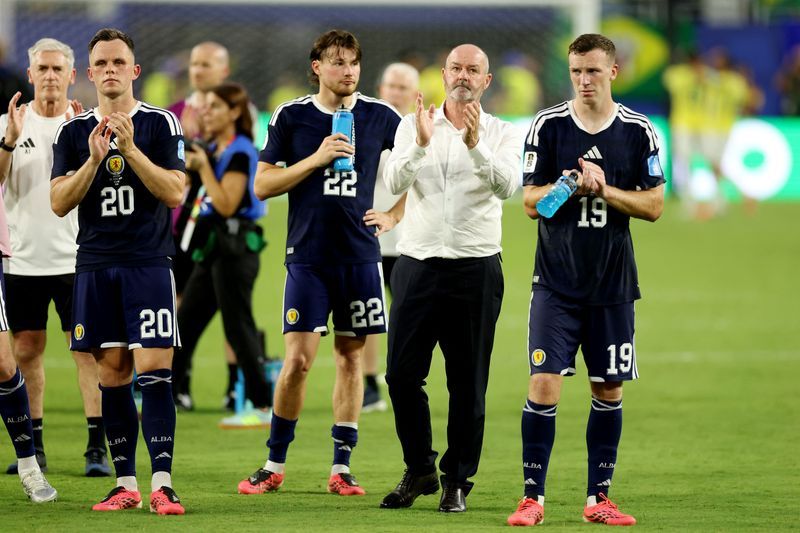
Scotland's World Cup campaign appears destined for an early exit following their 3-0 defeat to Brazil in their final Group C match, with coach Steve Clarke acknowledging that his team gifted the South Americans multiple goal-scoring opportunities that proved too costly to overcome. Speaking after Wednesday's match in Miami, Clarke displayed a mixture of resignation and frustration, recognising that despite maintaining three points on the board, the mathematical possibility of progression through the third-place finishers' route remains extremely slim given the quality of other teams competing for those spots across the tournament's 12 groups.
Although Scotland technically retain a chance of reaching the knockout stages as one of eight third-placed teams with the best records, Clarke's assessment reflected the harsh reality of their predicament. With 20 group matches still to be played across the tournament, the former Chelsea fullback believes at least two other third-placed finishers will accumulate superior records to Scotland's current tally, effectively rendering their survival hopes redundant. The Scots currently occupy the sixth-best position among third-placed teams, a precarious standing that Clarke suggested would almost certainly deteriorate as other group matches conclude.
The coach's candid admission of responsibility underscores the defensive vulnerabilities that plagued Scotland's performance against one of world football's elite attacking forces. Clarke was unsparing in his self-criticism, accepting that Brazil capitalised on chances the Scottish defence manufactured through poor positioning and decision-making. He noted that goalkeeper Angus Gunn produced several commendable saves that prevented the scoreline from becoming even more embarrassing, yet this provided only limited consolation for the systemic weaknesses exposed throughout the ninety minutes. The manner in which Scotland conceded suggested fundamental issues rather than isolated lapses of concentration.
Despite his evident disappointment, Clarke emphasised that he harboured no anger towards the players who accomplished the significant achievement of qualifying for Scotland's first World Cup since France in 1998. Instead, his frustration centred on the gap between Scotland's demonstrated capability and their actual performance on the tournament's biggest stage. The coach indicated that his squad possessed greater technical and tactical resources than they displayed against Brazil, but failed to access those qualities when it mattered most. This distinction between potential and execution will likely haunt Clarke and his players as they contemplate the tournament's conclusion.
Beyond the immediate match analysis, Clarke used the post-match forum to articulate broader concerns about Scottish football's structural capacity to compete consistently at elite level. His observation regarding the physicality, power, and technical sophistication of Morocco and Brazil suggested that Scotland operates at a disadvantage against the world's strongest football nations. Clarke's message to Scottish football administrators carried an implicit warning: without significant investment in player development systems, Scotland risks remaining perpetually unable to compete on equal terms with traditional powerhouses. The World Cup exposure of these deficiencies, he suggested, should prompt serious reflection within Scottish football.
Clark's concern about Scotland's inability to produce young players equipped to perform on the world stage reflects a perennial challenge facing smaller football nations. The recruitment and development pipelines that generate elite-level talent require substantial financial resources, sophisticated coaching infrastructure, and consistent exposure to competitive international football. Scotland's relatively small population and limited domestic league revenue create structural disadvantages that demand innovative solutions rather than complacency. Clarke's implicit argument suggests that qualifying for World Cups represents merely the entry point; the real challenge involves competing meaningfully once there.
The coach's remarks also attempted to contextualise Scotland's campaign within the broader experience of returning to the World Cup after an extended absence. While acknowledging the Tartan Army's substantial contribution to the tournament atmosphere and Scotland's ambassadorial role, Clarke sought to remind supporters that their presence in the United States represented a direct consequence of the players' qualification achievements. His somewhat pointed reminder—that without this squad's efforts, Scotland would remain at home watching the World Cup—appeared designed to prevent narrative revisionism whereby fans might overlook the tangible accomplishment of qualification itself.
Clark recognised the symbolic importance of Scotland's participation for the nation's football culture, particularly given the twenty-eight-year gap since their previous World Cup appearance in France. The return to football's greatest tournament carried genuine emotional significance for Scottish supporters, many of whom experienced the 1998 tournament in their youth or heard stories from previous generations. Clarke's acknowledgment of this context suggested he understood that Scotland's World Cup experience encompassed more than match results, encompassing a restoration of connection to global football competition.
However, Clark's assessment ultimately reflected the harsh mathematics of tournament elimination. Scotland entered the match knowing their World Cup future depended on either defeating Brazil outright or securing a result that kept them competitive in the third-place calculations. Instead, they received a comprehensive lesson in the difference between aspiring World Cup participants and established tournament contenders. The 3-0 scoreline represented not merely a defeat but a statement of relative quality that made the coaches previous concerns about Scottish football's development trajectory appear vindicated.
Looking forward, Scotland faces the dual challenge of processing a disappointing campaign while confronting uncomfortable truths about the nation's football infrastructure. Clarke's diagnosis of systemic issues rather than tactical failures suggests that rectifying Scotland's competitive position requires sustained, long-term commitment to player development rather than short-term adjustments. For Malaysian and Southeast Asian observers, Scotland's experience offers instructive lessons about the demands of competing at the highest level, particularly regarding the necessity of coherent long-term planning and substantial investment in youth development systems. The gap between qualification and genuine competitive performance represents one of international football's most persistent challenges.

