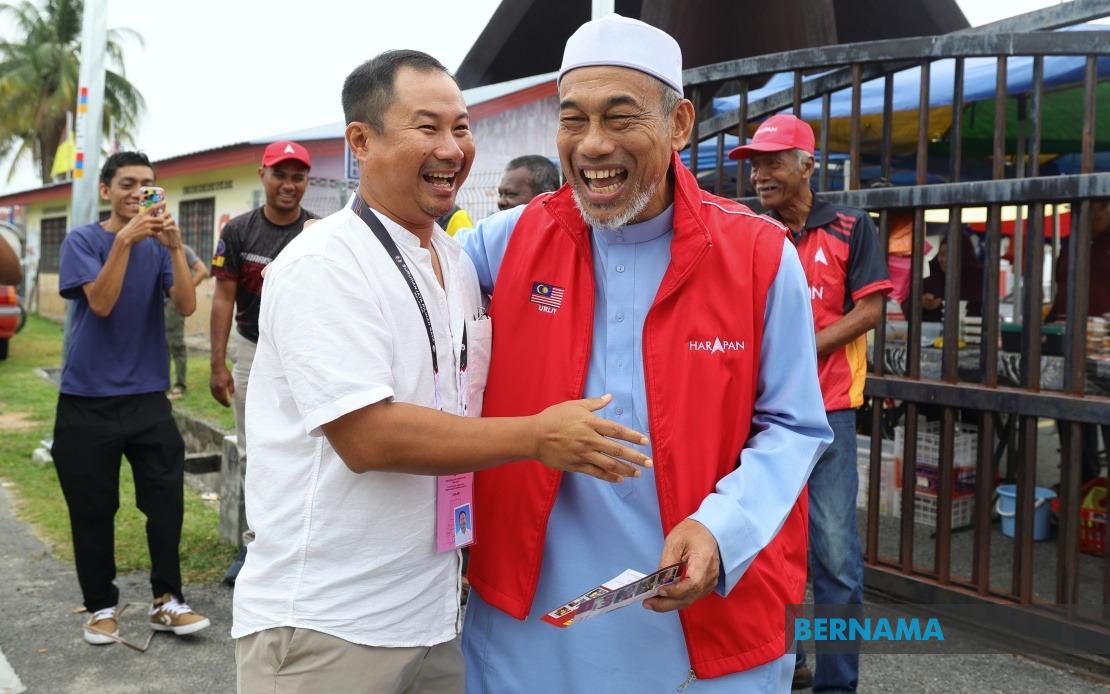
The campaign for Negeri Sembilan's Klawang state seat took an unusual turn when incumbent Datuk Bakri Sawir of Pakatan Harapan crossed paths with his cousin Danni Rais of Perikatan Nasional while both worked the crowds at Kuala Klawang weekend market during the second day of the campaign trail. The Saturday encounter drew considerable public interest, with voters and traders seizing the opportunity to interact with both candidates simultaneously, snapping photographs and exchanging words as the two made their separate campaign rounds through the bustling market stalls.
What might have been a tense confrontation between political rivals instead unfolded as a remarkably cordial affair, reflecting a broader trend of professional restraint in Malaysia's electoral contests. Rather than engaging in confrontation, the cousins maintained their respective campaign activities without provocation, even managing to share jokes with one another as they navigated the same market corridors. This measured approach stood in stark contrast to the sometimes fractious nature of Malaysian political campaigns, where personal attacks and heated exchanges frequently characterise rival encounters.
Bakri, speaking with journalists after the market engagement, deliberately downplayed the novelty of competing against a family member, framing the contest instead as a practical opportunity for both candidates to demonstrate their commitment to constituent welfare. He emphasised that the electoral process itself, rather than personal rivalry, provided the proper mechanism for voters to evaluate and choose between competing service offerings. This pragmatic stance suggested a maturity in managing family relationships within competitive political environments, an increasingly important consideration in Malaysian politics where clan and kinship networks frequently intersect with party allegiances.
The incumbent's remarks underscored the importance of maintaining institutional integrity throughout the campaign period. Bakri highlighted his administration's swift compliance when municipal authorities instructed the removal of campaign flags from stadium fencing, interpreting regulatory adherence as foundational to democratic legitimacy. His observation that political parties cannot credibly demand public respect for the law while simultaneously violating electoral regulations themselves contained an implicit rebuke to campaign practices that prioritise partisan advantage over procedural correctness. This position resonated with calls for electoral reform and enforcement of conduct standards that have become increasingly prominent across Southeast Asia.
Bakri further appealed to party machinery at all levels to maintain discipline and propriety throughout the campaign phase, positioning electoral harmony as essential to preserving public confidence in the democratic process. His message suggested awareness that electoral credibility rests partly on visible adherence to agreed rules and norms, particularly at the ground level where party workers and volunteers directly interact with voters. The emphasis on orderliness reflected concerns that overzealous campaign operatives might undermine the measured approach adopted by candidates themselves through inflammatory rhetoric or regulatory breaches.
The Klawang contest represents a three-cornered competition rather than a straightforward two-way duel between the cousins. Muhammad Adib Musa of Bersatu enters as the third candidate, potentially complicating vote distribution across the constituency's 13,355 registered voters. This three-way split changes the strategic calculus considerably, as neither Bakri nor Danni can assume that victory requires only defeating the other cousin. Instead, all three must build sufficiently broad coalitions to prevail, a dynamic that may explain the emphasis on positive campaign messaging rather than personal attacks.
The Klawang seat carries particular significance within Negeri Sembilan's electoral landscape, representing one of several state assembly constituencies where coalition fortunes will be determined. Pakatan Harapan's retention of this seat would signal resilience in the Jelebu area, whereas a Perikatan Nasional victory would suggest broader voter realignment favouring the opposition coalition. The involvement of Bersatu adds another dimension, reflecting the complex coalition dynamics that have characterised Malaysian politics since the 2020 general election, when party alignments fractured and reorganised across multiple platforms.
The Election Commission's scheduling of early voting for July 28 and general polling for August 1 compressed the campaign period into an intensive but brief timeframe, requiring candidates to maximise ground presence and voter engagement rapidly. Market appearances like the Kuala Klawang engagement thus assumed heightened importance, offering candidates direct access to voter concentrations without depending entirely on scheduled rallies or media coverage. The weekend market setting also provided a relatively informal atmosphere conducive to the kind of interpersonal engagement that resonates with Malaysian voters who often value perceived accessibility and personal connection.
For Malaysian and Southeast Asian observers, the Klawang race illustrates evolving norms around political competition within family contexts. While Malaysia's democratic traditions have long accommodated dynastic political participation, the question of how candidates should conduct themselves when competing against relatives remains partially unresolved. The Bakri-Danni approach of respectful competition while maintaining distinct policy positions offers a template that other family rivalries might emulate, suggesting that personal relationships need not be sacrificed on the altar of electoral victory.
The race also underscores the continued vitality of state-level politics in Malaysia, where assembly seats remain hotly contested and genuinely competitive. National political trends certainly influence state contests, yet local factors—including personal candidacies, constituency-specific issues, and community relationships—retain considerable weight in determining outcomes. Klawang's three-way contest and the visible campaign activity suggest voters retain agency in choosing between alternatives, rather than passively accepting outcomes predetermined by higher-level political negotiations.
As the campaign progressed toward its conclusion, the tone set by Bakri and Danni at Kuala Klawang market may establish broader expectations for how remaining campaign activities unfold across Negeri Sembilan. Their demonstration that vigorous political competition remains compatible with civility and institutional respect could influence not only voter perceptions but also the operational culture of their respective party machineries, potentially encouraging similar restraint elsewhere.

