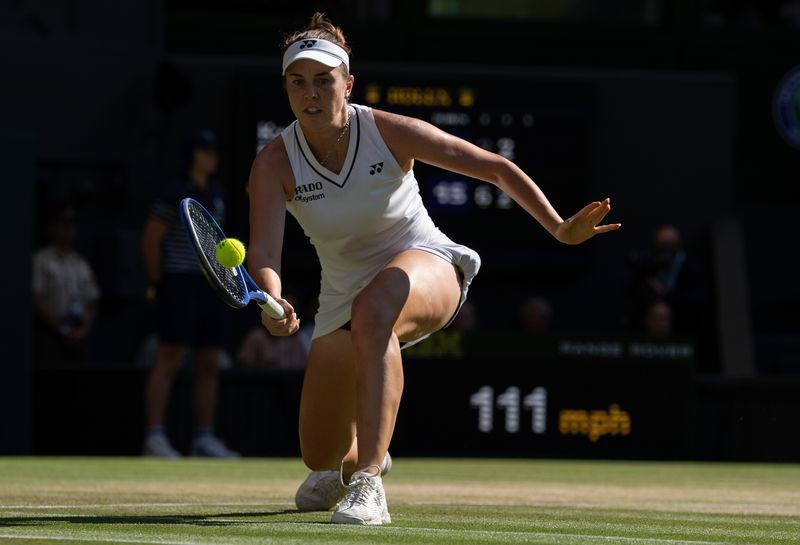
At just 21 years old, Linda Noskova has demonstrated the kind of mental fortitude and composure that separates champions from promising talents. The ninth-seeded Czech player's victory over fellow countrywomen Karolina Muchova in the Wimbledon final on Saturday was not merely a triumph of superior tennis—it was a masterclass in psychological resilience under the cruellest of circumstances. When Noskova stood at 5-2 in the second set, the trophy appeared destined for her hands. Few observers could have imagined the emotional rollercoaster that would follow before she ultimately prevailed 6-2 5-7 6-3 under the afternoon sun at Centre Court.
The turning point came as Muchova, serving to stay alive, mounted an improbable recovery. Noskova squandered five separate match points—three as Muchova served at 2-5, another on the subsequent hold at 5-3, and yet another in the ninth game. The psychological toll of these missed opportunities became visibly apparent as Muchova reeled off five consecutive games to force a deciding set. By the time the match entered its final chapter, Noskova appeared shell-shocked, her confident demeanour replaced by visible anxiety as she made her way to the player's chair, her hands covering her ears against the roaring crowd.
What happened during Noskova's subsequent bathroom break, however, proved transformative. Rather than allowing defeat to settle into her mind, she employed two distinct recovery mechanisms. The cold water splash served as a physical reset, clearing the mental fog that had engulfed her during those devastating minutes. Yet more significantly, as she returned to court, her eyes fell upon the trophies positioned near the walkway. In that moment, she made a psychological commitment that would define the remainder of the match. "I was looking at the big one. I was like, I'm taking this one no matter what. I'm going to leave my soul on court," she explained to reporters afterward, describing how this visual anchor redirected her focus from the pain of her missed opportunities toward the prize that remained within reach.
The impact of holding serve in the opening game of the third set cannot be overstated. Noskova herself identified this moment as genuinely decisive, recognising that conceding that game would have fundamentally altered the psychological balance of the deciding set. Instead, holding serve appeared to flip a switch. Her groundstroke timing returned, her footwork became crisp and purposeful once more, and her confidence visibly rebuilt with each passing game. When she reached match points again at 5-3, more than an hour after her first opportunity, she would not be denied. This time, when the decisive moment arrived, Noskova converted with the ruthlessness of a player who understood precisely what was at stake.
Noskova's journey to the Wimbledon title reflects far more than tennis talent. The youngest women's champion since fellow Czech Petra Kvitova claimed her first Wimbledon crown in 2011, Noskova becomes the third Czech woman to win the tournament within the past four years—a striking testament to the depth of women's tennis talent emerging from her nation. Beyond the statistics, however, Noskova possesses a maturity and perspective unusual for her age. She carries the emotional weight of having lost her mother Ivana to cancer two years ago, an experience that has shaped her worldview and approach to competition in profound ways.
This emotional sophistication extends beyond tennis into her broader life philosophy. Noskova's decision to spend part of her off-season volunteering in Zanzibar, working at a local school rather than pursuing the typical luxury holiday, reveals a consciousness oriented toward service and human connection. She has spoken with genuine passion about environmental causes, describing herself as a nature lover with concrete plans to engage in environmental volunteering once her professional tennis career concludes. Growing up in a village within a Czech forest, these concerns reflect not performative activism but deeply held personal values shaped by her upbringing and experiences.
The significance of Noskova's victory extends beyond individual achievement into the broader context of women's tennis and Czech sporting excellence. Her triumph reinforces the Czech Republic's position as a pipeline of elite female tennis talent, building on the legacies of Kvitova, Karolina Pliskova, and other recent champions. For Malaysian and Southeast Asian tennis enthusiasts, Noskova's breakthrough serves as a reminder that sustained excellence at the Grand Slam level remains achievable even for players from smaller tennis nations when supported by strong domestic development systems and individual determination.
The narrative of Noskova's Wimbledon fortnight also provides a compelling counterpoint to the often-discussed psychological fragility of young players competing in high-stakes environments. Rather than succumbing to the existential crisis that would reasonably accompany losing five match points from a position of complete dominance, Noskova accessed reserves of mental strength that allowed her not merely to stabilise her game but to elevate it when the stakes became highest. Her ability to compartmentalise disappointment, reset during the crucial bathroom break, and refocus through the visual motivation of the trophy itself demonstrates sophisticated emotional intelligence.
In her post-match reflections, Noskova emphasised the importance of beginning anew mentally following the second-set collapse. She acknowledged that losing five consecutive games represented a profound test of psychological resilience, making the strong start to the third set genuinely pivotal. This recognition of the match's turning points suggests a player with mature analytical capacity regarding both the tactical and psychological dimensions of elite tennis competition. Rather than attributing her triumph solely to opponent error or circumstantial factors, she identified the specific moments where her own mindset and decisions proved decisive.
Looking forward, Noskova's Wimbledon triumph will inevitably reshape expectations surrounding her career trajectory. No longer can she be viewed as a promising young talent still developing on the tour; she has now demonstrated the ability to perform under maximum pressure against quality opposition in the sport's most prestigious tournament. The question for Noskova becomes not whether she can win Grand Slams, but how many she can accumulate throughout her career. Given the emotional maturity, philosophical grounding, and competitive toughness she has displayed, the ceiling for her achievement appears considerably higher than might have been predicted before this fortnight.
Ultimately, Noskova's Wimbledon victory transcends the immediate achievement of capturing a Grand Slam title. It represents a statement about the evolving standards of mental resilience and emotional intelligence required to succeed at the highest levels of professional tennis. Her willingness to confront the abyss of five squandered match points, her commitment to resetting both physically and psychologically, and her determination to seize the trophy rather than merely accept the runner-up plate—these qualities will define her legacy far beyond the specific victory achieved on Saturday. As she absorbs the magnitude of her achievement, Noskova carries forward a championship earned not just through superior tennis, but through the unmeasurable human qualities that transform talented athletes into genuine champions.

