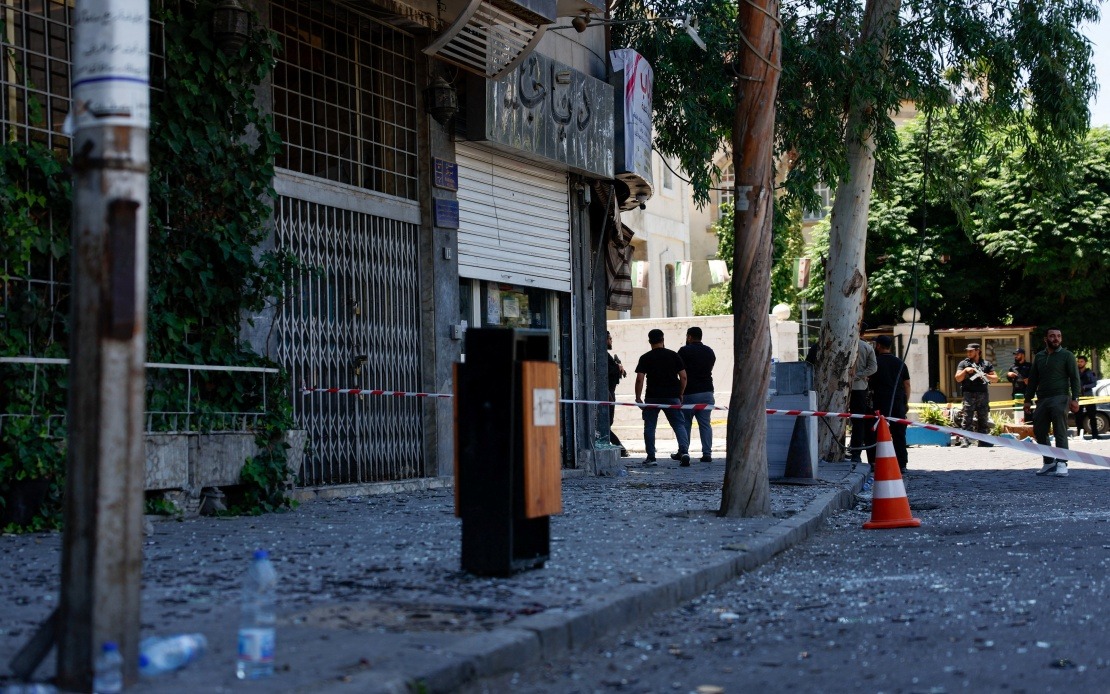
Coordinated bomb blasts rocked Damascus on Tuesday, injuring at least 18 people in an apparent security incident that unfolded as French President Emmanuel Macron conducted high-level diplomatic meetings in the Syrian capital. The Syrian Interior Ministry confirmed that two improvised explosive devices detonated in close succession, with the first explosion followed seconds later by a more powerful blast near the accommodation where the French leader was reported to be staying. Four police officers were among those wounded in the twin attacks, which sent shockwaves through the capital's civilian population.
The Syrian Observatory for Human Rights, a London-based monitoring organisation that tracks violence across the Middle East, provided eyewitness accounts suggesting the explosions occurred in rapid succession near the presidential compound area. Emergency response teams moved quickly to the scene, with ambulances and security personnel establishing a protective perimeter around the affected zone. The speed of the emergency services response underscored the heightened security posture maintained throughout the French delegation's visit.
The Élysée Palace in Paris swiftly confirmed that Macron had sustained no injuries in the blasts. The French presidential office released a statement indicating that the president remained at the presidential palace where he was engaged in substantive discussions with Syrian government delegations covering matters of bilateral importance. The confirmation came as a relief to international observers monitoring what represents a diplomatically significant moment in Franco-Syrian relations.
Macron's presence in Damascus marks a watershed moment in European engagement with Syria. By arriving in the country on Monday evening, the French president became the first leader of any European Union member state to visit Syria since 2010, representing a significant shift in Western diplomatic approach toward the conflict-ravaged nation. This visit carries considerable symbolic weight, suggesting evolving international recognition of Syria's position following years of civil conflict and international isolation.
The timing of the explosions during such a high-profile diplomatic engagement raises serious questions about security vulnerabilities and the operational challenges facing Syrian authorities responsible for protecting visiting dignitaries. The incident occurred despite presumably heightened security measures implemented to safeguard the French delegation during its stay. For Malaysian observers and regional policymakers, the incident underscores the ongoing security concerns that plague Syria despite military victories and territorial stability improvements in recent years.
The political context surrounding Macron's visit reflects broader shifts in international relations toward Syria. France has maintained a more pragmatic diplomatic approach compared to some Western counterparts, and this visit signals potential movement toward normalising diplomatic engagement despite persistent concerns about governance, human rights, and regional stability. However, the bombing incident serves as a stark reminder that Syria remains a volatile environment where violence can erupt with little warning, complicating efforts to rebuild international relations.
For Southeast Asian nations, particularly Malaysia with its significant Muslim population and historical concerns about regional stability, such incidents carry implications for understanding how international powers navigate complex geopolitical situations. Malaysia has consistently advocated for dialogue-based approaches to regional conflicts, and France's diplomatic overture toward Syria aligns with this principle, even as security challenges persist.
The response by Syrian authorities to the bombing will likely influence perceptions of the government's capacity to maintain security and order as it attempts to reintegrate into the international community. Demonstrating effective crisis management and swift investigative response becomes crucial during moments when high-profile international visitors are present. The ability to protect foreign dignitaries while managing domestic security threats will significantly impact Syria's broader rehabilitation efforts in the eyes of international observers.
The attack also highlights the persistent security threats that organisations and governments must contend with in post-conflict environments. Even as major military operations have concluded, terrorist organisations, armed groups, and criminal networks continue operating in Syria, capable of launching attacks against civilian and government targets. The proximity of the explosions to the location of the visiting French president suggests either a deliberate targeting strategy or an attempt to create maximum publicity for whatever group orchestrated the blasts.
From a broader perspective, Macron's insistence on continuing with his scheduled diplomatic engagements despite the bombing demonstrates resolve, though it also raises questions about the wisdom of maintaining such high-profile visits in inherently unstable environments. The decision reflects the French government's commitment to pursuing dialogue with Syria regardless of security incidents, a position that carries both diplomatic significance and tangible risks.
As Syria continues its complicated journey toward international reintegration, incidents such as these underscore the multifaceted challenges facing reconstruction and normalisation efforts. For regional stakeholders like Malaysia, which has expressed interest in supporting Syrian reconstruction initiatives through multilateral frameworks, understanding these persistent security dynamics remains essential for formulating coherent and effective policies toward the country.

