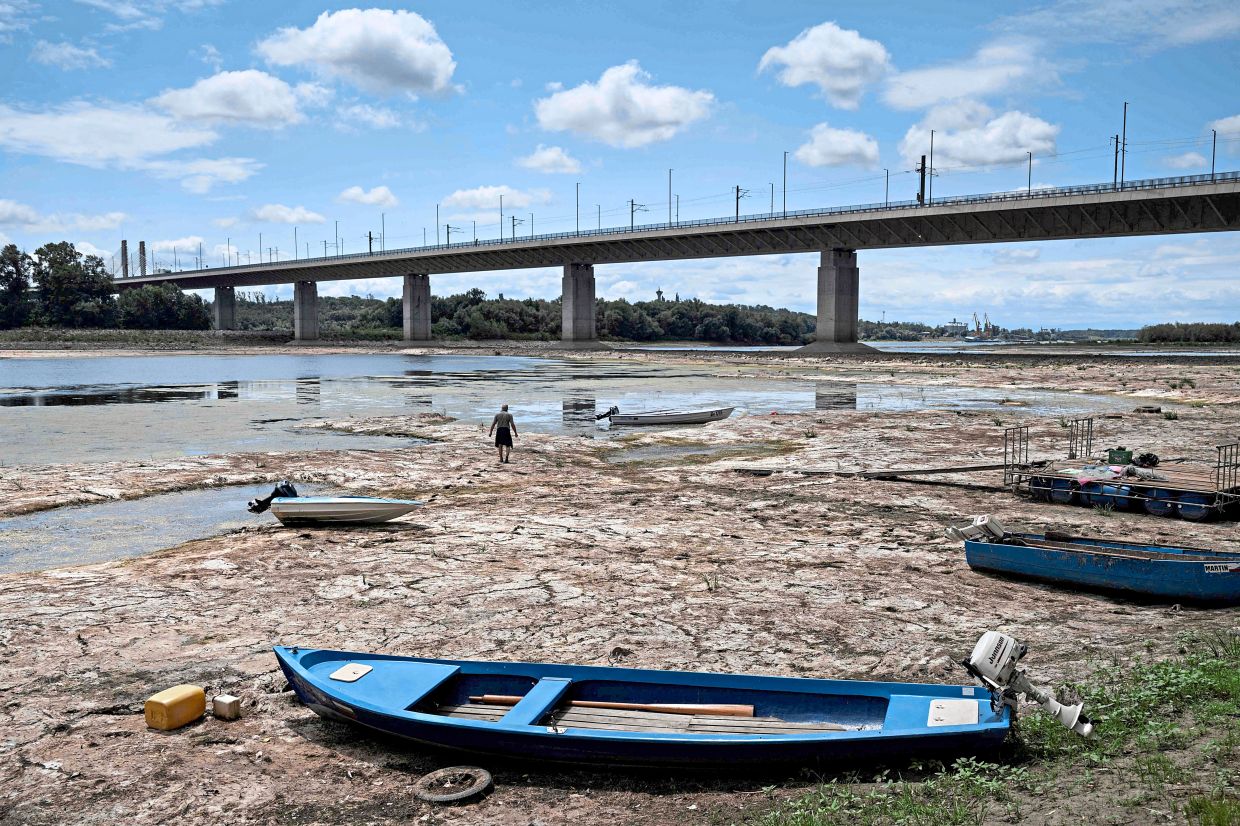
The Danube River, one of Europe's most vital waterways, has reached a critical turning point. An extended drought combined with successive heat waves has pushed water levels to historic lows across the 10-country corridor stretching from southwestern Germany to the Black Sea. The consequences are cascading through tourism, commerce, energy production, and daily life along the waterway, offering a stark illustration of how climate pressures are reshaping infrastructure and economic activity across the continent.
The scale of the water deficit has become undeniable. In Budapest, Hungary's capital, authorities recorded a water level of just 23 centimetres on 29 July, shattering the previous record low of 33 centimetres established in 2018. That decline underscores a troubling acceleration in water scarcity. The Hungarian Meteorological Service has documented that 90-day precipitation totals across nearly the entire country stand between 80 to 130 millimetres below multi-year averages, indicating a systematic failure of summer rains to materialise. Forecasts offer little relief, with no meaningful precipitation anticipated and temperatures climbing beyond 38 degrees Celsius—conditions that will continue to draw moisture from the riverbed and surrounding landscape.
The visual impact has struck observers forcefully. At Budapest's Margaret Bridge, photographer Gabor Kertesz documented an otherworldly landscape of bare rocks and exposed sandbars that normally remain submerged, alongside remnants of old shipwrecks rarely visible in living memory. For residents and visitors, the transformation carries a weighty symbolism. Kertesz reflected on the shock of witnessing this transformation, acknowledging the unmistakable hand of climate change in reshaping the river that has anchored Central European life for millennia. His documentation captures not merely a curiosity but a warning about ecological systems under profound stress.
The tourism sector has absorbed immediate and tangible damage. The river cruise industry, which has built a lucrative business model around scenic journeys through Budapest and the Danube Valley, has been forced to adapt to treacherous conditions. Popular cruise vessels that typically dock in Budapest for passenger disembarkation must now anchor far upriver, stranding tourists at inconvenient distances from the city's attractions. For the hospitality and cultural tourism ecosystem dependent on these operations, the disruption threatens both seasonal revenue and employment. The situation extends beyond Hungary: in late July, Bulgarian police evacuated 186 tourists from the Viking Ullur near the port city of Vidin after the vessel ran aground on a shallow shoal. The cruise ship, unable to reach Vidin to resupply, left passengers without adequate food and water until rescue operations concluded, exposing how fragile modern tourism infrastructure becomes when water availability collapses.
Commercial shipping has essentially halted across significant stretches of the river. Serbia's Novi Sad region illustrates the scope of the paralysis: hundreds of small boats and dozens of cargo ships sit marooned on the desiccated riverbank. Radovan Segrt, who operates river excursions for tourists on his own vessel, reported that the Danube's water table had withdrawn between 15 to 20 metres from the shoreline. For operators whose livelihoods depend on seasonal navigation, the message is unambiguous: the summer operating season has effectively concluded, representing a significant loss of income across an entire economic sector. The ripple effects extend to manufacturers and industries dependent on barge transport for raw materials and finished goods, adding another layer of economic strain to regions already confronting inflation and supply chain disruption.
The drought has triggered an unforeseen crisis in energy production. Across Central Europe, nuclear power stations have traditionally relied on Danube water for reactor cooling—a system that functions reliably when water availability is assured. In Romania, where Danube water flow has plummeted to 1,630 cubic metres per second, roughly one-third of the typical July average, authorities were forced to shut down a reactor unit at the Cernavoda power plant for safety reasons, with an additional shutdown announced. For countries already grappling with energy security and affordability, such actions threaten grid stability and household electricity costs. Hungary's situation proves even more precarious: the Paks nuclear plant, which supplies nearly half of the nation's electricity generating capacity, began powering down a reactor on 29 July due to restricted cooling-water availability. Prior reductions had already taken place over the preceding two days, indicating a cascading series of capacity reductions. The implications extend beyond Hungary's borders, as power shortages in the region could require energy imports from neighbouring countries at premium prices, exacerbating an existing energy crisis.
The receding waters have uncovered hazards that modern populations had assumed safely buried. In Budapest, authorities were compelled to close the Margaret Bridge after World War II-era ordnance—a bomb—surfaced at the bridge's base as water levels retreated. This discovery underscores how climate-driven changes to riverine environments can resurrect historical dangers in contemporary contexts. Across Europe, thousands of unexploded ordnance from the twentieth century remain scattered in waterway beds and floodplains. As water levels fall and sediments shift, these weapons become accessible, creating genuine public safety risks that extend beyond environmental concerns into military and public health domains.
Yet the crisis has also attracted those who see opportunity in extremity. Treasure hunter Zsolt Horvath has taken advantage of the exposed riverbed to recover metal objects using powerful magnets, retrieving items ranging from old radio equipment to World War-era bullet casings. While such activities reflect human ingenuity in adapting to changing circumstances, they also underscore a deeper tension: for some, the Danube's crisis enables new forms of economic activity, while for the vast majority dependent on reliable water supplies, the drought represents an unmitigated curse that threatens livelihoods, energy security, and regional stability. This disparity in consequences illustrates how climate change does not affect all sectors and social groups uniformly, but rather concentrates losses among those already vulnerable while creating unexpected advantages for others positioned to exploit the altered landscape.

