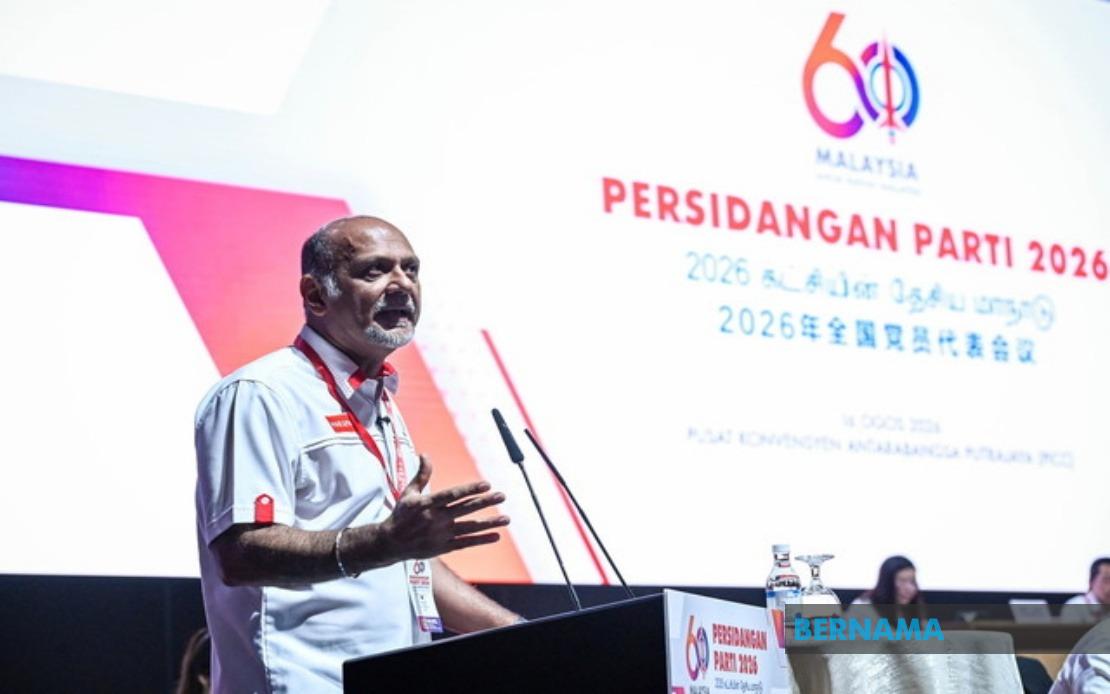
The Democratic Action Party is at a crucial juncture, according to party national chairman Gobind Singh Deo, who acknowledged that disappointing outcomes in recent state elections signal a need for strategic recalibration. Speaking at the DAP Party Conference 2026 in Putrajaya on August 16, Gobind framed the electoral setback not as a crisis but as an opportunity for genuine reflection. The party must use this moment to assess how it remains relevant within Malaysia's shifting political terrain, he suggested, particularly given its three-and-a-half-year involvement in the Unity Government arrangement alongside its coalition partners.
Gobind's remarks carried an implicit message: DAP needs to reset expectations both internally and among its supporters regarding what can realistically be achieved within a multi-party governing coalition. After years of navigating the complexities of shared power, the party faces fundamental questions about its role and influence. The chairman signalled acceptance of the electoral verdict while insisting that the party must learn from this feedback and adjust course accordingly. This balancing act—acknowledging public sentiment without appearing defeated—reflects the delicate position in which DAP finds itself as a significant component of the broader Pakatan Harapan alliance that anchors the current government.
A particularly revealing aspect of Gobind's address was his emphasis on pragmatism over ideological purity. Rather than attempting to implement DAP's comprehensive manifesto through unilateral action, he argued the party should focus on identifying which reforms can command agreement among all coalition partners. This represents a notable philosophical shift, suggesting that DAP's leaders have concluded that partial victories achieved through consensus may prove more durable and politically beneficial than symbolic gestures that divide the coalition. For Malaysian observers accustomed to seeing DAP pursue an ambitious reform agenda, this represents a recalibration of ambitions to match political realities.
On the institutional reform front, Gobind proposed convening a special Parliament sitting to debate and approve critical legislative amendments. High on his list are changes to the Security Offences (Special Measures) Act 2012, which civil rights groups have long criticised for enabling detention without trial. The Peaceful Assembly Act 2012 would similarly face scrutiny under this framework. Additionally, Gobind advocated for separating the constitutional roles of Attorney General and Public Prosecutor, and imposing two-term limits on the Prime Minister's tenure. These proposals carry significant weight within reform-minded circles across Southeast Asia, where concerns about executive overreach and institutional safeguards remain pressing issues.
The rationale underpinning these reform proposals deserves careful attention. Gobind framed such changes not merely as ideological commitments but as essential components of transparent governance architecture that can prevent abuse of power. This framing suggests DAP believes that demonstrable progress on institutions, even if incremental, may help restore public confidence eroded by recent electoral disappointments. For a Chinese-majority party that has historically positioned itself as a champion of democratic values and constitutional governance, institutional reform represents both a philosophical anchor and a potential avenue for rebuilding political credibility.
Economic concerns featured prominently in Gobind's analysis, reflecting DAP's recognition that electoral outcomes increasingly turn on bread-and-butter issues rather than abstract governance principles. He acknowledged that government must demonstrate genuine understanding of the economic pressures facing ordinary Malaysians, from cost-of-living challenges to employment prospects. This recognition is particularly significant given that DAP's urban base, while more affluent than the overall population, has not been immune to inflation and purchasing power erosion. The party's ability to connect institutional reform advocacy with tangible economic relief measures may determine its political trajectory over the coming months.
Gobind explicitly linked political stability to foreign investment attraction and job creation, advancing an argument that connects governance quality to material prosperity. This economic-political nexus is crucial for understanding DAP's calculations. A government perceived as unstable or riven by internal conflict struggles to attract capital investment. Conversely, a government capable of projecting coherence and delivering on developmental promises enhances investor confidence. For DAP, which draws support from business communities and professional classes, this linkage between political stability and economic opportunity provides ideological justification for coalition participation despite electoral setbacks.
The party conference itself carries substantial symbolic weight, coinciding with DAP's 60th anniversary. This convergence allows the party to position current difficulties within a longer historical narrative of institutional development and political maturation. At the conference, attended by senior party figures including secretary-general Anthony Loke and multiple vice-chairmen, delegates confronted a defining question: should DAP remain within the Unity Government through the end of the current parliamentary term, or withdraw from the coalition? This binary choice frames the fundamental strategic debate occupying the party at present.
The mechanics of this decision deserve note. Nearly 4,300 delegates from over 1,700 branches would determine the motion through secret ballot, ensuring that the decision could not be attributed to factional manipulation or leadership pressure. This democratic process, while potentially time-consuming, grants DAP's base genuine voice in determining party direction. For a party claiming to champion democratic values, maintaining internal democratic processes even under electoral stress sends important signals about institutional commitment.
DAP's position within the broader Pakatan Harapan coalition adds layers of complexity to this assessment. As one of three major PH component parties alongside PKR and Amanah, DAP's strategic choices affect the entire alliance. Withdrawal from government would shake the coalition's stability, potentially triggering broader political realignment. Conversely, continued participation without demonstrating tangible achievements may erode the party's support base further. This constrained choice set reflects the reality that Malaysian electoral politics operates within structural constraints that limit the autonomy even of influential parties.
The appeal to economic competence and institutional reform represents DAP's attempt to recapture political initiative following electoral disappointment. By emphasising what the party can deliver through government participation—transparent institutions, economic stability, rule of law—rather than focusing on what it cannot achieve unilaterally, Gobind suggests DAP has absorbed important lessons about coalition governance. Whether this recalibration suffices to reverse electoral momentum remains an open question, but the party's willingness to engage in serious strategic reassessment indicates recognition that business-as-usual approaches no longer command public confidence.

