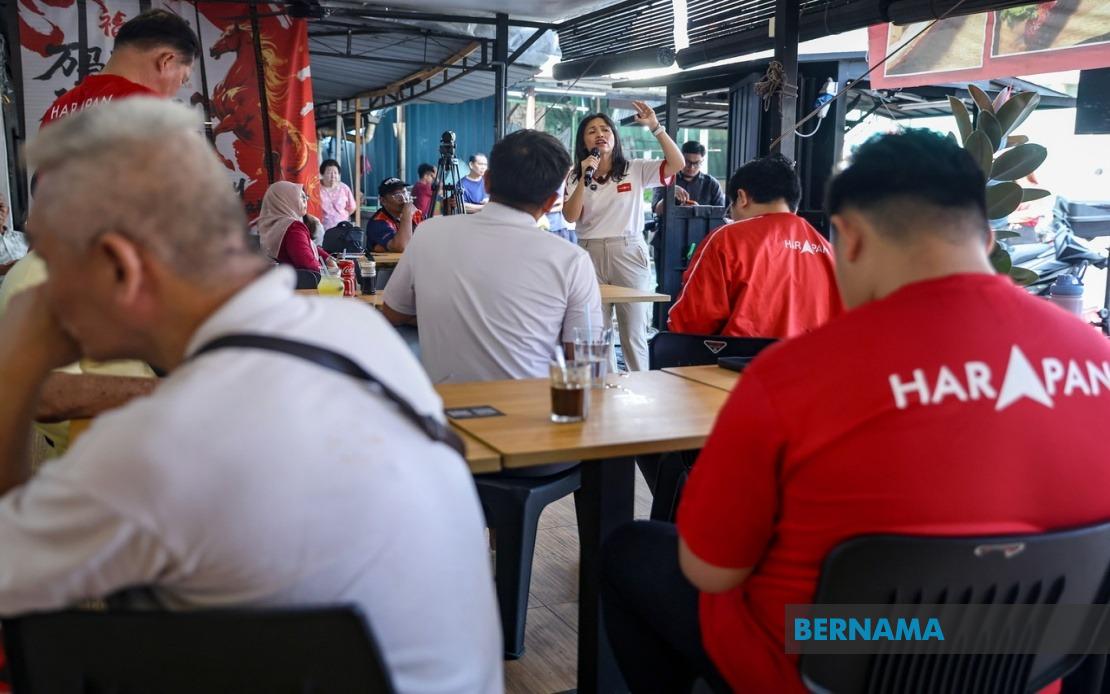
The conduct of a technical education roadshow in Kluang has become a flashpoint in the Johor state election, with the opposition DAP questioning whether government resources and venues were improperly deployed for partisan political purposes. Johor DAP chairman and Deputy Communications Minister Teo Nie Ching levelled the allegations at a press event in Kulai on July 7, demanding clarification from Menteri Besar Datuk Onn Hafiz Ghazi over the Johor MARA TVET Roadshow held at the Inland Revenue Board Hall in Kluang four days earlier.
According to complaints received by the party from parents and students, attendees at the July 4 event had been instructed to participate under threat of absenteeism penalties. What began as what appeared to be a routine government programme promoting technical and vocational education, however, allegedly transformed into a platform for canvassing votes for the BN candidate, with the Menteri Besar himself said to have publicly mentioned the candidate's number and urged support. The nature of these allegations touches on a sensitive issue in Malaysian electoral politics: the blurring of lines between legitimate government functions and partisan campaigning, particularly when public institutions and coercive measures are involved.
Teo articulated the DAP's position with precision, distinguishing between Onn Hafiz's legitimate attendance at a government event and the allegedly inappropriate use of that event for political messaging. She emphasised that the core concern was not the Menteri Besar's presence but rather whether the venue and platform were misused for campaign purposes. The party possesses documentary evidence supporting its claims, including the programme itinerary, a letter instructing compulsory attendance, and video footage purporting to show the campaign-related remarks. The existence of such evidence suggests that the allegations rest on something more substantial than hearsay, lending weight to demands for a formal response.
A critical dimension of the controversy involves the use of a government agency's premises for what the DAP characterises as party political activity. Teo posed a direct question: if the roadshow was genuinely a government programme, it should not have been converted into a campaign platform; conversely, if it functioned as a party event, the use of a government building for such purposes raises procedural and ethical questions. This line of questioning reflects deeper concerns about institutional neutrality and the proper delineation of government functions from electoral competition.
The human impact of such allegations cannot be overlooked. Teo framed the issue from a parental perspective, highlighting that young people were allegedly compelled to participate in an event where they faced pressure to support a particular political party. This element introduces questions about the vulnerability of students to institutional coercion and the appropriateness of using educational settings to advance electoral objectives. The intersection of technical education, vocational development, and partisan politics creates an uncomfortable scenario that observers across the political spectrum might reasonably scrutinise.
Pakatan Harapan indicated that individual candidates, such as Wong Bor Yang contesting the Senai seat, would consider whether to lodge a formal complaint with the Election Commission. This potential escalation reflects the seriousness with which the opposition views the allegations and suggests that the controversy may extend beyond rhetorical exchanges during the campaign period. The Election Commission holds responsibility for investigating electoral violations and breaches of campaigning protocols, and a formal complaint would trigger an institutional review of the events in question.
Beyond the immediate allegations, Teo also criticised what she characterised as inconsistency in how the Menteri Besar attributes policy outcomes to his administration. She noted that when policies prove popular, the state government claims credit, yet when they attract criticism, blame is directed toward the federal government, DAP, or PKR. Teo underscored that major policies require Cabinet approval, suggesting that the Menteri Besar's recent calls for policy reviews were misdirected attacks that overlooked the federal decision-making process involved in policy formation.
Tan Sri Lim Kit Siang, present at the event alongside Teo, broadened the campaign narrative by calling on voters to reject racial politics and unite behind what he termed the "Malaysian Dream" founded on equality, freedom, prosperity, and human rights. His intervention, while not directly addressing the TVET allegations, reflected a PH strategy of positioning the opposition as advocates for inclusive national development rather than factional interests. Lim urged voters to consolidate rather than split their support, a plea that implicitly acknowledged competition within opposition ranks for electoral advantage.
The Johor state election encompasses 56 seats with 172 candidates in contention, representing one of the more significant electoral contests on Malaysia's political calendar. Early voting took place on July 7, with the main polling day scheduled for July 11. The timing of the TVET allegations—emerging just days before voting—positioned them strategically within the campaign cycle, potentially influencing voter perception of the incumbent administration's conduct and use of public resources. The election represents an important test of the BN's political standing in a state that has been central to Malaysian politics for decades.
For Malaysian and Southeast Asian observers, this episode illustrates persistent tensions between executive authority and electoral propriety in competitive democracies. The allegation that students faced compulsory attendance requirements to support a particular political narrative reflects concerns that surfaced periodically across the region regarding the instrumentalisation of public institutions and educational spaces for partisan purposes. Whether such allegations prove substantiated through Election Commission investigation, they already serve to underscore debates about institutional neutrality, the protection of students from political pressure, and the proper boundaries between government administration and electoral campaigning in a functioning democracy.
The broader implications for Johor and Malaysia more generally rest not merely on whether the specific allegations are upheld but on how political institutions and electoral bodies respond to them. A thorough and transparent investigation would reinforce confidence in electoral processes and the role of government agencies as neutral arbiters rather than extensions of political machinery. Conversely, perceived evasion or dismissal of the allegations could amplify scepticism about administrative integrity and the commitment to maintaining institutional boundaries during highly contested electoral periods.

