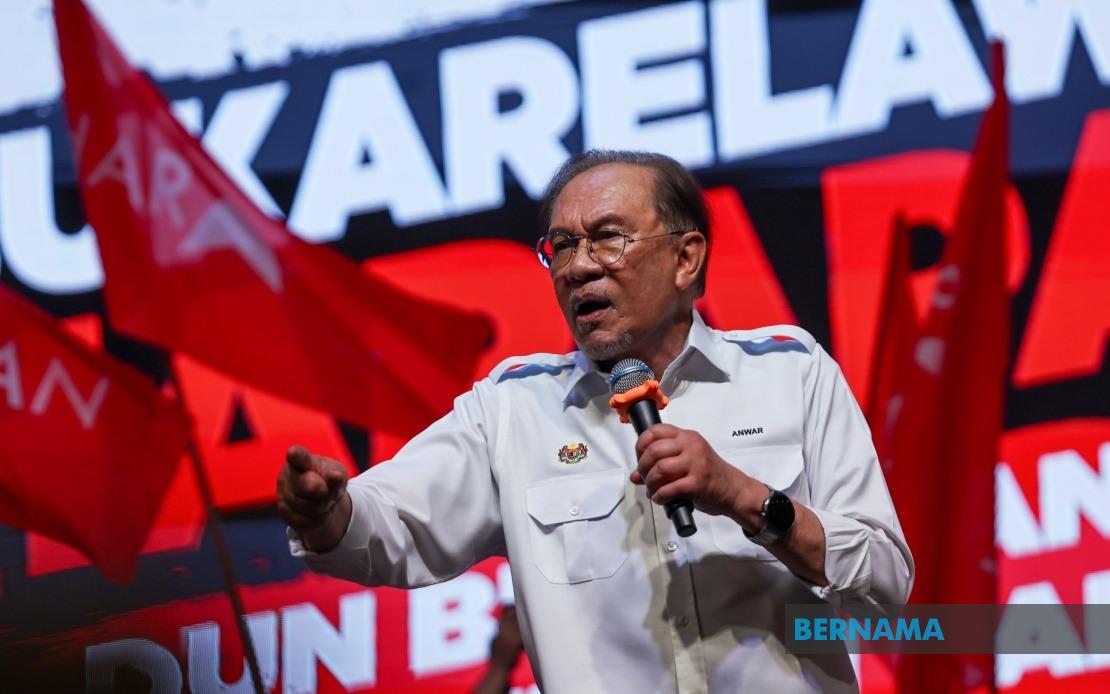
Prime Minister Datuk Seri Anwar Ibrahim defended the Democratic Action Party (DAP) against persistent accusations that it threatens Malay-Muslim interests, asserting during a campaign visit to Muar that the party has consistently upheld constitutional protections while supporting inclusive governance. Speaking at a public engagement session, Anwar moved to counter a narrative that has periodically resurged in Malaysian politics, whereby opposition figures and their allies characterise the DAP as an organisation hostile to Malay rights and privileges. His remarks came amid the Johor state election campaign, where issues of ethnic and religious sensitivity remain potent electoral factors.
As chairman of Pakatan Harapan and custodian of a coalition government spanning diverse political traditions, Anwar presented concrete instances of DAP's pragmatism on race-sensitive matters. He highlighted the party's absence of objection to the gazetting of 20.23 hectares of land in the Bandar Malaysia development as Malay Reserve Land, an action that would ordinarily be expected to trigger opposition from parties viewed as ethnically neutral or Chinese-centric. This example, Anwar suggested, demonstrates that DAP operates within constitutional frameworks and does not fundamentally challenge the special position of Malays and Bumiputeras enshrined in the Federal Constitution. The readiness to support such designations, without apparent controversy, undercuts claims of an anti-Malay agenda.
Yet Anwar's defence extended beyond defensive posturing about specific policies. He articulated a broader philosophical position about what the Unity Government represents—a framework within which equal treatment and non-discrimination do not equate to erosion of constitutionally protected rights. This distinction proves crucial for understanding how multiracial coalitions navigate Malaysia's delicate constitutional settlement. The Premier stressed that his role as leader of this government demands fairness across communities, a principle he presented as compatible with, rather than contradictory to, programmes targeted at Bumiputeras and Malays.
The government's budgetary commitments to Bumiputera development agencies such as the Perbadanan Usahawan Nasional Berhad (PUNB) were cited as evidence that DAP poses no obstacle to initiatives benefiting the Malay-Muslim majority. These allocations, which represent continuity with historical state investment in Malay economic participation, continue unimpeded under the current administration. However, Anwar's framing introduced an ethical dimension often absent from routine political discourse: he insisted that equivalent commitment must extend to supporting economically vulnerable populations across all communities. Poor Chinese, poor Indians, and the numerically significant poor among the Malay majority all merit government assistance through targeted programmes.
This universalist conception of social policy reflects tensions inherent in Malaysia's political economy. The country has historically operated through a bargain whereby Malay-Muslim numerical preponderance translated into preferential treatment in business licensing, education quotas, and civil service appointments, ostensibly justified as compensation for non-Malay dominance in commerce. Chinese and Indian communities accepted this arrangement partly in exchange for citizenship and economic freedom outside reserved sectors. The Unity Government's appeal, according to Anwar's statements, rests on transcending this zero-sum framework by ensuring that economic growth benefits all communities rather than concentrating gains within single ethnic groups or privileged individuals.
The Prime Minister shifted emphasis toward economic management and distribution, suggesting that current macroeconomic expansion should translate into tangible improvements in living standards for ordinary Malaysians rather than accruing to political elites or narrow business circles. He enumerated concrete aspirations—affordable housing, functioning basic infrastructure, and educational quality—that transcend ethnic boundaries and resonate across Malaysian society. These deliverables matter more to families navigating economic pressures than theological debates about the constitutional status of different communities. By anchoring his defence of inclusive governance in material outcomes, Anwar attempted to reframe the debate from identity politics toward performance-based legitimacy.
Educational messaging featured prominently in Anwar's remarks, particularly his exhortation that young Malaysians understand political power as a stewardship responsibility rather than personal enrichment opportunity. This moralising tone, addressing corruption and elite capture, suggests that the Prime Minister views the current political moment as an opportunity to reshape public discourse around governance. The Unity Government's legitimacy, from this perspective, depends not merely on managing competing communal interests but on demonstrating that power holders serve the national interest rather than factional advantage. Such rhetoric appeals to younger voters and educated urban constituencies potentially fatigued by perpetual ethnic and religious positioning.
The Johor state election context illuminated why Anwar chose this moment for clarification. The state, Malaysia's second-largest by population, encompasses diverse communities and has experienced competitive politics across multiple coalitions. With 172 candidates contesting 56 assembly seats and polling set for July 11, state-level campaigns often serve as proxies for national political positioning. Johor has historically tilted toward Umno-dominated coalitions, yet the Unity Government's performance in this electoral laboratory would influence perceptions of its viability and appeal. Anwar's campaign intervention directly addressed voter anxieties that coalition participation by DAP somehow jeopardised constitutional arrangements valued by Malay-Muslim communities.
Critically, Anwar's defence assumed that policy conduct rather than institutional architecture determines whether multiracial coalitions respect constitutional protections. DAP's acceptance of specific Bumiputera policies proves willingness to work within existing frameworks, but sceptics might question whether such postures genuinely reflect party philosophy or represent tactical accommodation necessary for coalition participation. The historical record of DAP advocacy for meritocracy and colour-blind governance suggests some tension between its stated principles and constitutional provisions explicitly according preference based on ethnicity. Anwar's framing attempted to resolve this contradiction by distinguishing between respecting constitutional provisions and opposing them, a position that assumes implementation details rather than fundamental commitments determine communal welfare.
The economic boom referenced by the Prime Minister provides crucial context for his appeals to equitable distribution. Malaysia's recent growth trajectory, partly driven by commodity prices and regional investment flows, has created fiscal space for expanded social spending without necessarily requiring redistribution from established privilege. This circumstance allows the Unity Government to simultaneously maintain Bumiputera programmes while expanding assistance to other communities, a luxury that might evaporate if economic conditions deteriorate. Whether the government can sustain such inclusive spending during slowdown periods will ultimately determine whether Anwar's philosophical position translates into durable political practice or represents merely the product of temporarily favourable circumstances.

