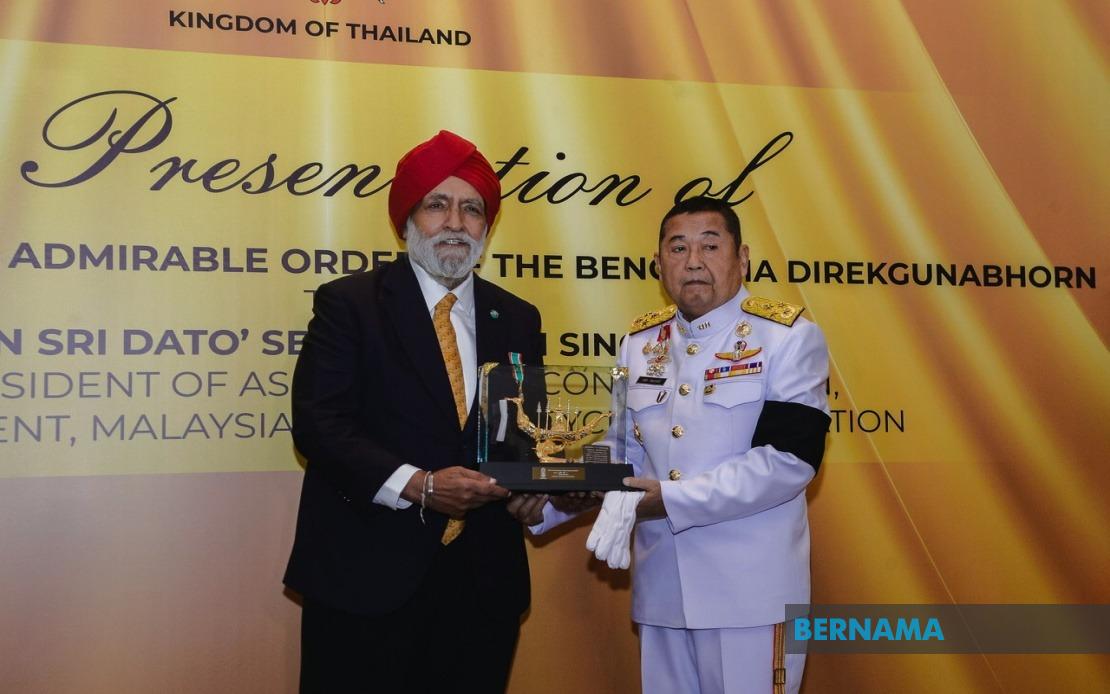
Tan Sri Darshan Singh Gill, who shaped Malaysian cycling's trajectory as a federation and confederation leader across three decades, has been recognised with one of Thailand's highest honours. Presented in Kuala Lumpur today, the Most Admirable Order of the Direkgunabhorn (Fifth Class - Benjama Direkgunabhorn) acknowledges his remarkable stewardship of the sport at national and continental levels, marking a rare accolade for a Malaysian administrator in the cycling world.
The royal decoration originated from His Majesty the late King Bhumibol Adulyadej The Great, Rama IX, and was formally handed over by ACC senior vice-president General Decha Hemkasri during an official ceremony here. The honour underscores Thailand's recognition of Darshan's profound influence on cycling development throughout Malaysia and the broader Asian region, reflecting the deep cross-border appreciation for his administrative contributions.
Darshan's tenure at the Malaysian National Cycling Federation from 1988 to 1990 laid foundational work during a formative period for the sport locally. His leadership subsequently extended to the continental stage when he served as Asian Cycling Confederation president from 1996 to 2005, positioning him as a pivotal figure in charting cycling's course across Asia during a transformative decade. These roles placed him at the intersection of policy-making, athlete development, and international representation.
Speaking after receiving the insignia, Darshan framed the recognition as extending beyond personal achievement, emphasising its significance for Malaysian cycling as a whole. He positioned the award within a broader narrative of national sporting progress, suggesting that international recognition of administrators reflects not just individual merit but systemic capacity development within Malaysian sports governance. This perspective highlights how individual honours often function as indicators of institutional strength and credibility on the global stage.
The former federation chief drew particular attention to Malaysia's current generation of cyclists, citing Datuk Mohd Azizulhasni Awang as an exemplar of athletic excellence. Azizulhasni's recent triumph at Glasgow's Commonwealth Games, where he captured gold in the men's keirin event at the Sir Chris Hoy Velodrome, ended a 16-year gold medal drought for Malaysia in Commonwealth track cycling. The achievement represents not merely individual brilliance but validates decades of administrative infrastructure building that Darshan and his contemporaries established.
Darshan also highlighted parallel achievements in cycling administration itself, pointing to Datuk Amarjit Singh Gill's election as International Cycling Union vice-president. This elevation represents a watershed moment for Malaysian sports governance, marking the first occasion a Malaysian has secured such a senior position within cycling's world governing body. Amarjit's successful candidacy for the 2025-2029 term, secured during the 194th UCI Congress in Kigali, Rwanda, demonstrates that Malaysia's administrative capacity now extends to the highest echelons of international sports organisation.
The timing of these recognitions—Azizulhasni's Commonwealth gold mere weeks before Darshan's Thai royal honour, coupled with Amarjit's UCI vice-presidency—suggests Malaysian cycling has transitioned from aspirational to established status within Asian and global contexts. What once required aggressive capacity-building now manifests as routine representation at decision-making tables. This trajectory vindicates the foundational work undertaken during the 1990s and early 2000s, when figures like Darshan navigated less developed infrastructure and fewer international platforms.
For Malaysian readers, the honour carries broader significance beyond sporting achievement. It demonstrates how sustained administrative excellence and institutional commitment can generate recognition from neighbouring nations and across Asia. Thailand's conferral of its royal decoration on a Malaysian cycling leader suggests deepening cross-border respect for Malaysian contributions to regional sports governance, a dimension often overlooked amid discussions of bilateral relations that typically centre on trade and politics.
The award also contextualises the historical progression of Malaysian cycling itself. Darshan referenced earlier champions M. Kumaresan and Rosman Alwi, athletes who competed during an era when Malaysia lacked the administrative sophistication or international connections that now enable systematic talent development and global exposure. The evolution from scattered individual achievers to institutionalised pathways for excellence represents an administrative transformation that Darshan's generation of leaders engineered.
Furthermore, this recognition arrives at a moment when Malaysian sports governance faces scrutiny and calls for professionalisation. Darshan's honour from a fellow ASEAN nation serves as an implicit endorsement of Malaysian capacity to manage complex international sports portfolios competently. As Malaysia navigates questions about sports administration quality and international standing, the Thai recognition provides concrete evidence that Malaysian cycling leadership enjoys credibility and respect at the highest levels.
The convergence of Azizulhasni's athletic breakthrough, Amarjit's administrative elevation, and Darshan's international recognition suggests Malaysian cycling has achieved a rare alignment: elite athlete performance, sophisticated governance structures, and credible international representation functioning simultaneously. This equilibrium did not emerge spontaneously but reflects decades of intentional development by administrators like Darshan who prioritised institutional building alongside competitive outcomes.

