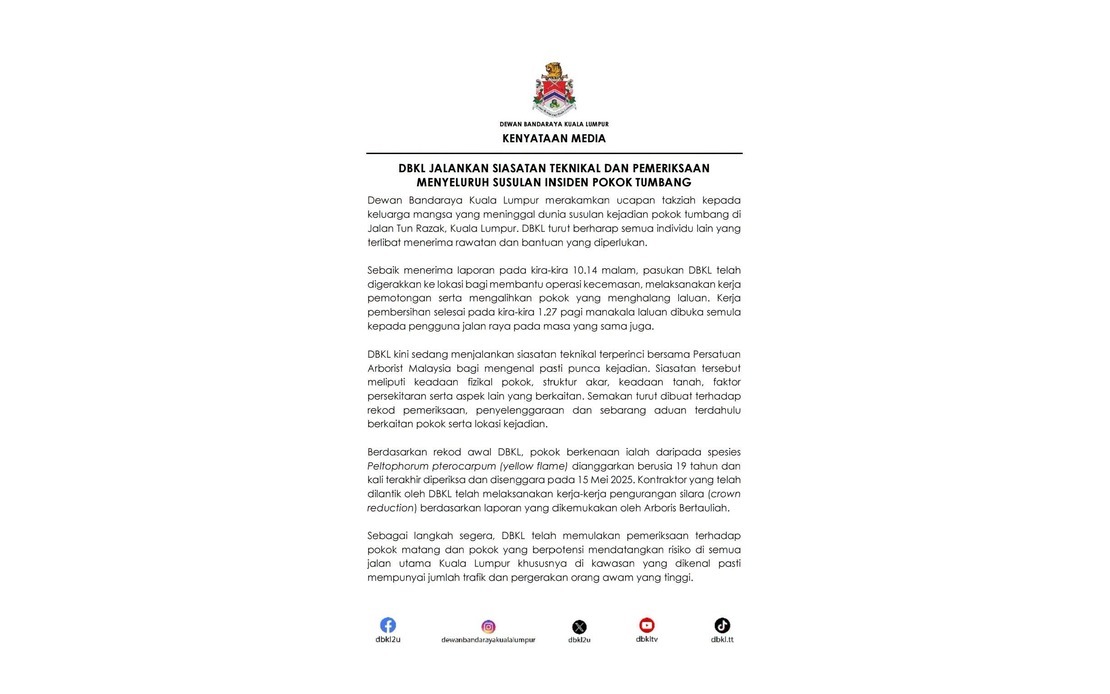
A man died when a tree fell on Jalan Tun Razak in Kuala Lumpur on the night of July 18, triggering an immediate response from the city authorities and launching what officials describe as a thorough technical inquiry into the incident. Kuala Lumpur City Hall (DBKL) has partnered with the Malaysian Society of Arborist to determine precisely what caused the collapse, signalling the seriousness with which the municipal authority is treating both the tragedy and the broader implications for public safety across the capital.
The investigation encompasses a wide spectrum of factors that could have contributed to the structural failure. Specialists are examining the tree's physical integrity, analysing its root system and the soil composition surrounding it, and evaluating broader environmental conditions that may have played a role. Beyond the immediate technical assessment, investigators are also reviewing historical records, including inspection and maintenance logs, as well as any prior complaints lodged about the tree or the surrounding area. This multi-layered approach reflects the complexity of determining causation in such incidents and the need to establish whether institutional oversights or natural deterioration triggered the collapse.
According to DBKL records, the fallen specimen was identified as a Peltophorum pterocarpum, commonly known as Yellow Flame, estimated to be 19 years old at the time of the incident. The tree had undergone its most recent inspection and maintenance on May 15, just two months before the tragedy. The contracted maintenance team had previously performed crown reduction work on the tree based on recommendations from a certified arborist, suggesting that DBKL had taken documented preventive steps to manage the specimen's condition. These details are significant because they demonstrate that the tree was not neglected from a municipal standpoint, yet the incident still occurred, raising questions about the adequacy of existing inspection protocols and maintenance intervals.
The response to the emergency itself occurred swiftly. An emergency team was dispatched to Jalan Tun Razak upon receiving a report at 10.14 pm and immediately commenced tree-cutting operations to clear the obstruction and restore safety to the area. The road was fully reopened by 1.27 am, indicating that DBKL mobilised substantial resources to mitigate the immediate aftermath of the collapse. DBKL extended formal condolences to the victim's family and pledged support for all those affected, while committing to cooperate fully with police and other relevant agencies as investigations proceed.
The incident has catalysed a broader reassessment of tree safety across Kuala Lumpur's urban landscape. As an immediate response, DBKL has initiated inspections of mature trees and those assessed as carrying potential risk along all major thoroughfares in the city, with particular emphasis on locations experiencing high volumes of traffic and pedestrian movement. These priority inspections have begun on Jalan Ampang, Jalan Sultan Ismail, Jalan Raja Laut, Jalan Datuk Keramat, and segments of Jalan Tun Razak itself. The authority has assembled eight inspection teams, including five certified arborists, to conduct this accelerated assessment programme, with completion anticipated within a ten-week timeframe.
The tragedy highlights a challenge facing rapidly urbanising Southeast Asian cities: managing vegetation in dense urban environments while ensuring public safety. In tropical Malaysia's climate, trees can experience rapid growth but also face accelerated degradation from factors including heavy monsoon rainfall, soil saturation, humidity, and the structural stresses imposed by dense canopy masses. The need to identify at-risk trees before failure occurs represents an ongoing operational challenge for municipal authorities managing thousands of specimens across sprawling metropolitan areas. The incident on Jalan Tun Razak underscores that even recently inspected trees can fail unexpectedly, complicating the planning of maintenance schedules.
Looking ahead, DBKL is pursuing a medium-term technological solution to enhance early warning capabilities. The city is awaiting approval from SIRIM (Standards and Industrial Research Institute of Malaysia) to deploy approximately 400 tree sensors in a phased rollout across high-risk locations throughout Kuala Lumpur. These sophisticated monitoring devices would continuously track critical indicators of tree health and structural stability, including soil conditions, moisture levels, structural movement, and the impact of adverse weather events such as heavy rainfall and flooding. Such sensors provide real-time data that could alert authorities to emerging problems before they evolve into public safety hazards.
The initial phase of sensor installation is targeted at four strategically significant locations: Jalan Bangsar, Dataran Merdeka, Jalan Ampang, and Jalan Raja Chulan. The selection of these sites reflects DBKL's assessment of where tree-related risks are most acute, either because of the density of mature specimens, the volume of public usage, or both. The deployment of monitoring technology represents a shift towards predictive maintenance and data-driven decision making in urban forestry, moving beyond traditional visual inspection cycles towards continuous environmental monitoring.
For residents and commuters across Kuala Lumpur, the incident and the ensuing municipal response carry practical implications. The expanded inspection programme means heightened scrutiny of trees in familiar locations, potentially resulting in pruning work, crown reduction, or in severe cases, removal of specimens deemed unsafe. While such interventions may temporarily alter the aesthetic character of some thoroughfares, they are necessary precautions to prevent further tragedies. The incident also underscores the importance of members of the public reporting concerns about tree health or structural integrity to DBKL, providing ground-level observations that complement formal inspection schedules.
The financial and operational investments DBKL is committing to this expanded safety regime reflect the legal and moral obligations facing municipal authorities. When negligence or inadequate maintenance contributes to preventable deaths or injuries, cities face not only civil liability but also profound reputational damage and loss of public trust. By demonstrating a comprehensive, multi-faceted response to the Jalan Tun Razak incident—encompassing immediate emergency response, detailed technical investigation, expanded inspection protocols, and long-term technological enhancement—DBKL is signalling its commitment to preventing recurrence and restoring public confidence in the safety of the urban environment it administers.

