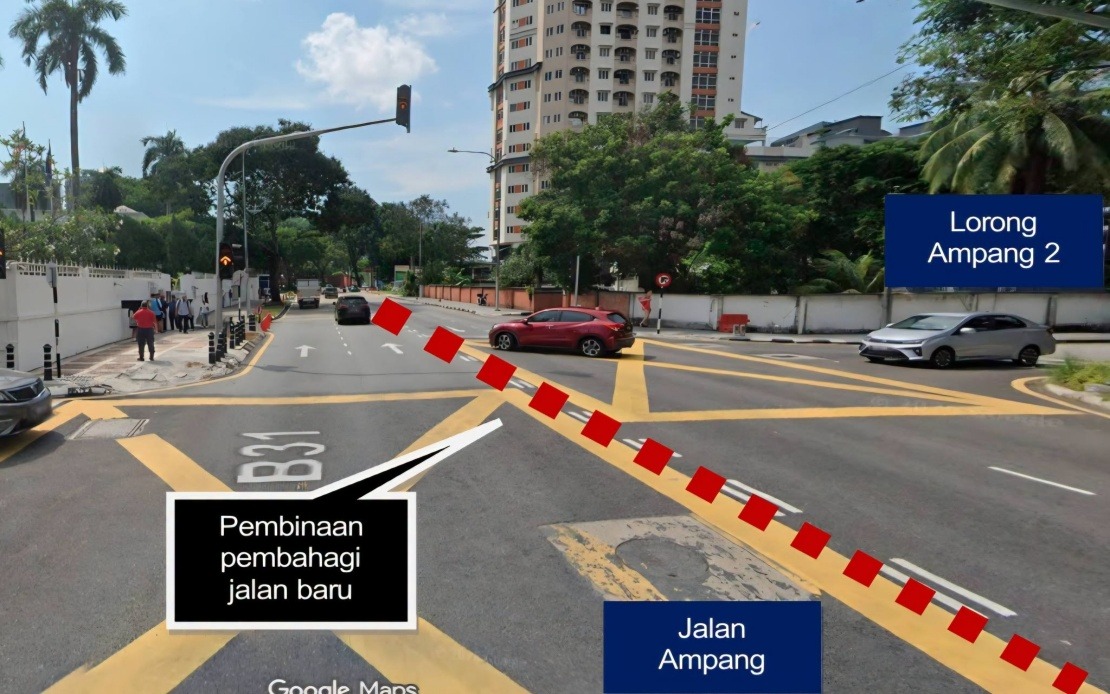
The Kuala Lumpur City Hall (DBKL) has begun permanently shutting down two traffic light intersections along Jalan Ampang, effective immediately, to facilitate a comprehensive upgrade of the major arterial road. The affected intersections are located in front of the Royal Thai Embassy and at Lorong Ampang 2, marking the first phase of infrastructure improvements intended to enhance traffic management and safety along one of the city's critical commuter corridors.
The closure forms part of an ambitious 3.2-kilometre modernisation initiative stretching from the Jalan Tun Razak intersection to the Middle Ring Road 2 (MRR2), a distance that encompasses some of the most heavily trafficked sections in central Kuala Lumpur. This significant undertaking represents a major intervention in urban traffic infrastructure, reflecting the city authority's commitment to addressing congestion and efficiency challenges that have long plagued the eastern approaches to the capital's business district.
Beyond merely removing traffic signals, the upgrade project encompasses a holistic redesign of the roadway itself. DBKL's planning includes the installation of systematic infrastructure improvements such as physical road dividers that will regulate traffic flow patterns and prevent unauthorised lane switching. The scheme envisions the creation of two-way four-lane roads with standardised lane markings and clearer directional delineation, fundamentally altering how vehicles navigate this stretch of road.
Pedestrian infrastructure receives considerable attention within the project scope, with plans to establish more spacious and secure walkways designed with modern safety standards in mind. These improvements address longstanding complaints from residents and workers in the area regarding inadequate sidewalk conditions. Complementing these enhancements are upgrades to street lighting infrastructure, which officials argue will improve both visibility and perceived safety for all road users, particularly during evening hours when crime and accident concerns intensify.
The strategic closure of traffic light intersections represents a deliberate effort to streamline traffic movement by eliminating conflict points where vehicles formerly braked and accelerated. Traffic engineers recognise that these intersections often become bottlenecks where vehicles weave between lanes attempting to position themselves for turns or continuous travel. By permanently closing these signals and consolidating traffic flows, DBKL anticipates measurable reductions in the delays drivers experience and smoother overall progression along the corridor during both peak and off-peak periods.
To mitigate disruption for the thousands of daily commuters who depend on Jalan Ampang, DBKL has established alternative routing protocols. Drivers travelling towards Ampang can execute U-turns at the Jalan Tun Razak intersection, effectively redirecting their vehicles away from the affected sections. Conversely, those heading towards the city centre have been instructed to utilise U-turn facilities at Jalan Ampang Hilir, ensuring that traffic displacement does not overwhelm adjacent routes or create new congestion elsewhere in the network.
The timing of these closures carries particular significance for Malaysia's bustling commercial and residential sectors. Jalan Ampang serves as a vital link connecting the eastern suburbs—including prestigious residential enclaves and established business parks—to central Kuala Lumpur's financial and administrative hubs. The temporary disruption occasioned by this upgrade will inevitably affect commute patterns for office workers, school transport operators, and commercial delivery services relying on this corridor during the construction phases.
DBKL's decision to implement permanent closure rather than phased or temporary restrictions suggests confidence in the alternative routes' capacity to absorb displaced traffic without creating secondary congestion problems. However, the success of this strategy will depend heavily on driver compliance with the newly posted traffic signage and official guidance. The authority has explicitly cautioned the public to observe all traffic indicators and directional markers to ensure journeys remain as efficient as possible during the implementation period.
This infrastructure project reflects broader trends in Malaysian urban planning, where governments increasingly recognise that expanding road capacity alone proves insufficient for managing metropolitan traffic. Instead, intelligent traffic management—through strategic intersection closure, improved pedestrian facilities, and systematic infrastructure upgrades—offers a more sustainable approach to urban mobility. The Jalan Ampang initiative demonstrates how authorities are attempting to leverage existing road corridors more efficiently rather than pursuing endless expansion that consumes limited urban land and financial resources.
For residents and regular commuters in the eastern sections of Kuala Lumpur, these changes will require adjustment to familiar driving patterns and new familiarity with alternative routes. The project timeline remains undisclosed in official statements, leaving uncertainty about when normalcy will return to this heavily used thoroughfare. Nevertheless, proponents of the upgrade argue that temporary inconvenience during construction phases will yield long-term benefits through reduced congestion, improved safety outcomes, and enhanced urban mobility for the broader metropolitan population.

