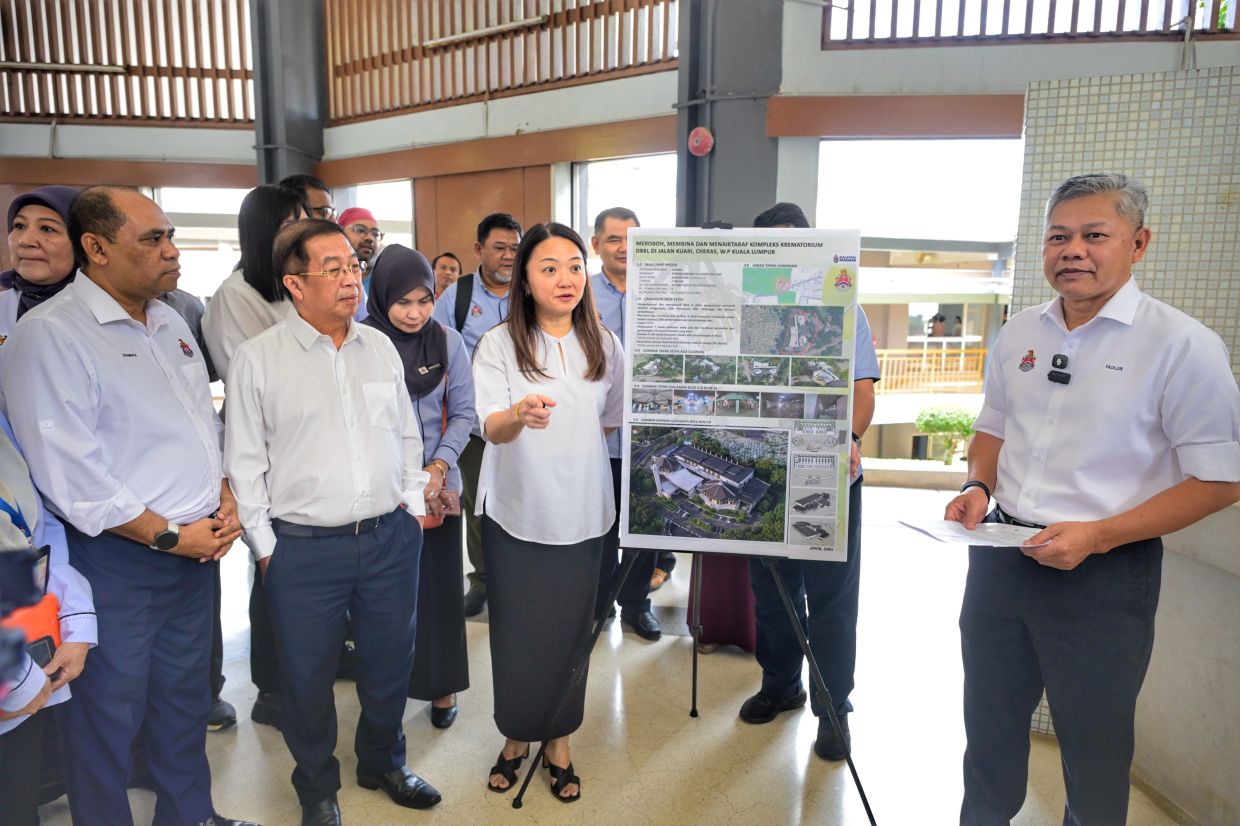
Kuala Lumpur City Hall has committed RM45 million to a substantial upgrade of the Cheras crematorium complex, signalling the municipal authority's recognition of demographic shifts within the capital and the need to expand funeral infrastructure for non-Muslim communities. The expansion project, which will commence in February 2026, represents a significant investment in civil services that often receive limited public attention despite their importance to citizens' final rites. During a site inspection on Wednesday, DBKL Mayor Datuk Seri Fadlun Mak Ujud outlined plans to augment the facility's capacity by installing three additional cremation units alongside the existing seven, effectively increasing operational capability by approximately 43 percent.
The crematorium facility on Jalan Kuari has served Kuala Lumpur continuously since its establishment in 1977, having processed more than 5,800 cremations annually according to recent municipal records. After nearly five decades of operation without major infrastructure expansion, the aging complex has become strained by the evolving composition and growth of the capital's population. Municipal officials determined that the current capacity no longer adequately addresses demand, prompting the decision to undertake this substantial renovation. The investment reflects broader municipal planning challenges facing Kuala Lumpur as a metropolitan hub with increasingly diverse religious and cultural demographics.
To ensure uninterrupted service delivery during the reconstruction period, DBKL has committed to maintaining four operational cremation units throughout the two-year upgrade cycle. This operational continuity is crucial for affected families who depend on timely funeral services and cannot endure extended delays or facility closures. The phased approach acknowledges that this essential public service cannot be halted entirely during modernisation, distinguishing infrastructure upgrades from non-critical municipal projects. The careful sequencing of work will require sophisticated project management to balance renovation activities with ongoing service provision.
Fadlun characterised the initiative as part of City Hall's broader strategic response to evolving public requirements, emphasising that municipal governments must adapt their service portfolios as populations change. He noted that the upgrading project has received formal approval under the 13th Malaysia Plan, the government's five-year development blueprint, indicating alignment with national infrastructure priorities. This inclusion in national planning documents underscores recognition at federal levels that funeral infrastructure constitutes a legitimate component of urban development strategy, not merely a peripheral concern.
Cheras Member of Parliament Tan Kok Wai attended the inspection and advocated for acceleration of the project timeline, highlighting that the crematorium's age and the capital's demographic growth demand expedited action. Tan's emphasis on urgency reflects increasing political attention to services that directly affect community welfare during significant life moments. His remarks suggest that parliamentary representation increasingly encompasses the practical infrastructure supporting diverse population segments, moving beyond traditional governance concerns. The MP's call for hastened implementation indicates potential parliamentary support for prioritising this project within municipal budgetary allocations.
Minister in the Prime Minister's Department (Federal Territories) Hannah Yeoh participated in the inspection, bringing federal oversight and visibility to the initiative. Her attendance signals higher-level governmental engagement with infrastructure serving non-Muslim communities, reflecting federal responsibility for managing the Federal Territories of Kuala Lumpur. Yeoh's presence underscores how funeral infrastructure has become a policy matter warranting ministerial attention, transcending purely local municipal concerns.
Simultaneously with crematorium expansion, Yeoh disclosed ongoing federal-state negotiations with Selangor's government to identify suitable locations in Semenyih for establishing Muslim cemeteries. This parallel initiative addresses comparable infrastructure pressures affecting Muslim burial grounds, revealing systematic municipal and federal engagement with funeral capacity constraints across religious communities. The dual approach—crematorium expansion in Kuala Lumpur coupled with cemetery development in Semenyih—reflects metropolitan planning realities where the capital's boundaries no longer contain all supporting infrastructure required by its resident population.
The identification of Semenyih sites represents a pragmatic acknowledgment that Kuala Lumpur proper lacks sufficient available land for expanded burial facilities. Land scarcity within the capital has become a defining constraint on municipal service expansion, forcing planners to utilise adjacent territories in Selangor. This cross-state coordination demonstrates how metropolitan governance increasingly requires intermunicipal cooperation, with the Federal Territories dependent on Selangor government cooperation for resolving infrastructure limitations. The approach reflects evolving metropolitan governance structures where administrative boundaries no longer align neatly with practical service delivery zones.
For Malaysian readers, particularly those based in Kuala Lumpur and surrounding regions, the crematorium expansion carries direct implications for access to timely funeral services during bereavement periods. The investment addresses a practical necessity that affects significant population segments but receives minimal media coverage despite its personal importance to thousands of families annually. The project's timing and scale reflect municipal authorities' increasing sophistication in long-term infrastructure planning based on demographic analysis rather than purely reactive crisis management.
The RM45 million expenditure also positions the municipal government as responsive to non-Muslim community needs, a significant positioning in an urban context where representation and service equity constitute ongoing political considerations. The visible commitment to expanding cremation facilities demonstrates municipal willingness to invest in services supporting minority community preferences, potentially influencing perceptions of governance fairness and inclusive public service delivery. Such investments carry subtle but meaningful implications for community relations and political trust.
Beyond Kuala Lumpur, the project offers lessons for other Malaysian municipalities grappling with similar infrastructure pressures as urbanisation accelerates and populations diversify. The two-year timeline and phased implementation approach provide a model for maintaining essential services during large-scale facility upgrades. The inclusion in the 13th Malaysia Plan suggests potential replicability within federal development frameworks, potentially encouraging similar initiatives in other major urban centres experiencing comparable capacity constraints.
The crematorium upgrade simultaneously highlights broader questions about Malaysian urban planning and infrastructure timing. Waiting decades before addressing capacity needs creates pressure-driven expansion rather than anticipatory planning, potentially increasing project costs and service disruptions. The modernisation project, while necessary and welcome, might have proceeded more smoothly and economically had capacity considerations informed earlier planning cycles. This pattern reflects challenges that Malaysian municipal governments face in balancing fiscal constraints with timely infrastructure investment.

