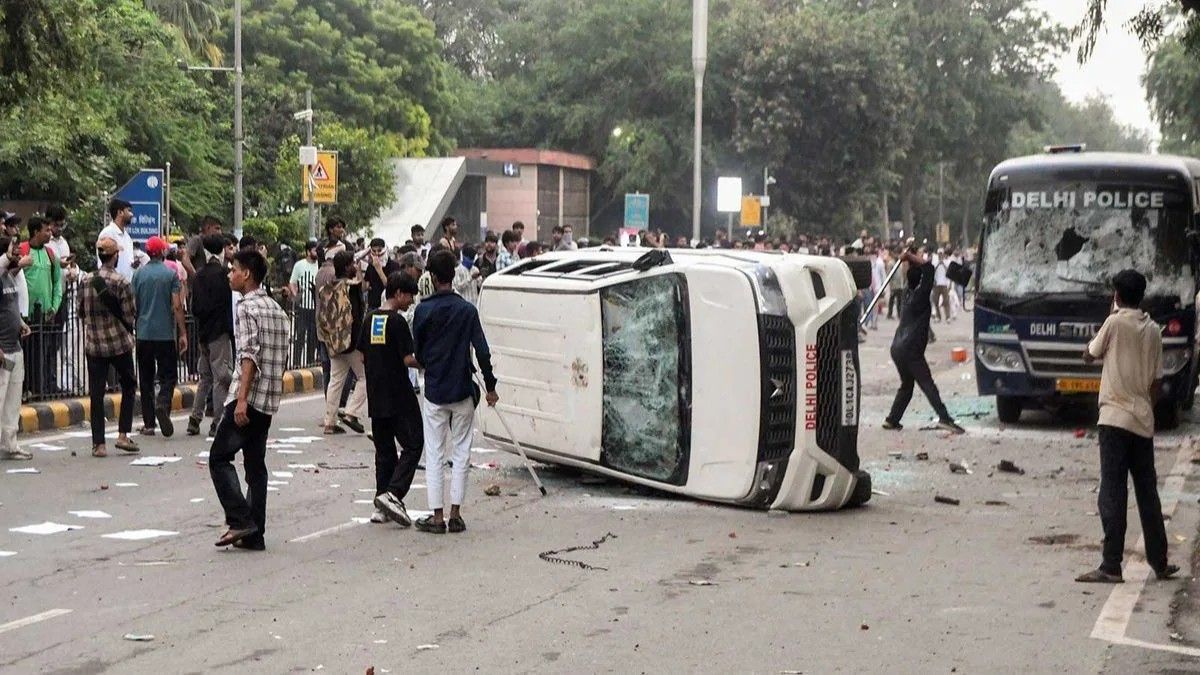
The Delhi Police have initiated 10 formal investigations into violence and related incidents stemming from the Cockroach Janta Party's "Sansad Chalo" march, though law enforcement authorities are pushing back against widespread social media allegations of fresh confrontations at Jantar Mantar on Tuesday. The move reflects escalating tensions in India's capital over an ongoing political agitation that has drawn significant public attention and competing narratives about the scale and nature of the demonstrations.
In a statement released through X, the Deputy Commissioner of Police for New Delhi district explicitly rejected claims circulating online that fresh stone-pelting or police action occurred on Tuesday. The police assertion comes amid a flood of videos shared across social platforms purporting to show clashes and law enforcement responses. By characterizing these videos as "false and misleading," Delhi Police appear intent on controlling the narrative around the protest, urging citizens to consult only official channels for reliable information about developments at the site.
The investigation encompasses incidents from the Cockroach Janta Party's march toward Parliament on Monday, which deteriorated into violence as demonstrators sought the resignation of Union Education Minister Dharmendra Pradhan amid allegations of examination irregularities in India's education system. The police have distributed these 10 cases across multiple stations within New Delhi district: four at Parliament Street, three at Connaught Place, and one each at Mandir Marg, Barakhamba Road, and Kartavya Path. This geographical spread suggests the violence was not confined to a single location but rather occurred at multiple points along the protest route or gathering areas.
The charges invoked in these cases reveal the seriousness with which authorities are treating the incidents. Delhi Police have applied provisions of the Bharatiya Nyaya Sanhita, India's new criminal code, alongside the Arms Act and the Prevention of Damage to Public Property Act. The specific allegations include a life-threatening assault on a Rapid Action Force personnel member, the unauthorized operation of a drone within the New Delhi district during Parliament's session, conspiracy charges, obstruction of government functions, attacks on law enforcement officers, and vandalism or destruction of public infrastructure. The inclusion of the drone-flying charge is particularly noteworthy, as it suggests concerns about sophisticated protest coordination or surveillance activities.
Police officials have characterized the Monday demonstration as displaying "unruly, aggressive and violent behaviour" despite multiple warnings and standing prohibitory orders. This framing establishes a police narrative that positions law enforcement as having exercised restraint and provided adequate notice before responding to what authorities describe as escalating disorder. The deployment of substantial forces, including specialized Rapid Action Force units, has remained visible at Jantar Mantar throughout the ongoing agitation, signaling police determination to maintain control over the situation.
A particularly revealing aspect of the investigation involves the systematic examination of more than 250 videos to identify participants and establish whether the violence followed a pre-planned conspiratorial strategy. This video forensics effort represents a substantial investigative undertaking and underscores law enforcement's commitment to holding individuals accountable for specific actions. The investigation's focus on potential conspiracy charges suggests police believe the violence may have been coordinated rather than spontaneous, though authorities have not yet publicly detailed the evidence supporting this hypothesis.
Meanwhile, the Cockroach Janta Party continues its sit-in occupation at Jantar Mantar, where security personnel had removed tents and the main protest stage but demonstrators have since returned to the location. The party's spokesperson Ashutosh Ranka has affirmed that the agitation will persist until the organization's demand for Dharmendra Pradhan's resignation is satisfied. This commitment indicates the political movement remains undeterred by police action and willing to sustain pressure through continued public assembly and media attention.
Countering the official police narrative, the Cockroach Janta Party has alleged that numerous protesters, including students and volunteers, sustained injuries during Monday's confrontations. The party has also raised allegations that women demonstrators, specifically citing Geetanjali J. Angmo, wife of prominent activist Sonam Wangchuk, were subjected to mistreatment during police operations. Such claims, if substantiated, would complicate the police portrayal of a restrained response and raise questions about proportionality in law enforcement tactics deployed against civilians engaging in political expression.
The divergence between official police claims and opposition allegations reflects deeper tensions within Indian civil society regarding protest rights and state response mechanisms. For observers in Southeast Asia, including Malaysia, the Delhi situation illustrates how political demonstrations in India's capital can rapidly escalate into confrontations between state security forces and civilian activists, with competing claims about responsibility and conduct shaping public understanding of events. The Indian government's willingness to pursue formal criminal investigations against protesters, coupled with apparent emphasis on controlling information flows through social media fact-checking, demonstrates a multifaceted approach to managing political dissent.
The documentation efforts by police, including the collection and analysis of extensive video evidence, reflect modern investigative capabilities while also raising civil liberties concerns about mass surveillance of public protests. For Malaysian analysts observing Indian governance patterns, the approach offers insights into how countries with significant activist movements navigate the balance between public order maintenance and protection of democratic freedoms. The outcome of these investigations may establish important precedents regarding the legal consequences protesters face when demonstrations result in confrontations with law enforcement.
As the investigation proceeds and the agitation continues, the situation at Jantar Mantar remains fluid. The heavy police and Rapid Action Force presence signals government determination to prevent further violence, even as the Cockroach Janta Party demonstrates commitment to sustaining political pressure through continued assembly. The competing narratives about what occurred, whether fresh violence happened on Tuesday, and the appropriateness of police responses will likely continue dominating public discourse, with social media platforms serving as contested spaces where different versions of events reach audiences across India and beyond.

