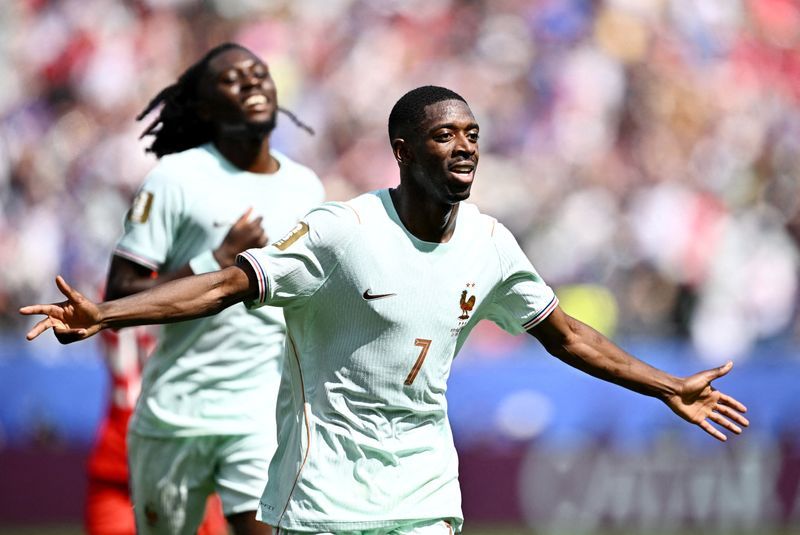
France's ambitions of capturing World Cup glory gained significant momentum in Foxborough, Massachusetts on Friday as they dismantled a severely depleted Norwegian side 4-1 to claim top honours in Group I. Ousmane Dembele's scintillating three-goal salvo, accomplished in the compressed timeframe of just 25 minutes during the opening half, provided the catalyst for the defending runners-up to advance into the knockout stages with considerable confidence and tactical momentum intact.
Dembele's remarkable achievement represents a significant milestone in French football's World Cup history. His feat makes him only the third player ever to score a hat-trick for France at the tournament, joining the legendary Just Fontaine and the mercurial Kylian Mbappe in this exclusive club. The velocity and precision of his three-goal burst established the second-fastest hat-trick in World Cup history, trailing only Erich Probst's achievement for Austria in 1954 against Czechoslovakia, which took 24 minutes.
The French contingent entered this encounter with their qualification to the Round of 32 already secured, yet they harboured clear intentions to secure first place in the group standings. This strategic priority extended beyond mere mathematical achievement; securing the group's top position offers substantial practical advantages for the remainder of the tournament, particularly regarding travel logistics across North America's geographically dispersed venues. The positioning also carries implications for the draw format, as group winners typically face more favourable matchups in the subsequent round.
France's motivation transcended football's purely competitive dimensions. The players had publicly pledged to pursue an emphatic victory as a meaningful tribute to head coach Didier Deschamps, who had returned to his homeland to attend his mother's funeral. This personal dimension appeared to galvanise the squad, translating into the aggressive, incisive attacking display that characterised their performance throughout the first half and beyond.
Norway's decision-making regarding team selection substantially facilitated France's dominance. Coach Stale Solbakken opted to rotate his personnel extensively, resting virtually every player who featured in the previous fixture against Senegal. This strategic gamble meant that key attacking catalysts including Manchester City's prolific Erling Haaland and captain Martin Odegaard remained absent from the starting formation, fundamentally altering the competitive dynamic and removing two of Norway's most influential presences from the pitch.
The match's opening moments telegraphed France's intentions unmistakably. Within twenty seconds, Kylian Mbappe's explosive drive from an acute angle cannoned against the crossbar, immediately establishing the dangerous tone of their attacking forays. Mbappe's involvement proved crucial to orchestrating the breakthrough; his incisive cross-field distribution located Dembele in the sixth minute, allowing the winger to weave past his marker before executing a clinical angled finish past goalkeeper Egil Selvik.
Dembele's second arrival came fourteen minutes later when Mbappe again manufactured space through intelligent positioning and precise passing, enabling his teammate to capitalise with a dipping shot that left no margin for error. The Norwegian defensive structure, undermined by the absence of experience and continuity, offered insufficient resistance to contain the French attacking thrust. Thelo Aasgaard briefly threatened to provoke a comeback when Norway pulled one goal back almost immediately, yet this temporary respite proved fleeting.
Dembele's completion of his hat-trick in the 32nd minute represented the contest's decisive moment. The Paris Saint-Germain forward curled a low, technically exquisite shot into the bottom corner, establishing himself as only the third French footballer to achieve this feat at World Cup level. His performance underscored the devastating impact that incisive attacking play can inflict when defensive organisation falters, delivering a cautionary lesson for the tournament's remaining participants regarding the consequences of compromised preparation.
Norway's second-half efforts proved insufficient to alter the fundamental trajectory of proceedings. Jorgen Strand Larsen's soft penalty attempt in the early stages of the second half was repelled by Mike Maignan, who demonstrated assured goalkeeping to maintain France's commanding advantage. Although Oscar Bobb's subsequent chance forced another save from the French custodian, exposing momentary defensive vulnerabilities, the outcome had long since been determined.
Desire Doue's late header from Bradley Barcola's cross provided the emphatic full stop to France's attacking exhibition, completing a 4-1 scoreline that understated neither the comprehensiveness nor the clinical precision of their dominance. The French now advance to face Sweden in the likely first knockout encounter, having secured the group's top position. Conversely, Norway's runner-up status sets them on a collision course with Ivory Coast in the Round of 32.
The contest served as a reminder that World Cup success ultimately favours those possessing the depth and flexibility to maintain intensity even when their progression has been mathematically assured. France's ability to combine personal motivations with competitive ruthlessness demonstrates the mental fortitude required to navigate the tournament's demanding schedule. For Malaysian football enthusiasts observing this North American spectacle, the French display illustrated how superior technical execution and tactical discipline can transform a single-minded attacking approach into devastating effectiveness, a lesson applicable regardless of continental geography.

