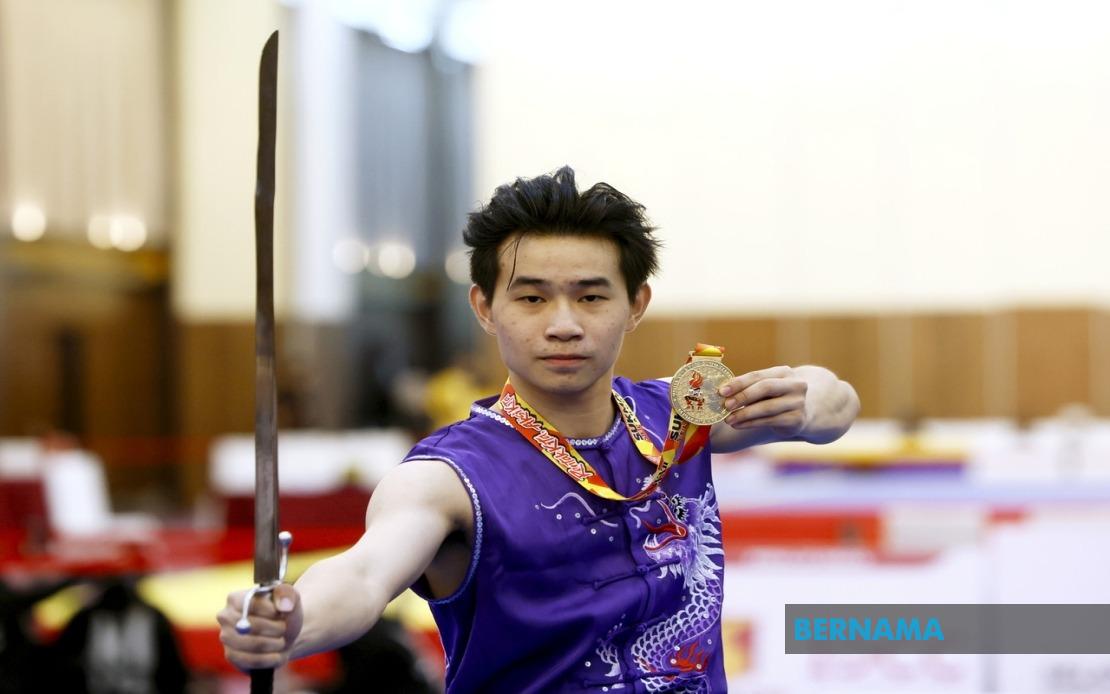
At the Ideal Convention Centre in Shah Alam, Penang's Wee Din Jun delivered a redemptive performance in wushu, capturing the men's nandao nangun gold medal on what marks his final Malaysia Games appearance. The 21-year-old from Bayan Lepas overcame both a significant hip injury incurred just a month before competition and the psychological weight of previous disappointments to post a winning score of 9.600 points, narrowly outpacing Sarawak's John Phang, who earned silver with 9.563 points. Selangor's Tan Yu Zhe rounded out the podium with bronze at 9.550 points.
The significance of Din Jun's triumph extends well beyond the margin of victory in a single event. His journey through three SUKMA appearances represents a narrative arc common among elite young athletes in Southeast Asia—one marked by early promise, setbacks, and the mental resilience required to return stronger. At SUKMA 2022 in Kuala Lumpur, he captured bronze, establishing himself as a competitor capable of medalling on the Games stage. Yet the intervening years proved considerably more challenging, culminating in his participation at SUKMA 2024 in Sarawak where he walked away empty-handed despite competing across three separate events.
That blank medal tally in 2024 represented more than simple athletic failure for the young wushu specialist. Speaking to BERNAMA following his victory, Din Jun articulated the profound disappointment that had shadowed his preparation for the 2026 Games, revealing how multiple technical errors during his previous appearance had compounded the sting of returning without medals. The gap between the bronze-medalist performance of 2022 and the unsuccessful 2024 campaign created a narrative of decline that weighed heavily on his psychological approach to competition.
The hip injury sustained approximately one month before Shah Alam added another layer of complexity to Din Jun's path to redemption. Rather than allowing the injury to derail his preparations entirely, the athlete channelled his recovery process into preparation, working closely with his coaching team to develop strategies that would permit competition despite the physical setback. This represents a sophisticated approach to athlete management often seen among disciplined martial artists, where mental fortitude and technical precision must sometimes compensate for physical limitations.
In discussing his approach to the nandao nangun competition, Din Jun credited his coaching staff with providing the psychological framework that enabled his breakthrough performance. Rather than fixating on the pressure of redemption or the weight of previous failures, his coaches encouraged him to compartmentalise his thinking, focusing exclusively on executing his technical elements with precision rather than dwelling on outcomes or external expectations. This coaching philosophy aligns with contemporary sports psychology approaches that emphasise present-moment awareness and process orientation over outcome fixation.
The athlete's public dedication of his achievement to his former coach—who has since relocated to China and thus was unable to attend previous SUKMA editions—reveals the personal relationships that undergird competitive wushu in Malaysia. The absence of his mentor at prior Games appears to have motivated Din Jun, creating a unfinished narrative he was determined to complete. This dedication also underscores how international coaching networks shape the development of elite athletes in Malaysia, with foreign expertise complementing domestic talent development infrastructure.
Din Jun's win in the nandao nangun event carries implications for Malaysian wushu's competitive standing within the regional Games context. The narrow margin of victory against Sarawak's Phang demonstrates the quality of competition within Malaysia itself, while the athlete's capacity to deliver under pressure—having previously faltered in high-stakes environments—suggests he possesses the mental qualities necessary for sustained success in international martial arts competition. His performance validates the investment in wushu development within Penang's sports ecosystem.
Looking forward, Din Jun has positioned himself to conclude his final SUKMA appearance with potentially multiple medals. The nanquan event scheduled for the following day represents his next opportunity to add to his tally, effectively transforming what could have been a final Games marked by accumulated disappointment into a valedictory competition that restores his competitive reputation. This remaining event carries particular significance given the pattern of his SUKMA trajectory.
For Malaysian sports observers, Din Jun's redemption arc offers a cautionary tale about premature dismissal of young athletes following singular unsuccessful competitions, while simultaneously illustrating how proper coaching, psychological resilience, and a genuine opportunity to address past failures can catalyse dramatic improvements in performance. His journey from the disappointment of 2024 to gold in 2026 demonstrates that athletes' trajectories are rarely linear, and that setbacks can serve as launching points rather than terminal endpoints. As Malaysia continues to develop its wushu programme and seeks to leverage martial arts success for regional prominence, athletes like Din Jun exemplify the character and determination that distinguishes medal winners from mere participants.

