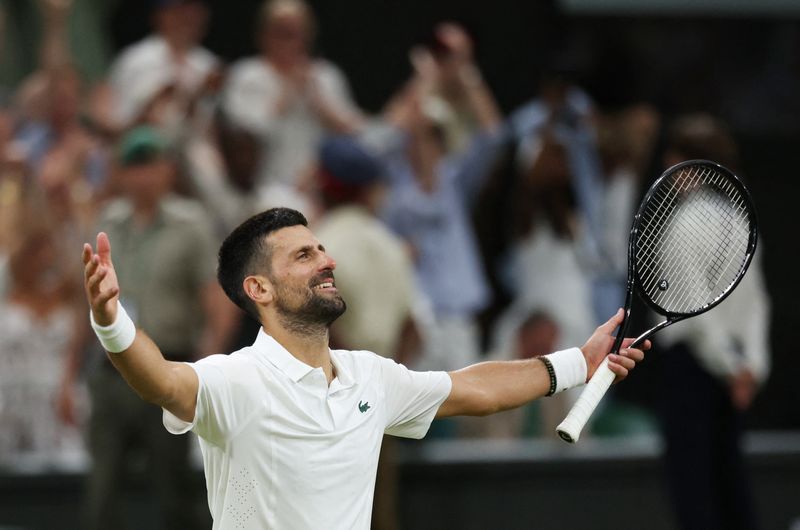
Novak Djokovic's remarkable run at Wimbledon extended to an eighth consecutive semi-final appearance on Tuesday evening, as the 39-year-old Serbian champion weathered a ferocious challenge from Canadian Felix Auger-Aliassime to claim victory 7-6(10) 3-6 6-3 6-7(4) 7-6(10-4) in an extraordinary quarter-final contest. The marathon encounter, lasting five hours and 15 minutes, proved to be the longest quarter-final match ever played at the All England Club, establishing a new benchmark for endurance and mental fortitude in the championship's storied history.
Djokovic's progression to the final four carries significant historical weight, as he continues to distance himself from the legacy of Roger Federer in the Wimbledon record books. By securing his 106th victory at the tournament in the previous round, Djokovic surpassed the Swiss master's tally of matches won at the venue. More notably, his eighth consecutive semi-final appearance makes him the first man in the sport's history to reach the last four on such a consistent basis at a single Grand Slam championship, underscoring his sustained excellence across nearly a decade of competition on the grass courts of Southwest London.
The journey to victory was neither straightforward nor assured, as Auger-Aliassime mounted a determined resistance throughout the contest, refusing to surrender despite mounting pressure. The opening set itself became a test of nerve, with both players locked in a tiebreak that extended to a 10-point margin before Djokovic finally prevailed, having endured several missed opportunities that could have ended the set earlier. Djokovic subsequently acknowledged the precarious nature of that opening encounter, describing the tension as suffocating and noting that his opponent had appeared positioned to claim the set with relative comfort before ultimately faltering on a missed volley.
Auger-Aliassime seized momentum decisively in the second set, executing a strategic break of serve to establish a commanding 5-3 advantage and demonstrating the capacity to compete with the world's elite. The Canadian's service hold in the following game drew the match level and appeared to signal a potential upset in the making. The closure of the Centre Court roof midway through proceedings, necessitated by fading daylight at approximately 7.40 p.m. local time, initially unsettled Djokovic, who voiced his disapproval of the timing and the changed atmospheric conditions. However, his response proved characteristically resilient, as he regained composure and began executing with noticeably improved precision.
The transformation manifested most clearly during the third set, when Djokovic's ball-striking achieved marked elevation in both pace and consistency. His breakthrough came in the sixth game, where he finally secured the crucial break that had eluded him during the match's earlier phases. From this juncture, Djokovic systematically tightened his grip on the contest, gradually accumulating the momentum necessary to move closer to victory.
Auger-Aliassime's resolve wavered temporarily in the fourth set when he surrendered his opening service game, his mounting frustration evident as he struck his chair with his racket in a rare display of emotional release. Despite this momentary lapse, the Canadian rallied admirably, demonstrating the competitive spirit that has elevated him among the sport's emerging talents. He leveled the match through another tiebreak victory, forcing the contest toward an ultimate decider and keeping alive his improbable hopes of engineering one of the tournament's major upsets.
The fifth set became a marathon unto itself, with neither competitor gaining ascendancy through 12 consecutive games of play. The decisive moment arrived in the match tiebreak, where Djokovic's accumulated experience and championship mentality proved decisive. His superior comfort in these highest-pressure situations, forged through decades of elite competition, allowed him to navigate the final exchanges and ultimately overcome Auger-Aliassime's brave resistance, culminating in thunderous applause from a captivated Centre Court audience.
In reflecting upon the encounter afterward, Djokovic characterized the contest as among the most memorable of his distinguished career at this venue, highlighting not merely the result but the quality of tennis and drama that had unfolded across the evening. He emphasized that victory emerged through a combination of technical execution and emotional resilience, referring to his triumph as a triumph of both "racket and heart." The victor acknowledged that management of the extreme nervous tension that characterizes such contests represented perhaps the most significant mental challenge he faced.
Djokovic's quest for an eighth Wimbledon title—which would equal Federer's record—and a 25th Grand Slam championship overall—which would move him past Margaret Court's long-standing record of 24—will next be tested against Jannik Sinner, the reigning champion and current world number one. This semi-final matchup represents the latest chapter in an emerging rivalry between the two players that has already produced several compelling encounters. Djokovic approached the prospect with characteristic professionalism, resisting the temptation to celebrate prematurely while openly acknowledging both his opponent's elite status and the recovery period he will require.
For Malaysian and Southeast Asian tennis enthusiasts, Djokovic's continued presence in major championship semi-finals at age 39 provides remarkable perspective on athletic longevity and dedication. His methodical, intelligent approach to the sport—emphasizing baseline consistency, tactical adaptation, and mental control rather than raw power—presents a template increasingly relevant to players across the region seeking to extend their competitive careers at the highest level. The match also underscores the emerging threat posed by a new generation of players like Auger-Aliassime, who possess the technical skills and athleticism to challenge the established order, even if ultimate victory remains elusive.

