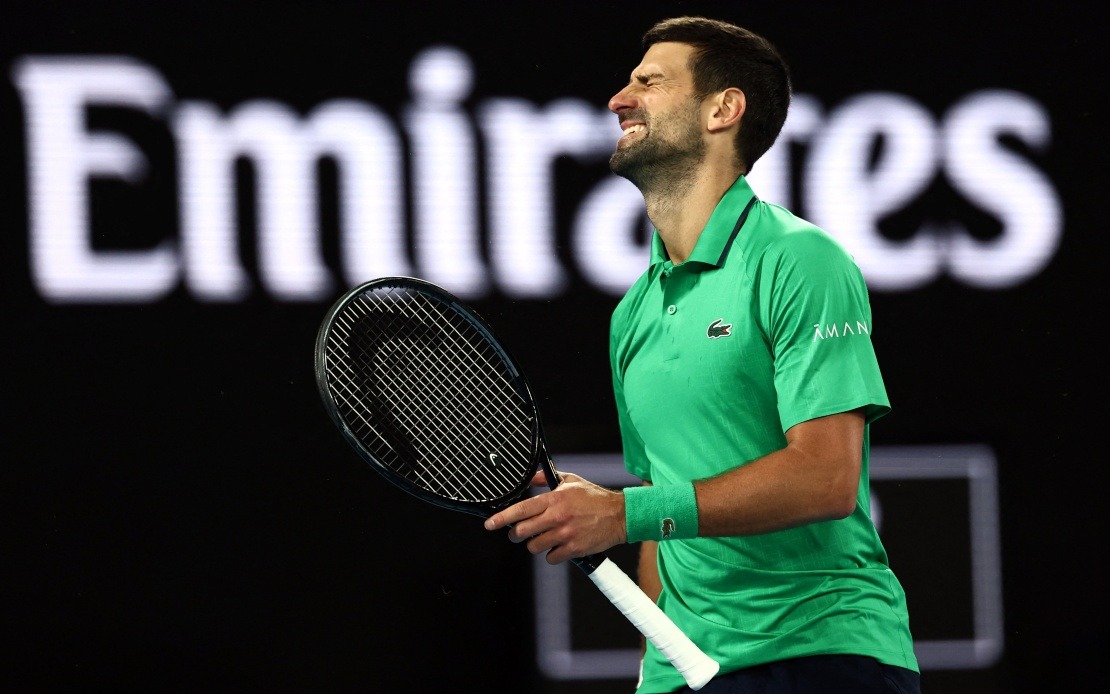
Novak Djokovic has etched his name deeper into tennis history by becoming the joint holder of the most men's singles victories at Wimbledon, matching the legendary Roger Federer's benchmark of 105 wins. The achievement came on Friday when the Serbian champion navigated past France's Arthur Rinderknech 7-5, 6-4, 1-6, 7-6 (7-4) in a tightly contested three-hour battle on Centre Court, advancing to the fourth round for the 18th time in his extraordinary Wimbledon career.
At 39 years old, Djokovic has demonstrated remarkable longevity in a sport typically dominated by younger competitors. His victory over Rinderknech represents far more than a statistical milestone; it underscores his enduring competitive edge and technical mastery on grass courts, the surface where arguably some of his greatest rivals have also flourished. The seven-time Wimbledon champion's pathway to this record reflects a career spanning two decades, characterised by relentless pursuit of excellence and an almost singular focus on winning major championships.
When reflecting on his accomplishment during his on-court interview, Djokovic displayed characteristic wit, proposing a hypothetical match against Federer to determine who would hold the 106th victory. Yet beneath the levity lay genuine reverence for the sport's history. The world number two emphasised that the milestone represented a profound honour, particularly at Wimbledon, which he described as a childhood dream tournament. His remarks suggested that personal records, while meaningful, remain secondary to the immediate challenge of competing effectively in each match.
Djokovic's next obstacle comes in the form of Roman Safiullin, a Russian qualifier who represents the unpredictable nature of tournament tennis. The path to the quarter-finals offers no guarantees, regardless of past achievements. Meanwhile, defending champion Jannik Sinner continued his dominance, dismantling American Jenson Brooksby 6-4, 6-3, 6-4. The Italian world number one has now established an Open Era record with 20 consecutive third-round victories at Grand Slam tournaments, an astonishing statistic that highlights his current consistency at major competitions.
In the women's competition, top seed Aryna Sabalenka demonstrated her credentials as a serious title contender by dispatching former French Open champion Jelena Ostapenko 6-4, 6-4. The Belarusian, still pursuing her maiden Wimbledon title, will face a compelling challenge in the fourth round against Naomi Osaka, creating one of the tournament's most anticipated matchups. Sabalenka acknowledged the formidable nature of her upcoming opponent, recognising that Osaka's powerful game will demand tactical flexibility and mental fortitude.
Osaka's advancement to the fourth round represents a career milestone of significance. The four-time Grand Slam champion navigated past Russian Daria Kasatkina with commanding efficiency, winning 6-1, 6-3 in a performance characterised by aggressive tennis and early dominance. For Osaka, reaching this stage at Wimbledon for the first time marks a breakthrough moment at a tournament where her hard-court pedigree has not always translated into deep runs. Her trajectory through the draw suggests a player rediscovering her form and confidence on the sport's most prestigious grass court.
The fourth-round clash between Sabalenka and Osaka epitomises modern women's tennis: both players possess formidable baseline firepower, aggressive serves, and the mental resolve required to execute their games under pressure. Sabalenka's readiness to embrace the challenge demonstrates the psychological edge that top rankings can provide. She has cast the encounter not as an obstacle but as an opportunity to test herself against another elite competitor, framing the match as a crucial examination of her Wimbledon ambitions.
These developments carry implications beyond the immediate tournament context. Djokovic's continued excellence at such an advanced age challenges conventional wisdom about athletic longevity and peak performance windows. For Malaysian and Southeast Asian tennis enthusiasts, his trajectory offers perspective on how dedication to technical fundamentals and strategic adaptation can sustain careers across multiple decades. Similarly, the resurgence of players like Osaka demonstrates the cyclical nature of professional tennis, where past champions can reclaim prominence through renewed focus and refined methodologies.
The convergence of these storylines at Wimbledon reflects the sport's capacity to generate compelling narratives across multiple generations. Djokovic's pursuit of Federer's records, Sinner's emerging dominance, and the championship credentials of top-seeded players create layered interest for global audiences. The tournament's significance extends beyond trophy presentation; it serves as a measuring stick for career ambitions and a testament to each player's place within tennis's evolving hierarchy. As the competition progresses, these fourth-round encounters will provide clearer indication of which narratives will ultimately define this year's championship at the All England Club.

