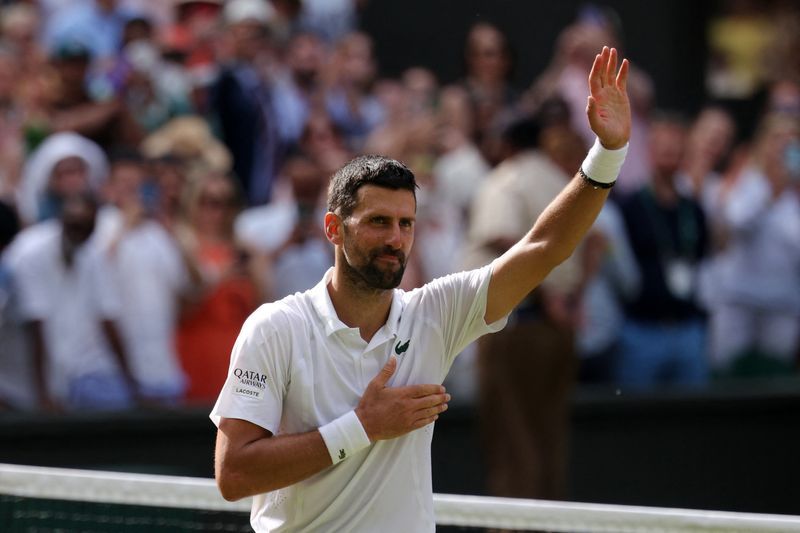
The quarter-final stage at Wimbledon opens on Tuesday with several compelling storylines, headlined by 39-year-old Novak Djokovic's quest for a record 25th Grand Slam title and a resurgent Naomi Osaka facing Karolina Muchova. The championship has already produced its share of memorable moments, with defending champion Jannik Sinner navigating the early rounds and several long-established records being set even as new ones emerge.
Djokovic arrives at the quarter-finals carrying the weight of accomplishment and ambition in equal measure. His progress through the tournament has been methodical but labour-intensive, typified by a gruelling 3.5-hour battle against qualifier Roman Safiullin in the previous round. That victory extended his remarkable record at the All England Club to 106 wins—more than any other male player in the tournament's history. Yet the Serbian champion remains acutely aware that reaching the semi-final is far from assured. He faces third-seeded Canadian Felix Auger-Aliassime, a 25-year-old who presents genuine tactical challenges despite the significant disparity in their career achievements.
The demands of advancing at this stage are evident in how Djokovic has described his recent matches. After beating Safiullin, he spoke candidly about embracing the grind inherent in tournament tennis, acknowledging that while he does not seek out extended battles, his ability to persist through adversity remains his most reliable weapon. His recent form has required multiple sets to overcome opponents, suggesting that maintaining the physical intensity required at age 39 is becoming increasingly demanding. Auger-Aliassime, who has faced Djokovic twice previously in 2022 with each player claiming a victory, views the matchup with a mixture of reverence and determination. The Canadian has reflected openly on the scale of Djokovic's accomplishments, suggesting that understanding the magnitude of his opponent's legacy has sharpened his focus.
On the women's side, Osaka has captured considerable attention with her unexpected emergence as a title contender. The Japanese player, seeded 14th, recorded a commanding victory over world number one Aryna Sabalenka in the round of 16—a performance that suggested the technical excellence that earned her four Grand Slam titles remains intact despite her time away from the sport. Osaka has been equally memorable for her bold fashion choices at Wimbledon, generating buzz that extends beyond conventional sports coverage. Her victory over Sabalenka, whom she had lost to in three meetings earlier this year, represented a significant statement of intent. The 28-year-old's last Grand Slam triumph came in 2021, making any deep run this fortnight particularly significant for her career trajectory.
Osaka's approach to her victory over Sabalenka demonstrated the mental resilience that characterized her earlier championship runs. Rather than burdening herself with the gravity of facing the world's top-ranked player, she reframed the encounter as a high-pressure practice match, a psychological device that allowed her to execute her game plan without excessive tension. Her dominance with the serve and the potency of her forehands neutralized Sabalenka's attacking capabilities, suggesting that the mental lapses that have occasionally derailed Osaka in recent seasons may have been addressed. This will be her first appearance in a Wimbledon quarter-final, a milestone that carries additional meaning given her intermittent participation in recent years.
Muchova, her quarter-final opponent, represents a formidable hurdle despite not yet advancing beyond the quarter-final stage in any of her three previous Wimbledon appearances. The Czech 10th seed defeated four-time Grand Slam champion Barbora Krejcikova in the previous round, demonstrating her capacity to overcome accomplished opponents on grass. Crucially, Muchova and Osaka have an even recent record, with each winning three of their past six encounters, though Muchova holds a slight grass-court advantage from their Bad Homburg Open meeting last month. Muchova's strategic decision to compete in two preparatory tournaments before arriving at Wimbledon has yielded dividends, providing her with crucial match practice on the surface.
The men's tournament continues to feature Jannik Sinner, the defending champion and world number one, who confronts German qualifier Jan-Lennard Struff. Sinner's path to the quarter-finals included a notably emotional moment when his opponent Hubert Hurkacz retired owing to a hip injury while trailing in the fifth set. The Italian four-time Grand Slam winner has acknowledged that the intensity and tension increase markedly at the quarter-final stage of major championships. Despite his status as defending champion, Sinner approaches each match with measured optimism, recognizing that previous results hold limited predictive value. He enjoys a perfect record against Struff across their three previous meetings, though the German's breakthrough to a Grand Slam quarter-final—achieved at age 36, the oldest first-time quarter-finalist in the Open Era—carries its own momentum.
Struff's achievement deserves particular emphasis within the broader context of professional tennis longevity. In an era dominated by players in their twenties and early thirties, the German's maiden Grand Slam quarter-final appearance at 36 represents an exceptional accomplishment and signals both his improved form and the narrowing of the competitive gap even among the sport's elite. His journey to the quarter-finals came unexpectedly, as Hurkacz's injury retirement meant Struff advanced without a final-set contest. Nonetheless, his presence in the last eight demands respect, and he has expressed satisfaction with his achievement while acknowledging the recovery work required before his quarter-final contest.
The quarter-final pairings also feature Jessica Pegula of the United States against fellow American Coco Gauff, both seeded among the top contenders. Their meeting between fourth and seventh seeds represents an all-American clash that underscores American tennis' continued competitive strength at major tournaments. Both players have previously reached Grand Slam quarter-finals, and their encounter will likely determine which American advances to the semi-finals.
Tuesday's schedule distributes the most prominent matches across Centre Court and Court One, with play commencing at noon GMT on Centre Court and 10 a.m. GMT on Court One. The staging of these contests reflects the tournament's assessment of their significance and public interest. Djokovic and Auger-Aliassime's clash, featuring a 14-year age gap and generational contrast in playing styles, promises intriguing tactical dimensions. The encounter between Osaka and Muchova will test whether the Japanese player's recent form represents genuine resurgence or a temporary flourish. For Sinner and Struff, their meeting carries different meanings—consolidation of the favourite's status and continuation of an unlikely run for the veteran German.
The quarter-final draw has produced compelling narrative threads that extend beyond conventional match-ups. Djokovic's pursuit of a record 25th title continues against younger opposition still building their legacies. Osaka's return to prominence at Wimbledon speaks to the resilience of established champions and the possibility of redemption through adversity. Struff's unprecedented breakthrough at 36 challenges assumptions about competitive longevity in professional tennis. These stories, combined with the performances of Sinner, Pegula, and Gauff, ensure that the quarter-finals will determine not merely the semi-finalists but also the narrative arc of this championship.

