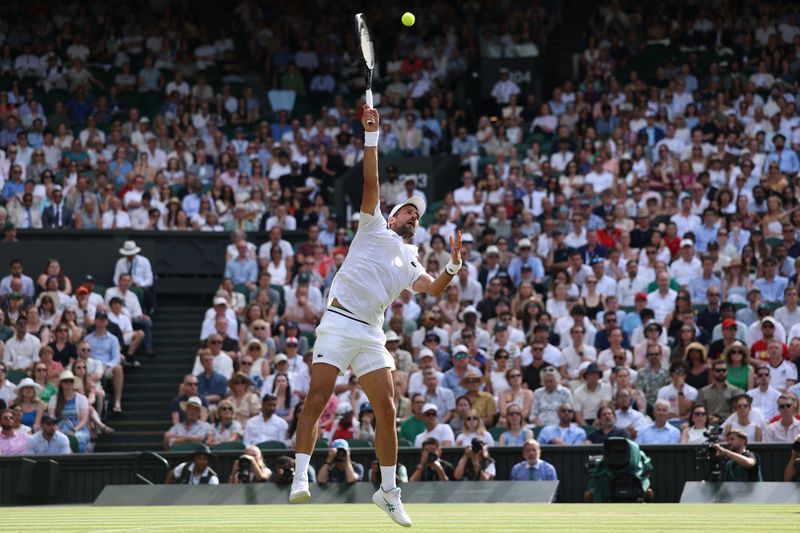
Novak Djokovic continues to reshape the landscape of tennis history, reaching the quarter-finals at Wimbledon after defeating qualifier Roman Safiullin 7-6(6) 6-3 3-6 6-3 on Centre Court. The Serbian veteran's 106th match victory at the grass court championship represents a significant milestone, moving him past Roger Federer's previous record for most match wins at the All England Club. At 39 years old, Djokovic demonstrates no signs of relinquishing his grip on the sport's most prestigious tournaments, even as he pursues increasingly rarefied historical achievements.
The path to this latest milestone proved anything but straightforward. Playing in searing heat, Djokovic encountered unexpected resistance from the Russian qualifier, who entered the match carrying momentum from his recovery following months away due to a hip injury. Safiullin, ranked 132nd in the world, refused to be overawed by his illustrious opponent, forcing the seventh seed into uncomfortable situations throughout the afternoon. The match unfolded as a contest of competing styles, with Djokovic's usual court dominance tested by Safiullin's aggressive baseline game and willingness to take risks.
The opening set encapsulated the match's overall tenor: tightly contested and requiring Djokovic to dig deep when circumstances turned precarious. Having dropped serve twice through unforced errors—a rarity for a player of his calibre—Djokovic faced set points while trailing 2-5. Rather than succumb, he orchestrated an improbable recovery, saving those opportunities before triumphing in a gruelling tiebreak that stretched to 6-4. The sequence demonstrated both his resilience and his capacity to elevate performance when stakes escalate, qualities that have sustained his career dominance across two decades.
Djokovic's second-set performance suggested he had located his rhythm and tactical approach. Breaking Safiullin's serve to establish a 4-2 advantage, the Serbian methodically extended his grip on proceedings. His serve-and-volley execution became particularly incisive during this phase, combining aggressive net play with precise placement to move within one set of victory. However, the Russian refused capitulation, breaking back and subsequently claiming the third set to force a fourth-set decider. This turn of events underscored Safiullin's competitive credentials and momentarily shifted momentum in an unexpected direction.
By the fourth set, Djokovic's superior experience and overall court mastery reasserted themselves decisively. After a tight opening hold, he elevated his intensity considerably, breaking Safiullin's serve and maintaining pressure through to the finish. His first-serve accuracy proved instrumental during this closing phase, providing the foundation for his attack and minimizing opportunities for his opponent to dictate rallies. The victory secured his progression into the quarter-finals, where he faces either third seed Felix Auger-Aliassime or Spaniard Alejandro Davidovich Fokina.
Djokovic's characterization of the encounter as a "hard-fought win" carries particular weight given the circumstances. He acknowledged Safiullin's effective early aggressive approach and credited wind conditions on Centre Court with complicating his baseline game. The Serbian seven-time Wimbledon champion noted his discomfort during extended baseline exchanges, a surprising admission from someone whose movement and positioning typically dominate such contests. His response—employing serve-and-volley tactics more liberally than usual and prioritizing first-serve effectiveness—showcased tactical flexibility and the ability to adjust mid-match when conventional approaches yield insufficient results.
The victory advances Djokovic's pursuit of multiple historic targets simultaneously. Most immediately, he stands one title away from equalling Federer's eight Wimbledon championships, a feat that would further cement his claim as the greatest grass court player of the modern era. Simultaneously, he continues his campaign toward a 25th Grand Slam title, which would provide definitive separation in the race among modern tennis's dominant figures. These twin ambitions have fuelled his motivation at Wimbledon throughout his career, and the current tournament provides another opportunity to enhance both legacies.
Djokovic's first week at the tournament has proven predictably challenging, with the seventh seed dropping sets in three of his first four matches. While such struggles might concern some, they align with his established pattern of building momentum throughout major championships. His mantra of "survive to thrive" encapsulates this philosophy perfectly—prioritizing advancement over dominant performances early, confident that physical and mental sharpness will emerge as the tournament progresses toward its conclusion.
For Malaysian and regional followers of professional tennis, Djokovic's continued excellence carries particular resonance. His sustained presence among elite competitors at an age when most players have retired provides inspiration regarding longevity and competitive drive. The philosophical approach he demonstrates—adapting tactics when necessary, remaining mentally engaged through adversity, and converting pressure situations into opportunities—offers lessons extending beyond tennis into broader competitive endeavours. As he progresses deeper into this year's Wimbledon draw, opportunities will multiply for him to add additional chapters to his extraordinary legacy while pursuing the specific milestones that remain tantalizingly within reach.

