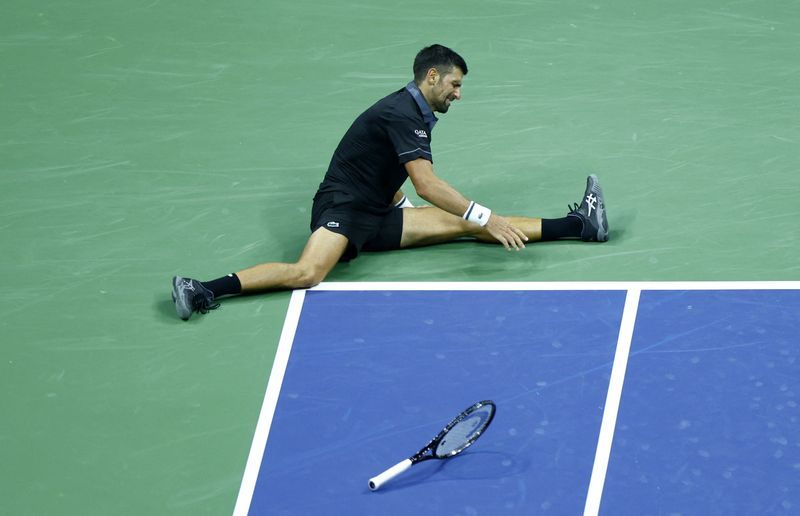
Novak Djokovic's pursuit of tennis history ended in heartbreak at the US Open when unseeded Argentine Mariano Navone orchestrated one of the tournament's most remarkable upsets, triumphing 7-6(5) 5-7 4-6 6-2 6-1 in a gruelling first-round encounter that left the 39-year-old Serbian icon emotionally devastated. The shock result represents Djokovic's earliest departure from a Grand Slam competition since 2006, when he exited the Australian Open in similar fashion—a stark reminder of how far his physical condition has deteriorated heading into what should be his prime years in the sport.
Djokovic's physical struggles became evident early and intensified throughout the four-hour-36-minute marathon, culminating in a breakdown that would have been unthinkable for a player of his stature just years ago. The four-time US Open champion vomited during the third set, a visceral manifestation of the deeper issues plaguing his body this season. Beyond the acute distress, chronic problems with his back and shoulder gradually undermined his capacity to execute the precise serving mechanics that have long defined his game, particularly as fatigue accumulated through the latter stages of the match. These cascading physical failures painted a troubling portrait of an athlete struggling against the dual enemies of age and injury.
In the post-match interview, delivered through tears, Djokovic articulated the mounting toll these physical ailments have exacted across his 2024 campaign. He acknowledged that vomiting and gastrointestinal distress have become persistent companions to nearly every match he has played this year, triggering a domino effect of muscular breakdown and cramping that undermines his entire system. The veteran competitor lamented how his body effectively "collapsed," reducing his capacity to maintain the relentless intensity that characterises his defensive style. Despite holding a break-point advantage in the fourth set, Djokovic found himself unable to capitalise, overwhelmed by pain and degradation in performance that suggested his body had reached its limit.
Navone's victory represented the crowning achievement of his career trajectory thus far, delivering a psychological jolt to the entire tennis world and fundamentally altering perceptions about which players can now compete at the sport's highest level. The Argentine world number 49, at just 25 years old, had never achieved anything remotely comparable to vanquishing the player widely regarded as the greatest of all time on one of tennis's most hallowed stages. His composed demeanour on court belied the magnitude of what he had accomplished, and in his courtside interview he struggled to articulate the weight of the moment, describing it as almost dreamlike in its unreality. The weight of the achievement only crystallised when he later reflected on his phone's incessant ringing and the presumably extraordinary reaction unfolding back home in Argentina.
The match itself unfolded with Djokovic initially asserting his customary dominance, racing to a 3-0 lead in the opening set as he appeared positioned for a routine victory. However, humidity blanketing Flushing Meadows and an environmental interruption—the stadium's roof closing against rainfall—seemed to disrupt his rhythm and provide Navone a psychological foothold. The Argentine gradually clawed back to level at 4-4, then forced a tiebreak where he held his nerve to claim the opening set, an outcome that provoked audible gasps from the crowd as the realisation dawned that something extraordinary might be unfolding.
Djokovic's response through the second and early third sets suggested he might yet reassert control, demonstrating the championship mettle that has defined his career across three decades. He claimed the second set with characteristic resilience, and despite the disturbing vomiting incident that occurred courtside during the third set, he appeared to recover sufficiently to break Navone and establish a 5-4 lead. The apparent stabilisation proved ephemeral; Navone demonstrated remarkable maturity for a player of his limited experience at the elite level, refusing to wilt under pressure and claiming the fourth set as Djokovic's serve mechanism completely abandoned him due to escalating back discomfort.
The fifth set became a formality, Navone's superior mobility and fresher legs allowing him to dictate terms while Djokovic's movement patterns became increasingly constrained. The Argentine's 6-2 run-away victory in the decider crystallised what had become inevitable—that Djokovic's body simply could not sustain the demands of Grand Slam tennis at the highest competitive level. When pressed on whether he considered retiring during the match, Djokovic insisted he harboured no such thoughts, remaining committed to completing the contest despite the mounting evidence that continuing served no strategic purpose.
Djokovic arrived at Flushing Meadows already laboring under significant doubt regarding his form and fitness. His loss to world number 96 Thiago Agustin Tirante in Cincinnati just two weeks prior had raised questions about whether the 39-year-old could still compete meaningfully at Grand Slam level, and the US Open debacle has only amplified such concerns. The timing appears particularly inauspicious given his explicit objective of capturing a record 25th major title, a milestone that seemed tantalisable mere weeks ago but now appears increasingly remote. His earliest Grand Slam exit in 18 years suggests a potentially terminal decline rather than merely a temporary setback.
For Southeast Asian tennis enthusiasts and observers, this result carries particular resonance in demonstrating the unprecedented democratisation now occurring within elite tennis. The traditional hierarchy that once guaranteed superior seeded players would prevail has fractured substantially, with emerging talents from across the globe—including lower-ranked competitors—now regularly producing performances that would have seemed impossible merely a decade ago. Navone's triumph symbolises how improved training methodologies, expanded professional opportunities, and enhanced talent development programmes across Latin America and other regions have fundamentally altered the competitive landscape that once appeared dominated by a narrow aristocracy of established champions.
The implications extend beyond mere sporting spectacle to touch upon generational transition in professional tennis. Djokovic's decline, however gradual, inevitably signals that the extraordinary era defined by his rivalry with Rafael Nadal and Roger Federer has fundamentally concluded. A new cohort of competitors—whether Navone himself or countless other emerging challengers—now occupies the space previously held by these titans of the sport. The physical vulnerabilities Djokovic displayed at Flushing Meadows underscore that excellence at this level demands not merely exceptional skill but also corporeal resilience that becomes increasingly elusive beyond a certain chronological threshold.
Looking ahead, Djokovic faces a critical juncture regarding his professional future. The pattern of mounting injuries, systemic failures, and early tournament exits suggests he must seriously contemplate whether continued participation serves any constructive purpose. His emotional response to defeat, manifest in tears at the conclusion, indicates he remains deeply invested in competitive outcomes, yet the evidence increasingly suggests his body cannot deliver the performances his competitive spirit demands. Whether he can recalibrate expectations and find renewed purpose, or whether this US Open collapse represents the beginning of a broader withdrawal from elite competition, remains to be determined in the coming months.

