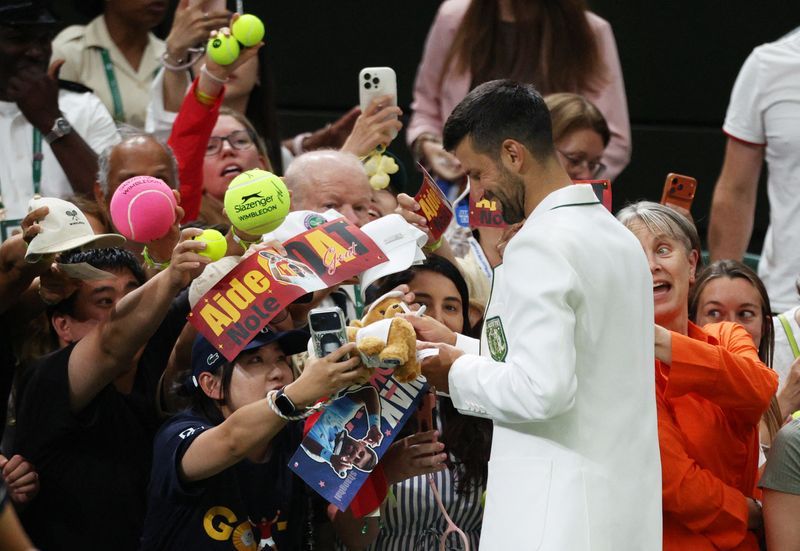
Novak Djokovic's composed demolition of Stefanos Tsitsipas at Wimbledon on Wednesday provided ample opportunity for the Serbian champion to showcase not just his dominance on court but also his relaxed demeanour. So commanding was his performance that he felt emboldened to entertain the crowd with an unexpected prank on one of the tournament's ball girls, revealing the carefree mindset that accompanies overwhelming superiority in a tennis match.
During a routine equipment adjustment midway through his rout, Djokovic called upon the ball girl to assist in removing black tape from his right shoulder using scissors. As she dutifully complied with his request, he suddenly let out an anguished cry of pain, prompting an immediate and visible panic response from his young assistant. The girl recoiled in genuine distress, clutching her chest as the realisation seemed to dawn that she may have accidentally inflicted injury upon one of the sport's greatest players in front of millions of television viewers worldwide. The moment of tension lasted only a fraction of a second before Djokovic burst into laughter, swiftly followed by the relieved and good-natured giggles of the ball girl once she recognised the entire episode as playful theatre.
Following his 6-3 6-4 6-2 demolition of Tsitsipas—a scoreline that underscores the completeness of his superiority—Djokovic addressed the incident during his on-court interview with characteristic candour. The 24-time Grand Slam champion acknowledged that such moments of levity tend to emerge when a player holds an insurmountable advantage rather than fighting desperately from behind. He expressed genuine contrition for having startled the ball girl, though he was equally keen to highlight how the lighthearted exchange had contributed to his relaxed frame of mind throughout the match. This candid reflection demonstrates how even at the highest echelons of professional tennis, humour and human connection can coexist with clinical, almost predatory, court performance.
Yet the entertainment value of Djokovic's afternoon extended well beyond his interaction with the ball girl. Seated prominently in Centre Court's prestigious Royal Box was two-time Masters champion Rory McIlroy, the accomplished Northern Irish golfer who was watching the proceedings while adorned in his green jacket—the iconic uniform of Masters Tournament champions. Djokovic, himself clad in a personalised cream blazer that has become part of his Wimbledon aesthetic this year, could not resist the temptation to engage in some cross-sport banter with the sporting elite surrounding him.
During the television interview segment, Djokovic's attention turned directly toward McIlroy, and he unleashed a volley of playful commentary directed at the golfer's prestigious garment. Addressing McIlroy by name, Djokovic commenced with admiration for the jacket itself, establishing the foundation for his subsequent cheeky proposition. He then inquired whether McIlroy's jacket was indeed the Masters Tournament trophy jacket, though his tone and demeanour suggested he already knew the answer to his rhetorical question.
With McIlroy confirming through a satisfied nod that the jacket represented his Masters victories, Djokovic escalated his jest into a formal wager. In a proposal that drew considerable amusement from the Centre Court crowd, the tennis champion offered to exchange his personalised cream blazer for McIlroy's green jacket, but with a crucial stipulation: the stakes would be determined through a tennis match rather than a golf competition. Djokovic's explicit exclusion of golf from the potential contest reflected both his confidence in his own sport and his acknowledgment of the relative futility of challenging an elite golfer on his own terrain.
Djokovic's playful tugging at his own jacket as he delivered this proposition, combined with the bemused expression on McIlroy's face, suggested genuine warmth and mutual respect between two athletes operating at the apex of their respective disciplines. The crowd's enthusiastic roaring approval demonstrated how such moments of cross-sport camaraderie resonate with spectators, transcending the technical boundaries of individual competitions. The exchange exemplified how the world's greatest athletes, regardless of their sport, share a recognisable culture of competitive spirit tempered by sporting grace.
The incident also offered insight into the mental landscape of elite performers at Wimbledon, particularly during matches where the outcome has been determined early. Rather than retreating into intense focus or calculated conservation of energy, Djokovic's behaviour illustrated how complete control of a match can enable athletes to engage in the pageantry and entertainment aspects of sport without compromising performance. His willingness to interact meaningfully with ball girls, interact with celebrities in the stands, and participate in banter with fellow champions speaks to a maturity and confidence that comes only from sustained excellence at the highest level.
For Malaysian and Southeast Asian sports enthusiasts, Djokovic's continued excellence at Wimbledon underscores the enduring competitive edge of the sport's established elites, even as new generations of players attempt to challenge the established hierarchy. His ability to dominate major championships while simultaneously engaging audiences through personality and humour contributes to tennis's broader appeal as both athletic spectacle and entertainment. The image of one of sport's most formidable competitors joking with ball girls and joshing with other champions presents a more human dimension to the rarefied world of Grand Slam tennis.

