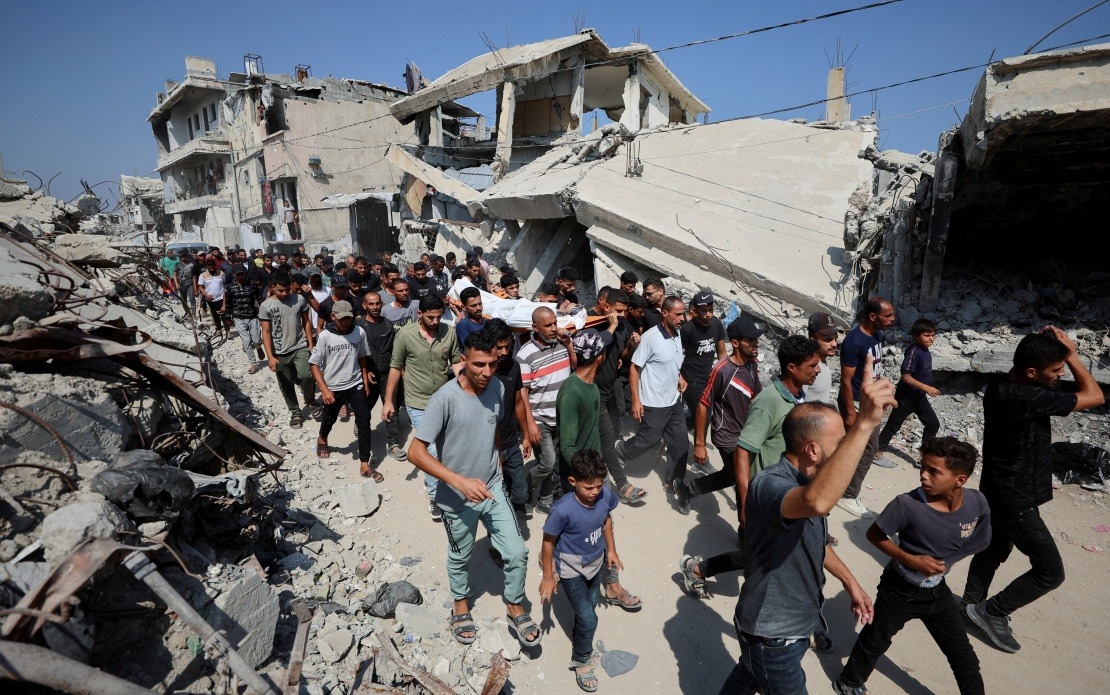
Doctors Without Borders (MSF) has delivered a scathing rebuke of the Israeli military's approach to accountability, announcing Thursday that it will not pursue criminal investigations into the killings of its personnel and their family members in the Gaza conflict. The decision by Israel's Military Advocate General to close these cases marks a significant breakdown in the international humanitarian organisation's efforts to secure justice, nearly two years after MSF initially requested formal inquiries into the incidents.
The humanitarian group's condemnation strikes at the heart of a fundamental tension in conflict zones: whether military institutions can credibly investigate themselves in cases where civilians and aid workers perish. MSF argues that self-investigation mechanisms are inherently compromised and cannot substitute for the kind of independent, transparent accountability mechanisms that international law demands. The organisation contends that such internal military reviews lack the impartiality necessary to address what it characterises as potential war crimes during the Gaza campaign that began in October 2023.
MSF has documented specific incidents that it says demonstrate a pattern requiring genuine investigation. In November 2023, an airstrike targeted an MSF convoy, resulting in the deaths of two individuals with direct ties to the organisation's operations: one was Alaa Al Shawa, who served as a volunteer supporting MSF medical teams at the Al-Shifa Hospital. Three months later, in February 2024, an attack on an MSF shelter in Khan Younis killed the wife and daughter-in-law of an MSF staff member while injuring six others, including five women or children. These incidents were not isolated occurrences but part of a broader pattern affecting the humanitarian sector.
The scale of casualties among medical personnel since the conflict's outbreak underscores the humanitarian crisis's severity. MSF reports that 15 of its own staff members have been killed by Israeli forces within Gaza's boundaries, a figure that sits within a much larger tragedy: approximately 1,700 healthcare workers have perished during the same twelve-month period. This devastation extends across multiple nations and organisations, reflecting the indiscriminate toll that modern urban conflict exacts on the infrastructure designed to preserve life.
Crucially, MSF maintains it took extensive precautions that should have prevented these deaths. The organisation states that it shared identifying information about its personnel and clearly marked all vehicles in accordance with international humanitarian law protocols. These measures, standard practice for aid organisations operating in conflict zones, should theoretically provide protection under the Geneva Conventions. The fact that MSF staff members were nonetheless killed suggests either systematic targeting or profound negligence in distinguishing between combatants and protected personnel—either scenario demands thorough external investigation.
The closure of investigations without criminal proceedings raises fundamental questions about accountability mechanisms in asymmetrical conflicts. MSF's escalation to Israel's High Court before this closure decision indicates that conventional military channels proved unresponsive to the organisation's demands for justice. The High Court's apparent inability or unwillingness to compel the Military Advocate General to initiate investigations reveals potential structural gaps in Israel's legal oversight of military operations affecting civilians.
For Southeast Asian readers, this case illustrates persistent challenges that humanitarian organisations face when operating in any conflict zone, regardless of geography or the parties involved. Malaysia and neighbouring countries host numerous NGOs and development workers whose safety depends on respect for international humanitarian law and effective accountability when violations occur. The MSF situation demonstrates that even organisations with strong international profiles and legal resources struggle to secure investigations when military institutions resist external scrutiny.
MSF's linkage of these case closures to what it describes as genocide in Gaza represents an escalation in rhetorical framing that connects accountability failures to broader allegations of systematic civilian targeting. Whether courts ultimately validate this characterisation, the organisation's assertion that "no military objective justifies the wholesale sacrifice of civilians" reflects principles enshrined in international humanitarian law that transcend any single conflict or region.
The humanitarian group's call for an independent investigative body to review these cases signals that MSF has exhausted confidence in Israel's internal mechanisms. This demand reflects a model increasingly advocated by human rights organisations globally: establishment of impartial international fact-finding missions when national systems demonstrate inadequacy. Such mechanisms face political obstacles but represent the direction international justice advocates favour for conflict-related accountability.
Gaza's Health Ministry, meanwhile, continues documenting a parallel toll: it reports 73,417 deaths since October 2023, with 174,360 injured. Over a 24-hour period referenced in reports, ten Palestinians died and 25 sustained injuries. These figures, contested by some observers but broadly aligned with international monitoring organisations, underscore the humanitarian catastrophe that investigation of individual incidents cannot fully capture. Each death of an MSF staff member represents not merely a personal tragedy but a diminution in the conflict zone's capacity for medical response.
The broader implication of MSF's stance concerns the precedent this establishes for humanitarian accountability. If military systems worldwide conclude that internal investigation suffices and external scrutiny is unnecessary, aid organisations will lack meaningful recourse when their personnel suffer casualties. This erosion of accountability mechanisms potentially makes future humanitarian work more dangerous, as perpetrators of violations anticipate minimal consequences. For Malaysia's medical and development community, particularly those with regional operations or partnerships, the MSF experience offers cautionary lessons about risk management in conflict environments.
MSF's position also highlights the tension between maintaining operational access and preserving principle. Humanitarian organisations often moderate public criticism of host governments or military actors to retain operational permission. MSF's forceful language here suggests that the organisation has concluded that continued restraint serves no protective function—that speaking publicly about accountability failures carries no greater risk than silence, and may better serve the broader cause of establishing international legal norms.

