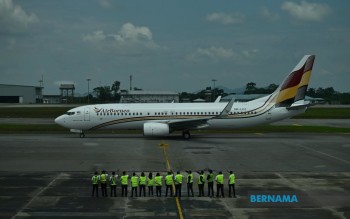
Deputy Prime Minister Datuk Seri Fadillah Yusof officially welcomed AirBorneo Airways into commercial service today when its inaugural flight touched down at Kuala Lumpur International Airport Terminal 1. Flight MY5005 from Kuching carried not only passengers but also significant political symbolism, with Premier of Sarawak Tan Sri Abang Johari Tun Openg aboard alongside state ministers and senior federal officials. The arrival represents a watershed moment for Sarawak's aviation sector and signals the federal government's backing for the state's strategic push toward greater autonomy in air connectivity.
AirBorneo, wholly owned by the Sarawak state government, has transitioned from a regional feeder service operator into a commercial jet carrier with the introduction of two leased Boeing 737-800 aircraft. This shift in operational scope reflects years of planning by state authorities determined to establish Sarawak's own flag carrier for scheduled passenger services. The timing of the Kuching–Kuala Lumpur connection, linking Sarawak's capital to Malaysia's primary aviation hub, positions the airline to capture market share on one of the country's busiest domestic routes and provides the state with direct control over a critical economic corridor.
AirBorneo chairman Datuk Amar Mohamad Abu Bakar Marzuki, who also serves as Sarawak state secretary, framed the launch as integral to the state's broader economic development strategy. He emphasized that aviation connectivity underpins Sarawak's ability to compete regionally, facilitate business investment, and integrate its economy more seamlessly with federal centres of commerce. The carrier's entry into the scheduled service market represents the culmination of an initiative aimed at reducing Sarawak's dependence on federal carriers for essential air links and strengthening the state's leverage in negotiations over aviation policy and infrastructure investment.
The commercial airline venture also carries implicit messaging about Sarawak's constitutional autonomy and resource management capabilities. By establishing its own carrier, the state demonstrates administrative capacity and financial wherewithal to operate complex infrastructure independently—a subtle assertion of state-level governance credibility that resonates within Malaysia's federal structure. The presence of federal ministers at today's ceremony, including Tourism, Arts and Culture Minister Datuk Seri Tiong King Sing and Deputy Transport Minister Datuk Hasbi Habibollah, indicates federal endorsement of this state-led initiative and reflects the collaborative approach between Putrajaya and Kuching on economic development matters.
From July 21, AirBorneo will operate twice-daily rotations on the Kuching–Kuala Lumpur sector, fundamentally altering the competitive landscape on this high-traffic route. Economy fares begin at RM375 for a one-way journey, positioning the airline competitively against established carriers while remaining above low-cost operator pricing. Business Class tickets start at RM736, targeting business travellers and premium passengers willing to support the fledgling carrier with higher yields. Pricing strategy suggests AirBorneo is aiming for a hybrid positioning—more affordable than traditional full-service carriers but premium relative to budget airlines—a model that may appeal to corporate travellers and leisure passengers seeking perceived quality above rock-bottom cost.
AirBorneo chief executive officer Megat Ardian Mohd Aminuddin positioned the launch as the beginning of a phased expansion programme rather than a final endpoint. He committed the airline to maintaining rigorous safety and service standards while building operational credibility and customer loyalty from inception. This measured messaging seeks to manage expectations around a new entrant without established reputation in commercial scheduled service, acknowledging that success will depend on consistent execution rather than promotional activity alone. The executive's emphasis on continuous enhancement suggests the airline recognizes competitive pressures from incumbent carriers with established networks and customer bases.
The Kuching–Kuala Lumpur connection serves as AirBorneo's launchpad for broader network development within Malaysia's domestic market. The airline has already signalled intentions to progressively extend its reach beyond this initial route, with multiple destinations potentially within reach of the Boeing 737-800 fleet. This incremental expansion strategy allows the carrier to build operational expertise and financial reserves before committing additional resources to further network deployment, reducing risk exposure during the critical early operational phase when reliability and cost discipline are paramount.
International expansion plans are already underway, with Singapore identified as AirBorneo's first international destination. This choice reflects strategic logic: Singapore represents the nearest major international hub, offers strong connecting market potential, and serves as a natural testing ground for cross-border operations before pursuing more distant or complex international routes. The Singapore connection would also enable AirBorneo to position itself as a genuine competitor offering regional services rather than purely domestic operations, potentially attracting transit traffic and enhancing network value for business and leisure travellers throughout Southeast Asia.
From a Malaysian aviation sector perspective, AirBorneo's entry introduces fresh competitive dynamics at a moment when regional carriers face mounting cost pressures and evolving consumer preferences. The state-owned model, with access to government support and long-term capital commitment, provides strategic advantages that private carriers may struggle to match. However, execution risks remain substantial: maintaining schedules, managing costs, competing against established carriers with superior scale, and building brand recognition all present formidable challenges for any new airline, particularly in a market dominated by entrenched players with extensive route networks and loyalty programmes.
The broader significance of this launch extends beyond commercial aviation. AirBorneo represents tangible evidence of Sarawak's capacity to initiate and execute major infrastructure projects independently, reinforcing the state's position within Malaysia's federal arrangement. For Southeast Asian observers, the carrier's development reflects wider regional trends toward state and provincial governments investing directly in aviation connectivity as a development enabler. As AirBorneo scales operations and establishes market presence, it will serve as a test case for whether state-owned carriers can compete effectively in increasingly liberalized regional aviation markets while maintaining public interest considerations.
The success or otherwise of AirBorneo's commercial venture will likely influence similar initiatives elsewhere in the region and potentially affect how Malaysian policymakers assess state-owned enterprises' appropriate roles in competitive industries. Federal support evident today, combined with strategic geographic positioning and capital investments, provides the carrier with meaningful advantages as it navigates the challenging early years of operation. Whether these advantages translate into sustainable profitability and market acceptance remains to be determined, but the inaugural flight marks an undeniably significant moment for Sarawak's economic aspirations and Malaysia's evolving aviation landscape.

