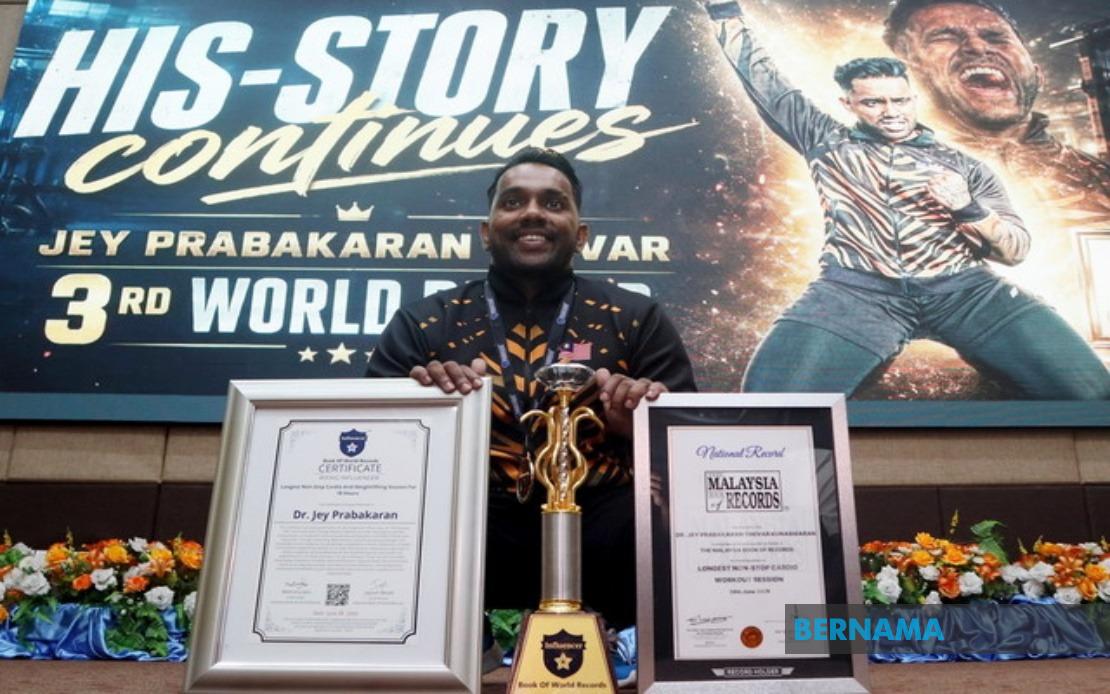
Fitness athlete K. Jey Prabakaran Thevar, widely recognised as Dr Kjey, has etched his name deeper into Malaysian sporting history by achieving his third world record. The 29-year-old successfully completed an 18-hour non-stop cardio and weightlifting challenge last Sunday, further solidifying his position as one of the nation's most dedicated athletes. The gruelling event, held at Healthland Kuala Lipis in Pahang, began at 4 am and concluded at 11 pm, with his achievement now recognised in both the Malaysia Book of Records and the Influencer Book of World Records.
Beyond the physical accomplishment, Dr Kjey chose to dedicate this record-breaking milestone to his late father, Kunasigaran Suppiya Thevar, who passed away on March 3, 1999. The personal motivation behind the achievement adds profound meaning to what might otherwise be viewed as a purely athletic endeavour. Speaking to journalists following the event, Dr Kjey reflected on growing up without paternal guidance, explaining that rather than succumbing to adversity, he channelled the loss into determination and resilience. His father's memory became a driving force that propelled him through moments of doubt during the challenging ordeal.
"Despite growing up without a father's love, the loss was a source of inspiration and strength that motivated me to continue fighting until I succeeded in bringing glory to the country on the world stage," Dr Kjey shared. This perspective reveals how personal tragedy can fuel exceptional achievement when properly directed. For Dr Kjey, each record represents not merely a personal triumph but a way of honouring his father's legacy and demonstrating that circumstances of birth need not determine one's destiny or capacity for greatness.
This latest accomplishment represents the culmination of Dr Kjey's progressive push into endurance athletics. His previous records in 2023 and 2024 showcased escalating ambition, with a 12-hour challenge initially breaking ground, followed by a 15-hour attempt. He additionally established an Asian record by completing the 13-hour variant of the same discipline. This trajectory demonstrates a systematic approach to record-breaking, each successive attempt building upon lessons learned and physical conditioning refined through previous efforts. The progression from 12 to 15 to 18 hours illustrates not reckless ambition but calculated progression within endurance sports.
Preparations for this third record began immediately after Dr Kjey completed a national record challenge in October of the previous year, held in conjunction with National Sports Day festivities. The preparation period thus spanned several months, allowing adequate time for physical and psychological conditioning. The athlete underwent substantial lifestyle modifications to optimise his performance, most notably transitioning entirely to a vegetarian diet in the lead-up to the attempt. This dietary overhaul resulted in a weight loss of 32 kilogrammes, fundamentally altering his body composition and metabolic efficiency for the challenge ahead.
The actual attempt presented multifaceted difficulties beyond the obvious physical demands of continuous exercise for 18 hours. Managing fatigue represented one challenge, but equally significant was combating drowsiness as the body naturally approached exhaustion. The human body's circadian rhythms work against such endeavours, making mental resilience as crucial as physical training. Dr Kjey's success in navigating these neurological and physiological obstacles underscores the psychological dimension of extreme endurance athletics, where mental fortitude often determines whether an athlete pushes through or succumbs to the body's calls for rest.
Beyond his individual athletic pursuits, Dr Kjey serves as president of the Malaysian India Fitness Association, positioning him to influence broader health trends within the Malaysian-Indian community. He has explicitly stated that his record-breaking achievements aim to inspire younger Malaysians to embrace healthier lifestyles and explore fitness pursuits seriously. In a nation grappling with rising obesity rates and lifestyle-related chronic diseases, athletes who demonstrate sustained commitment to physical excellence serve valuable public health functions, potentially shifting cultural attitudes toward exercise and wellbeing.
Looking forward, Dr Kjey has already mapped out his next challenge, planning a national record attempt of 5,000 jumping jacks to be completed within a five-hour window. This next milestone is scheduled to coincide with National Sports Day celebrations in October, demonstrating his strategic alignment of personal achievement with national sporting occasions. The choice of jumping jacks as the focus represents a shift in emphasis from the mixed cardio-and-weightlifting format of his previous records, potentially indicating an evolving exploration of different endurance modalities and how they test human capability.
Dr Kjey's trajectory reflects a broader narrative within Malaysian sports culture: the emergence of athletes willing to push conventional limits and establish themselves within global frameworks of achievement. Unlike traditional sports where Malaysia has established historical presence, extreme endurance athletics represents relatively newer terrain for Malaysian records. By securing recognition from both national and international record-keeping bodies, Dr Kjey contributes to elevating Malaysian sports visibility on the world stage. His achievements demonstrate that excellence and record-breaking need not be confined to team sports or established Olympic disciplines, opening pathways for other athletes to explore unconventional avenues of distinction.

