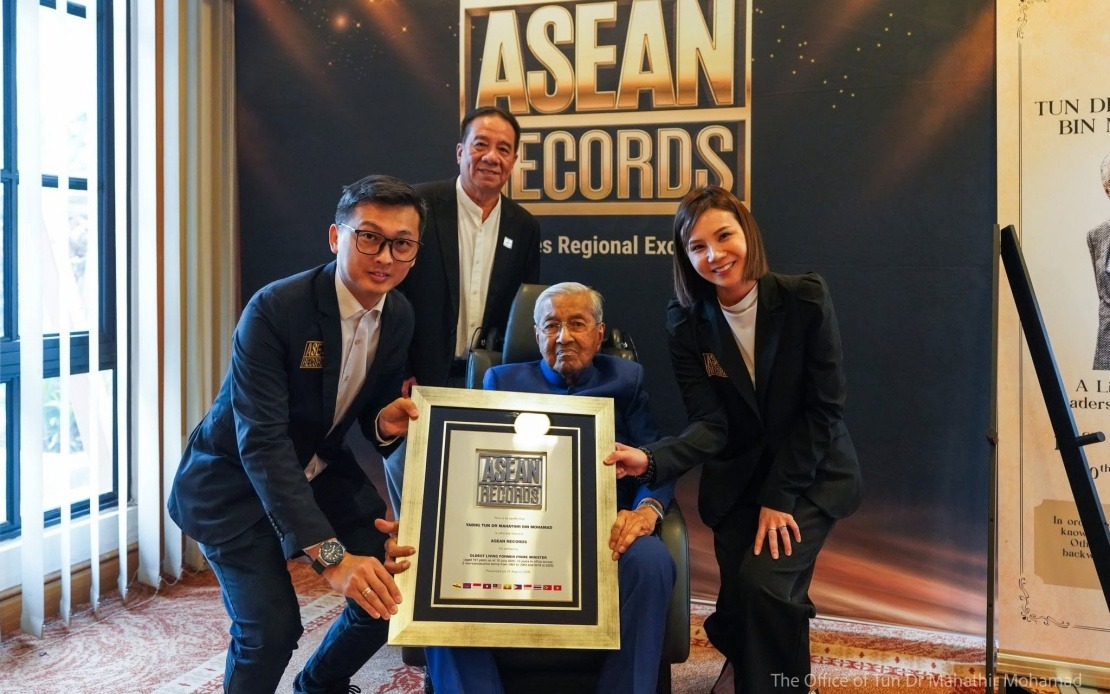
Tun Dr Mahathir Mohamad and his wife Tun Dr Siti Hasmah Mohd Ali have been formally recognised for three historic records that underscore their exceptional longevity and unique position in the region's political and social landscape. The former Prime Minister, now 101 years old, has been acknowledged by ASEAN Records as the Oldest Living Former Prime Minister, while Dr Siti Hasmah, at 100 years of age, holds the distinction of being the Oldest Living Spouse of a Former Prime Minister. Beyond these individual recognitions, the couple jointly received a third honour from ASIA Records as the First Former Head of Government and Spouse to Both Become Living Centenarians, a milestone that underscores their shared journey through a century of Malaysian history.
The presentation of these certificates took place during a formal ceremony at the Perdana Leadership Foundation in Kuala Lumpur, marking an appropriate venue given Dr Mahathir's towering legacy in the nation's leadership. The recognition came at a particularly significant moment, as the couple had recently celebrated a succession of personal milestones that themselves deserve attention. Dr Mahathir marked his 101st birthday on July 10, followed just two days later by Dr Siti Hasmah's entry into her second century of life on July 12. The celebrations did not end there; on August 5, the pair observed their 70th wedding anniversary, demonstrating a sustained partnership that has spanned nearly three-quarters of a century.
The adjudication process behind these records involved rigorous verification by teams from both ASEAN Records and ASIA Records, who conducted extensive research to confirm that no comparable achievement has been publicly documented across the ASEAN region or major Asian markets. This level of scrutiny reflects the significance of the accomplishment—the confluence of factors required for both members of a couple to not only reach centenarian status but to do so while one maintains the distinction of being a former national leader is extraordinarily rare. The verification process suggests that this achievement stands alone in the contemporary experience of Southeast Asia and its broader Asian neighbours.
The certificates were presented by Tan Sri Danny Ooi, chairman of the ASEAN Records Advisory Board, alongside chief adjudicators Gillian Ooi and Eldrick Koh, who serve as directors of both ASEAN and ASIA Records. The involvement of such official channels and independent verification bodies lends substantial weight to the recognitions, distinguishing them from informal acknowledgments. Dr Mahathir subsequently shared news of the achievement through a Facebook post, using the platform to inform his supporters and the broader Malaysian public of this notable moment for his family.
For Malaysian observers, the records hold particular resonance given Dr Mahathir's outsized influence on the nation's development trajectory. His tenure as Prime Minister, spanning two distinct periods, fundamentally shaped Malaysia's economic policies, infrastructure development, and regional standing. That he and his wife have both achieved centenarian status represents not merely a personal victory against the passage of time but a cultural and historical marker for a generation of Malaysians who witnessed the country's transformation through the latter half of the twentieth century.
The achievement also speaks to advances in healthcare, nutrition, and living standards in Malaysia over recent decades. The fact that both members of this prominent couple have enjoyed robust health into their second century suggests the benefits of improved medical care, better awareness of wellness practices, and the advantages of privilege and access to quality services. However, it also serves as an interesting counterpoint to broader health discussions in the region, where disparities in life expectancy persist across different socioeconomic groups.
From a Southeast Asian perspective, this achievement distinguishes Malaysia as home to a remarkable living example of longevity paired with political prominence. While other nations in the region have experienced leaders living into advanced age, the combination of both a former head of government and his spouse reaching centenarian status simultaneously remains uniquely notable. This positions Malaysia and its institutions, including the Perdana Leadership Foundation, as custodians of an important record in the region's collective history.
The 70-year marriage itself merits consideration as part of this broader narrative. In an era where marriage longevity is increasingly variable, a partnership sustained across seven decades, during which one partner held the highest political office in the land, represents a form of stability and commitment that resonates with traditional values while navigating the complexities of modern political life. The couple's public presence during milestones has generally been dignified and measured, reflecting a long-standing approach to their shared public profile.
Looking ahead, these records serve as a formal acknowledgment of Dr Mahathir and Dr Siti Hasmah's place in the historical record, preserved through the mechanisms of international record-keeping organisations. For younger Malaysians, the records provide a tangible connection to the nation's more recent past and the figures who shaped its trajectory. For those who lived through the periods of Dr Mahathir's leadership, the recognition offers a moment to reflect on the passage of time and the evolving nature of Malaysian society.
The recognition also comes at a time when Malaysia, like many Southeast Asian nations, grapples with questions about demographic change, ageing populations, and the role of elder citizens in society. The visibility and vitality of a former Prime Minister and his wife at this advanced stage of life contributes to broader conversations about healthy ageing and the potential for continued engagement and contribution beyond traditional retirement.
Ultimately, the three records held by Dr Mahathir and Dr Siti Hasmah represent more than statistical achievements—they embody a chapter of Malaysian and Southeast Asian history, marked by personal resilience, institutional memory, and the enduring bonds of partnership. As the nation continues to evolve, these recognitions ensure that this centenarian couple remains formally acknowledged as significant figures not merely in political terms, but in the broader human experience of longevity and shared purpose.

