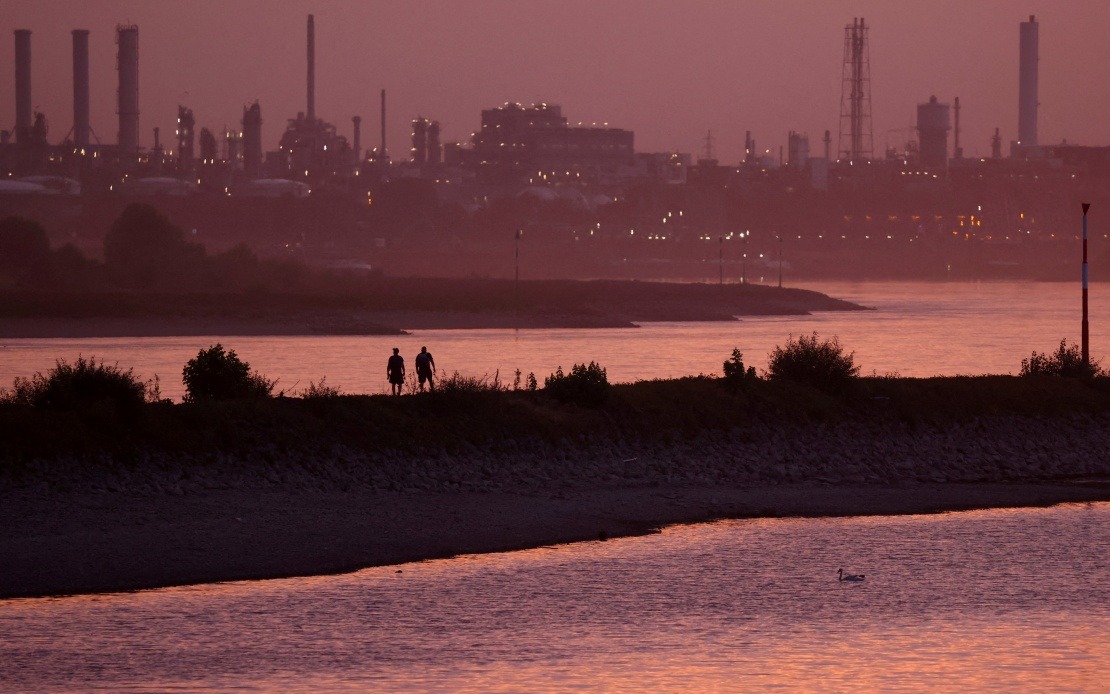
German explosives specialists mobilised this week to neutralise a half-tonne American aerial bomb that materialised along the Rhine riverbank near Cologne, exposed by water levels that have dwindled to their lowest point in recent memory. The discovery underscores how prolonged heat and drought conditions across Central Europe are literally uncovering the physical remnants of World War II, transforming environmental stress into security operations that disrupt civilian life and commerce across one of the continent's most vital transport arteries.
The 500-kilogramme ordnance was identified on Wednesday evening adjacent to Rheinpark, a recreational zone in the city, prompting authorities to activate evacuation protocols affecting approximately 360 individuals within a 400-metre safety perimeter. The affected population encompasses residents of an elderly care facility as well as personnel stationed at nearby broadcasting facilities operated by RTL television. Officials declined to disclose the specific timing of the defusing procedure, leaving uncertainty hanging over the operation's duration and the period during which displacement would remain necessary.
The Rhine's water gauge plummeted to 67 centimetres on Thursday, matching a historic minimum achieved only days prior, with forecasters anticipating it would sink further to 66 centimetres as the day progressed. This represents an extraordinarily constrained operational baseline for a waterway that historically carries immense volumes of containerised cargo, petroleum, and industrial materials northward toward the Netherlands and beyond. The convergence of heat stress and inadequate precipitation has created conditions reminiscent of severe droughts witnessed in 2018, when similar low-water episodes necessitated substantial logistical adaptations across the Rhine basin's shipping network.
The shallow water situation has precipitated cascading complications for commercial navigation throughout western Germany. Barge operators have responded by dramatically reducing payload capacities, loading vessels to perhaps 40 or 50 percent of their standard tonnage to maintain safe passage. This constraint reverberates through supply chains spanning automotive manufacturing, petrochemicals, fertiliser distribution, and coal transport—sectors where Rhine-based logistics represent critical cost factors. The resulting inefficiency translates to increased transportation expenses that ultimately filter through to consumers and industrial customers across Europe and Southeast Asia, where goods manufactured with Rhine-transported raw materials eventually reach markets.
What renders the WWII bomb discovery particularly significant is how it exemplifies the broader environmental reckoning unfolding across Europe. The Rhine, shared between multiple nations including Switzerland, Germany, France, and the Netherlands, functions as a shared resource where unilateral climate stress produces transnational consequences. Droughts that expose century-old ordnance in Germany simultaneously constrain electricity generation in France, where nuclear power plants struggle with insufficient cooling water, creating energy deficits that ripple across interconnected European grids and eventually affect manufacturing competitiveness globally.
The excavation of buried wartime munitions has become an almost routine occurrence as climate volatility intensifies hydrological disruptions. Similar discoveries have materialised throughout German territories following previous drought episodes, suggesting that Europe's riverine ecosystems function somewhat as archaeological repositories for twentieth-century conflict, gradually releasing their contents as water tables fluctuate. Explosives authorities in Germany have developed established protocols for such circumstances, yet each incident demands localised coordination, evacuation logistics, and periods of transportation disruption that accumulate into measurable economic impacts.
Water levels are anticipated to rise marginally in subsequent days, though meteorological forecasting indicates no sustained amelioration approaching the hydrological baseline necessary for unimpeded navigation. This forecast of persistent constraint implies that shipping operators must budget for extended periods of reduced-capacity operations. Insurance costs escalate, delivery schedules lengthen, and the competitive economics of water-based transport relative to rail or road alternatives shift disadvantageously. For Southeast Asian exporters whose products transit Hamburg and other Rhine-dependent ports, such disruptions translate to delivery delays affecting just-in-time manufacturing systems increasingly prevalent across Malaysian automotive and electronics sectors.
The defusing operation itself exemplifies Cold War legacies that continue demanding active technical intervention decades after conflict's conclusion. Unexploded ordnance remains distributed across landscapes where intensive bombardment occurred, and systematic clearance remains incomplete. Environmental shifts that expose these devices force societies to confront historical unfinished business whilst simultaneously managing contemporary logistical disruptions. The resources devoted to bomb disposal—specialised personnel, evacuation coordination, traffic management—represent carrying costs imposed by history upon present-day economic activity.
For Malaysia and broader Southeast Asia, the Rhine episode carries implications extending beyond immediate European concerns. Climate-driven water stress that impedes river transport in Europe parallels similar vulnerabilities affecting Southeast Asian waterways including the Mekong and Irawaddy rivers. As global supply chains have become increasingly geographically distributed, disruptions affecting transportation nodes anywhere across interconnected networks eventually reverberate into Malaysian manufacturing hubs and export sectors. Furthermore, the environmental conditions driving European drought—intensified heat and precipitation volatility—reflect the same atmospheric disruptions beginning to manifest more acutely across Southeast Asia, suggesting that similar logistical challenges may materialise regionally within coming years as climate patterns continue shifting.

