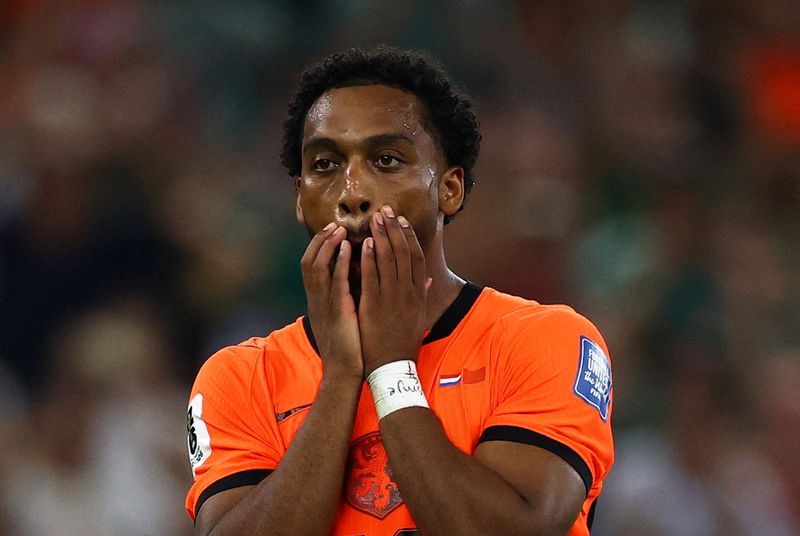
The Royal Netherlands Football Association (KNVB) has moved swiftly to address a wave of online racial abuse targeting three of its national team players following their penalty shootout defeat to Morocco in the 2022 FIFA World Cup last-16 match. Justin Kluivert, Quinten Timber, and Crysencio Summerville each failed to score during the fateful spot-kick sequence in Monterrey, which saw the Netherlands lose 3-2 on penalties after their regulation match finished 1-1 following extra time. The trio became the focal point of discriminatory and hateful commentary across social media platforms in the days immediately following their elimination from the tournament.
The KNVB's decision to escalate the matter to formal legal channels reflects growing institutional awareness of how social media platforms have become vectors for coordinated hate campaigns against athletes, particularly those from minority backgrounds. The federation filed a complaint with Meld Online Discriminatie, a Dutch platform dedicated to reporting digital discrimination, which undertakes formal assessment of whether offensive content meets the threshold for criminal prosecution. Should the legal team determine that violations have occurred, the matter proceeds to the Public Prosecution Service, potentially triggering formal criminal investigations into the perpetrators.
This incident represents a troubling pattern in international football where players become lightning rods for abuse following high-stakes failures on the pitch. The parallel with England's experience at the Euro 2020 final—held in 2021—is instructive for understanding how deeply entrenched this problem has become in professional sport. When Marcus Rashford, Bukayo Saka, and Jadon Sancho missed penalties during England's loss to Italy, the resulting online assault prompted widespread police intervention across Britain, culminating in multiple arrests and convictions.
The English case established important precedent for how authorities might respond to such abuse. Two individuals received custodial sentences while another faced a suspended prison term, demonstrating that judicial systems increasingly view social media hate speech as conduct serious enough to warrant criminal penalties. The British police operation in the aftermath of the Euro 2020 final represented an extensive crackdown spanning several weeks, involving multiple arrests as part of what authorities characterized as a comprehensive effort to confront online extremism targeting athletes.
The KNVB's public statement accompanying its legal filing carries symbolic weight beyond the immediate procedural response. The federation's assertion that discrimination fundamentally contradicts football's unifying mission speaks to how governing bodies are attempting to recalibrate institutional values in the face of a sport increasingly fractured by social divisions. Football's historical role as a vehicle for bringing together diverse communities now stands in tension with the toxic dynamics enabled by digital platforms, where anonymity facilitates the expression of prejudice that participants might suppress in physical spaces.
For Malaysian and Southeast Asian observers, these developments underscore how global sports controversies increasingly intersect with broader questions about digital governance and the responsibility of social media companies. The region's own football communities have witnessed similar phenomena, with players and officials subjected to coordinated online harassment. The Dutch and English responses illustrate that formal legal mechanisms, while imperfect, represent one avenue for countries seeking to protect their athletes from systematic abuse.
The timing and scale of such incidents following major tournaments also reveals how sporting disappointment can catalyze latent prejudices. The pressure-cooker environment of World Cup penalties—where entire national competitions hinge on individual performance—transforms personal failure into a vessel into which broader social anxieties and hatreds can be poured. Players who miss crucial kicks become, in effect, convenient targets onto which complex social frustrations can be displaced and expressed through the relative anonymity of social media.
The KNVB's invocation of Meld Online Discriminatie demonstrates increasing coordination among European law enforcement and civil society organizations to create reporting infrastructure capable of translating online abuse into real-world consequences. This approach differs markedly from earlier eras when social media platforms functioned with minimal oversight regarding hate speech, and individuals could operate with near-total impunity. The evolution toward prosecutorial involvement represents a significant shift in how societies are grappling with the challenges posed by digital communication technologies.
Looking forward, the case of the Dutch players may influence how other football federations across Southeast Asia and globally approach similar situations. As digital literacy increases and social media penetration deepens, the capacity for coordinated harassment campaigns will likely expand. The question facing sporting institutions is whether legal remedies can operate at sufficient speed and scale to deter would-be abusers, or whether supplementary interventions—including platform accountability measures and educational initiatives—must accompany formal prosecution efforts.
The KNVB's determination to pursue this matter through formal legal channels sends a message that football institutions will no longer treat online racism as an inevitable cost of participation in the sport. Implicitly, it challenges other governing bodies to adopt similarly robust positions. For players across Europe, Asia, and beyond, such institutional backing may provide some measure of reassurance that their dignity will not be treated as expendable collateral in the aftermath of sporting defeats.

