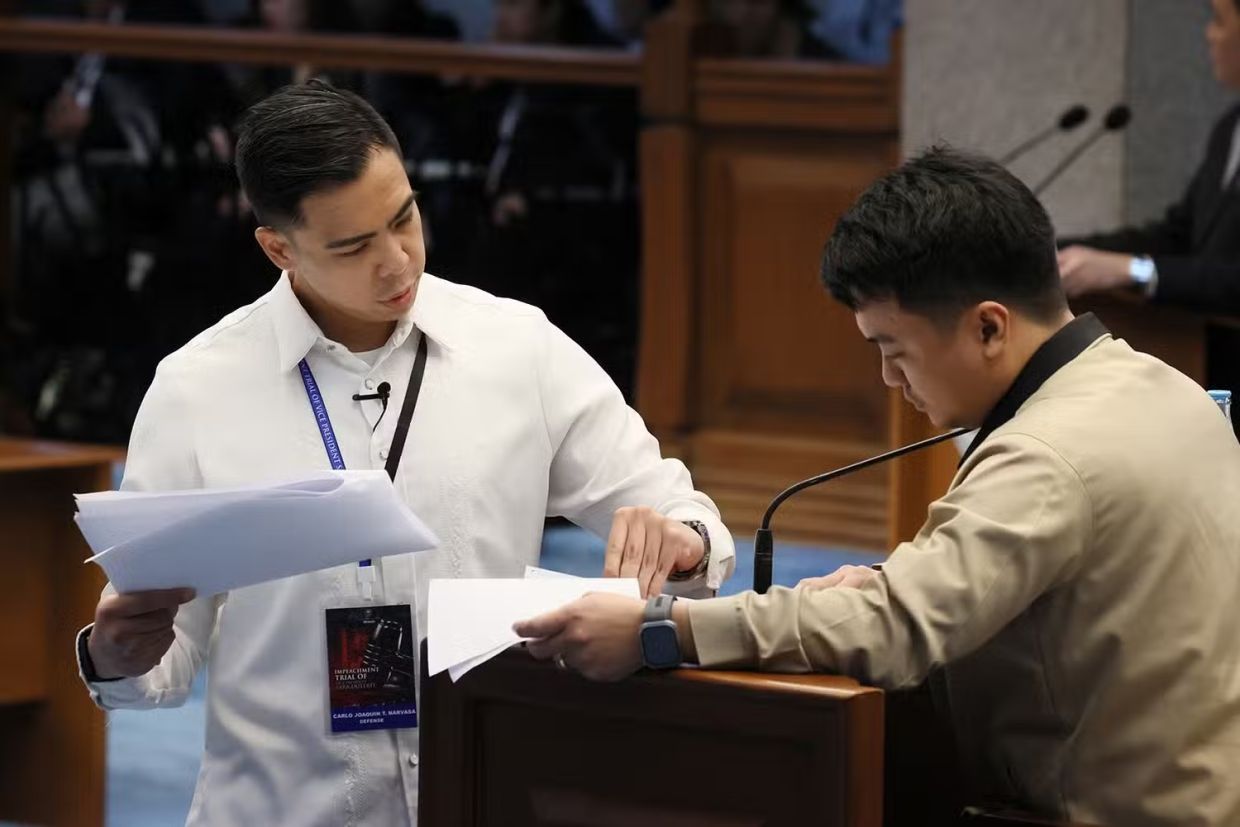
The impeachment trial of Philippine Vice President Sara Duterte took a significant turn on Wednesday as her legal team systematically dismantled the prosecution's central allegations, arguing that her disputed statements from late 2024 fall short of the constitutional threshold required to remove a sitting vice president. The defence focused its attack on both the substance of the charges and the procedural gaps in the investigation, presenting an argument that hinges on reframing Duterte's words within the context of alleged harassment rather than criminal intent to hire an assassin.
At the core of the defence strategy lies a technical constitutional argument: that the remarks attributed to Duterte do not qualify as "other high crimes" under Article XI, Section 2 of the 1987 Constitution. This provision lists specific grounds for impeachment, including culpable violation of the Constitution, treason, bribery, graft and corruption, and betrayal of public trust. Defence counsel Mark Vinluan contended that the prosecution has fundamentally failed to establish a chain of evidence connecting Duterte to an actual assassination plot, instead pointing to an isolated video statement without corroborating proof of criminal conspiracy. This distinction between uttering threats and demonstrating intent to contract an assassin became the crux of the trial's third day, with the defence effectively challenging whether words alone, however provocative, meet the legal standard for impeachable conduct.
The defence team's cross-examination of National Bureau of Investigation senior agent John Mark Calilung exposed critical evidentiary weaknesses in the prosecution's case. Calilung was forced to acknowledge that neither President Ferdinand Marcos, First Lady Liza Araneta-Marcos, nor former Speaker Martin Romualdez had personally filed criminal complaints or appeared before the bureau to provide sworn statements. This admission undermined the prosecution's narrative that the alleged victims took the threats seriously enough to initiate formal legal proceedings. The NBI conducted its investigation motu proprio, meaning without a formal complainant driving the inquiry, a procedural irregularity that the defence leveraged to question the legitimacy of the entire investigation. Furthermore, Calilung conceded that the bureau's revised affidavit contained no statements from the alleged victims or even from journalists who attended the November 23, 2024 press briefing, creating what the defence characterized as insurmountable gaps in substantive evidence.
A pivotal moment came when the defence highlighted an exchange from the previous day's proceedings in which prosecution counsel Amando Ligutan admitted that the video recordings did not conclusively prove Duterte had hired an assassin. While Ligutan argued the statements formed part of a series demonstrating intent, he essentially conceded that the prosecution lacked direct evidence of the foundational crime—contracting a hitman. This admission allowed the defence to frame the entire case as circumstantial and speculative, relying on inference rather than documented facts. The prosecution's inability to produce hard evidence of an assassination plot weakened their position significantly, forcing them to rely on interpretative arguments about Duterte's state of mind rather than objective documentation of criminal activity.
The defence strategy evolved beyond mere technical objections into a narrative reframing of Duterte's statements. Vinluan presented the vice president not as a high official abusing her power but as a woman reacting to perceived threats against her family and associates. According to the defence, Duterte was operating under the belief that "Operation Romanov" was active—an alleged unauthorised intelligence operation targeting her household. This framing invited the court to consider whether a person facing genuine security threats might respond unconventionally, even imprudently, yet not necessarily criminally. The defence argued that Duterte's homes in both Davao and Manila had been profiled, her security personnel reassigned, and her family subjected to intense surveillance, creating a climate of fear that justified, in their view, her forceful response. This recontextualization transformed the trial from a case about threatening a president into one about government overreach and the defensive reactions it provoked.
The role of Zuleika Lopez, Duterte's chief of staff, featured prominently in the defence's narrative. The defence presented video evidence showing Lopez breaking down during a House committee hearing when informed of her planned transfer to the Correctional Institution for Women in Mandaluyong City. By linking Duterte's statements directly to this moment of distress affecting someone she trusted, the defence argued that the vice president's subsequent remarks were triggered by immediate circumstances rather than premeditated intent to conspire in assassination. This connection served to humanise Duterte's response and place it within the framework of a person defending her staff and family from what she perceived as systematic oppression by the House of Representatives.
The defence team also highlighted what they characterised as systematic harassment dating back beyond the immediate impeachment proceedings. Defence lawyer Carlo Narvasa pointed to the House committee chaired by Representative Joel Chua—now one of the prosecutors—as having subjected Duterte and her associates to what amounted to coordinated persecution. According to Narvasa, Lopez had been cited in contempt despite her cooperation, and her lawyer was prevented from accompanying her during her transfer, further illustrating the adversarial environment in which Duterte operated. This broader contextualisation suggested that the impeachment case represented a continuation of political antagonism rather than a genuine effort to hold a vice president accountable for high crimes. For Malaysian observers, this aspect of the trial resonates with concerns about the weaponisation of constitutional mechanisms in Southeast Asian democracies where impeachment procedures can become instruments of political rivalry.
Senator Risa Hontiveros' line of questioning revealed the tension at the heart of the case. When she asked whether grave threats could be justified if legitimate reasons existed, the defence carefully distinguished between explaining conduct and excusing it. This proved strategically important because it allowed the defence to argue context without appearing to endorse threatening language. However, the presiding officer, Senator Francis Escudero, later intervened to restrict further questioning along these lines, noting that such matters properly belonged to closing arguments rather than examination of witnesses. His ruling suggested that the impeachment court recognised the trial was approaching its pivotal question: whether Duterte's actions, in context or not, met the constitutional standard for removal.
The procedural criticisms advanced by the defence also merit attention. The defence noted that the NBI's revised affidavit contained no statements from either the alleged victims or from independent witnesses such as the journalists present at the press briefing. This absence of corroborating testimony from neutral parties weakened the prosecution's ability to establish the objective impact of Duterte's words. When Narvasa pointedly asked whether the NBI had truly investigated the case, the prosecution's objection prevented Calilung from answering, but the question hung over the proceedings, inviting scepticism about the investigation's thoroughness. Instead, Calilung testified that the bureau had merely executed an affidavit attesting to minutes of investigators' interviews and secured Department of Justice certification of sufficiency, a bureaucratic compliance that fell short of the rigorous documentation one might expect in a case of such gravity.
For regional observers watching this trial, the proceedings illuminate deeper questions about constitutional governance in Southeast Asia. The Philippines' impeachment mechanism was designed to check executive power, yet the Duterte case raises questions about whether it can be deployed against a sitting vice president for statements, however intemperate, made during a period of perceived political conflict. Malaysia's own constitutional framework includes impeachment provisions for state rulers and federal officials, yet Malaysian jurisprudence has similarly grappled with distinguishing between political disagreement and impeachable conduct. The Duterte trial suggests that the threshold for "high crimes" in Commonwealth-influenced constitutions sets a deliberately high bar, requiring concrete evidence of constitutional violations rather than inference from rhetorical excess.
The defence's closing argument will ultimately rest on this structural vulnerability in the prosecution's case: the absence of direct evidence that Duterte actually contracted an assassin. Without proof of the underlying conspiracy, the prosecution must argue that her words alone—divorced from demonstrable intent and action—constitute impeachable conduct. This represents a novel and troubling expansion of impeachment doctrine, at least in the Philippine context. If the Senate were to convict on such evidence, it would establish a precedent whereby a vice president could be removed based on inferred intent derived from angry or threatening speech uttered during a period of political tension. Such a standard would have implications for executive immunity and the bounds of protected political speech throughout the region, making the outcome of this trial significant beyond Manila's political circles.

