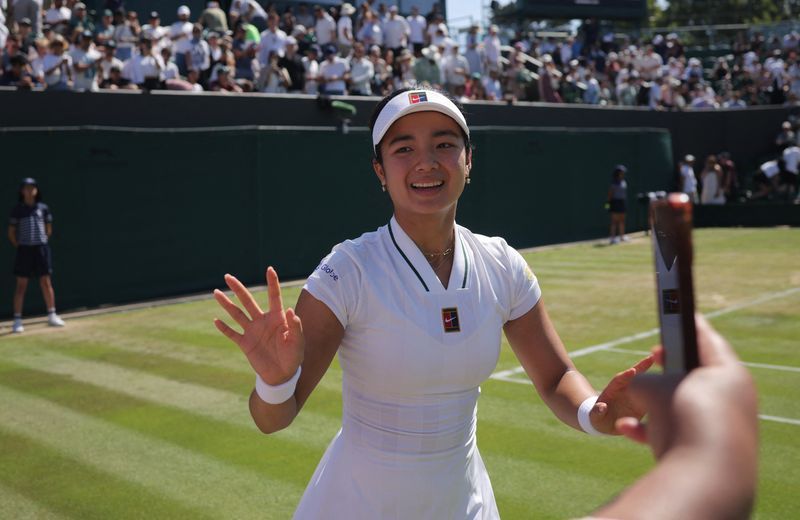
Alexandra Eala has shattered a barrier for Philippine tennis, becoming the first player from her nation to advance to the third round of a Grand Slam tournament. The 21-year-old from Quezon City accomplished the feat at Wimbledon on Thursday, storming back against Australia's Maya Joint to secure a commanding 3-6 6-2 6-0 victory. The achievement represents a watershed moment for a tennis programme that has struggled to gain consistent representation at the sport's most prestigious events, marking tangible progress in the country's competitive standing in global tennis.
Eala's comeback performance showcased the resilience that has defined her rapid rise through professional ranks. After losing the opening set to Joint, who had previously eliminated Serena Williams in the first round, the 29th seed demonstrated composure and tactical acuity to dominate the remaining two sets. The recovery proved particularly impressive given the pressure of the occasion and the psychological hurdle of chasing history. Her ability to settle into the match after a sluggish start suggests a mental toughness that may serve her well as she confronts increasingly formidable opponents in this tournament and beyond.
The road ahead presents a formidable challenge that would daunt many emerging players. Eala will face Poland's Iga Swiatek, the defending Wimbledon champion and a six-time Grand Slam title holder, in the third round on Saturday. However, the Filipino's recent performances and confidence suggest she approaches the encounter without excessive trepidation. Speaking to reporters immediately after her victory, Eala acknowledged the difficulty ahead whilst projecting quiet determination. "I think it's going to be tough for me. I'm going to try to make it tough for her, as well," she remarked, displaying the balanced perspective of someone who understands the gap in experience yet refuses to be intimidated by reputation.
Eala's rapid ascent through the professional rankings has been underpinned by her comfort on grass surfaces, a finding that carries strategic significance for her career development. Just last month, she captured the title in Birmingham, followed by a semi-final appearance in Berlin, results that validated her grass-court credentials ahead of Wimbledon. This seasonal success pattern suggests she may have identified a surface where her technical style and physical attributes yield optimal results—a crucial insight for any rising professional player seeking to establish a competitive niche.
The significance of Eala's achievement extends beyond mere statistics or rankings. For Philippine sports, a nation with limited representation at elite international competitions, her breakthrough carries profound symbolic weight. Tennis has historically occupied a marginal position in Philippine sporting consciousness, overshadowed by basketball and boxing, making Eala's emergence particularly notable for potential to elevate the sport's profile domestically. Her historic third-round qualification may inspire younger Filipino players and catalyse increased investment in tennis development programmes across the archipelago.
Eala's approach to representing her heritage on tennis's grandest stage reveals a sophisticated understanding of the cultural dimensions of professional sport. Her sun visor bore a Tagalog phrase—"Kapag lumago, hindi na hihinto," which translates roughly as "once it grows, it cannot be stopped"—a personal motto that resonates both as sporting mantra and cultural statement. This deliberate incorporation of Filipino elements into her competition kit demonstrates how modern athletes navigate the intersection of personal identity and international competition. Her sponsor Nike collaborated with her to ensure these touches were integrated authentically into her equipment, suggesting a broader commercial recognition of the market value and inspirational power of culturally grounded athletic narratives.
The visual symbolism extends to previous competitions as well. During her Wimbledon debut the previous year, Nike supplied Eala with a custom hair tie adorned with a sampaguita bloom—the national flower of the Philippines. These small but considered details reveal an athlete who refuses to compartmentalise her national identity from her professional ambitions. Rather than adopting the homogenised aesthetic that dominates professional tennis, Eala has consciously carried elements of her culture onto tennis's most traditional venue, implicitly challenging conventions that have historically marginalised non-European tennis players and their cultural expressions.
Eala articulated her philosophy regarding cultural representation with unusual eloquence for a 21-year-old athlete navigating her sixth Grand Slam tournament. "I think it's so sentimental to be able to wear things or I guess to carry parts of my culture with me on court," she explained, emphasising how her Filipino heritage shapes her identity both on and off the court. She elaborated that representing the Philippines at the world's biggest stages carries profound personal significance, transcending the typical trappings of international competition. Her willingness to publicly connect her sporting achievements to her national identity distinguishes her from athletes who treat such matters as peripheral to competitive performance.
Training at the Rafa Nadal Academy in Mallorca has provided Eala with access to world-class coaching and facilities that would be unavailable in the Philippines, a testament to the reality that elite tennis development increasingly requires geographic mobility. This expatriate arrangement, whilst enabling her to compete at the highest level, also underscores the infrastructural deficiencies that continue to constrain Philippine tennis. Eala's success, therefore, exists somewhat paradoxically—whilst representing genuine national achievement, it simultaneously highlights the necessity for Filipino players to seek development opportunities abroad, a pattern that raises uncomfortable questions about domestic investment in sports talent.
Eala demonstrated remarkable perspective when processing the historical dimensions of her achievement. Rather than treating her milestone as the culmination of ambition, she contextualised it within a larger personal journey of continuous improvement and boundary-pushing. "It sounds super impactful when you say it like that," she noted, suggesting humility about being positioned as a national symbol. She emphasised that her primary focus remains on personal goals and authentic self-expression rather than assuming the weight of being the sole representative of Philippine tennis at Wimbledon. This balanced mentality—taking pride in historical achievement whilst maintaining focus on immediate competitive challenges—may ultimately prove more valuable than any single tournament result.
Looking forward, Eala's breakthrough at Wimbledon positions Philippine tennis at an inflection point. Her continued success could genuinely catalyse broader interest and investment in the sport domestically, potentially creating pathways for younger players to develop talent within the country rather than exclusively depending on overseas academies. The Philippines, with a population exceeding 110 million, currently punches remarkably below its weight in professional tennis, suggesting substantial untapped potential should proper infrastructure and support systems develop. Eala's historic third-round qualification may prove the catalyst that shifts perceptions and priorities.
As Eala prepares to face Swiatek, Philippine sports observers will be watching with particular intensity, recognising that her tournament run represents far more than individual achievement. Every match victory extends the narrative of Philippine tennis breaking through barriers that have constrained the nation's sporting representation for decades. Whether she defeats the defending champion or falls short, Eala has already accomplished something genuinely historic—opening a door that remained closed for generations and demonstrating that Philippine tennis possesses the talent to compete at the highest levels of the sport.

