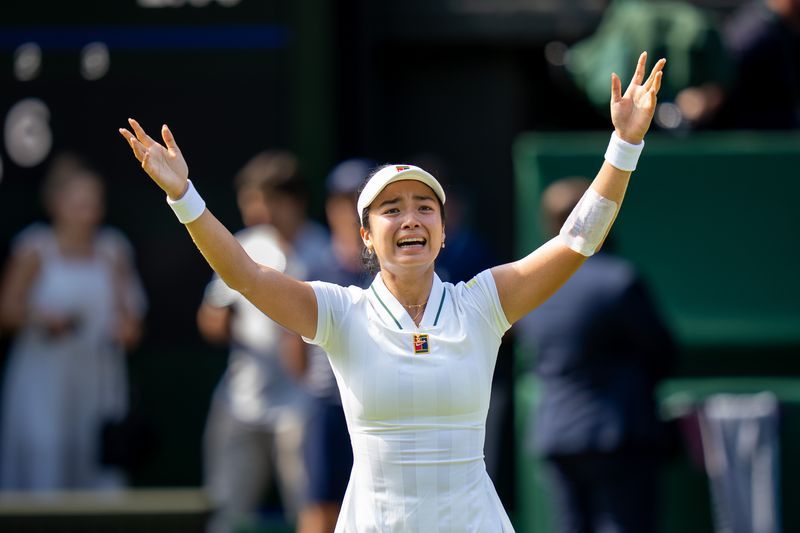
The women's draw at Wimbledon experienced seismic shifts on Saturday as two significant seeds fell victim to determined underdogs, with Philippine crowd-favourite Alexandra Eala delivering a stunning performance to dismiss defending champion Iga Swiatek 7-6(9) 6-2 in a match that showcased both technical brilliance and mental fortitude. The result marked a watershed moment for Southeast Asian tennis, propelling Eala into the fourth round of a Grand Slam and establishing her as a genuine threat on grass courts.
Swiatek's downfall came after absorbing a gruelling first-set tussle that consumed nearly 90 minutes of intense baseline exchanges. The Polish third seed found herself outmanoeuvred by an opponent displaying remarkable composure under pressure, particularly during the opening-set tiebreak where Eala's defensive prowess prevented the world number one from capitalising on a set point when her forehand sailed into the net. Rather than wilting after this reprieve, Eala seized momentum and maintained her aggressive rhythm throughout the second set, capitalising on Swiatek's inability to regain the precision that had carried her through previous rounds.
The defeat underscored broader concerns about Swiatek's current form and mental approach to competition. In her post-match comments, the Polish champion revealed a philosophical shift in how she processes tournament results, suggesting that sustained focus on outcomes had become counterproductive to her performance. Her candid acknowledgement that "I don't care anymore about the results" hinted at the psychological toll accumulating disappointments have inflicted, a factor that may have subtly influenced her inability to dictate play against an opponent executing a relentless tactical gameplan.
Simultaneously, second seed Elena Rybakina's exit at the hands of Belgian qualifier Elise Mertens represented an equally significant disruption to the tournament's expected trajectory. Rybakina, seeking to build on her Australian Open triumph earlier in the year and consolidate her path toward world number one ranking, faltered dramatically after a competitive opening set. Mertens, who has now reached the last 16 at Wimbledon for the fourth occasion, imposed suffocating defensive pressure that forced the 2022 champion into unforced errors and tactical uncertainty, ultimately prevailing 7-6(4) 6-1.
Eala's remarkable achievement carries particular resonance throughout Southeast Asia, as the 29th seed became the first player from the Philippines to advance to the fourth round of a Grand Slam championship. Her journey from humble beginnings—training daily after school with her brother and grandfather—to competing on Centre Court embodies the transformative power of sporting dedication. The motivational phrase etched on her cap in Tagalog, "once it grows, it cannot be stopped," resonates with her personal narrative while serving as an aspirational symbol for emerging tennis talent across the region seeking pathways to elite international competition.
Despite the magnitude of her achievement, Eala projected disciplined ambition rather than satisfaction, immediately refocusing toward her next challenge against 13th seed Jasmine Paolini, the 2024 Wimbledon runner-up. This steely determination suggests that Eala possesses the mental architecture required to sustain momentum through successive rounds rather than becoming overwhelmed by the historic nature of her breakthrough performance. Her refusal to be seduced by the spectacle of her own triumph indicates maturity beyond what her ranking might suggest.
The American contingent experienced mixed fortunes on the nation's Independence Day celebration, beginning inauspiciously when Serena Williams withdrew from her eagerly-anticipated doubles pairing with sister Venus due to injury. Williams had returned to Wimbledon after a four-year hiatus but encountered disappointment in singles competition at the hands of Maya Joint. Her injury withdrawal, announced via Instagram, represented another setback for two sporting legends whose appearances together had generated considerable anticipation among the sport's traditionalists.
However, American participation proved far from entirely disappointing, as 26th seed Madison Keys delivered precisely the kind of dominant performance that characterised her recent form following her title triumph at Eastbourne. Keys dismantled sixth seed Amanda Anisimova 3-6 6-2 6-3 in an all-American contest, showcasing the momentum and confidence that typically accompanies recent grass-court success. Beyond Keys' victory, qualifier Ashlyn Krueger advanced with a comprehensive 6-3 6-2 dismissal of Ukraine's Daria Snigur, though 23rd seed Emma Navarro's three-set elimination to Marta Kostyuk prevented a clean sweep of American success.
The men's draw, by contrast, maintained greater predictability as top seeds navigated their matches with measured efficiency. Alexander Zverev, recently crowned French Open champion and seeded second, dispatched American Marcos Giron 6-2 7-6(4) 6-4 while maintaining the consistency that had characterised his recent dominance. Flavio Cobolli, seeded ninth and fresh from a runner-up finish at the French Open, engineered a dramatic turnaround against Russia's Karen Khachanov after surrendering the opening set 6-0, eventually prevailing in five sets 0-6 7-6(4) 6-7(5) 6-2 6-2. This recovery demonstrated the resilience required to navigate Grand Slam competition, particularly when facing seemingly insurmountable deficits.
Italy harboured aspirations of placing four men in the last 16 of a major championship for the first time since 1947, though Lorenzo Sonego's loss to sixth seed Taylor Fritz 4-6 6-3 6-4 7-6(5) punctured those ambitions. Defending champion Jannik Sinner had already secured his progression, potentially maintaining Italian representation in the championship's later stages. Cobolli's scheduled encounter with Australian Alex de Minaur promised further competitive testing, with de Minaur having dispatched American Zachary Svajda 6-2 5-7 6-2 6-4.
Beyond the primary draws, British competitor Arthur Fery captured the day's most emotionally resonant victory, mounting an improbable comeback against Belgium's Zizou Bergs on a raucous Court 18 despite enduring three nosebleeds throughout their encounter. Fery's refusal to surrender despite trailing by two sets and facing a double break at 4-1 in the final set exemplified the theatrical drama that Wimbledon traditionally produces. His decision-set tiebreak triumph represented the longest match contested throughout the championship thus far, rewarding his mental perseverance with a narrative victory that transcended the mere accumulation of points.
The weekend's results fundamentally altered the women's championship landscape, eliminating two prominent seeds while elevating unexpected challengers toward championship-winning trajectories. Eala's advancement particularly signals the emergence of a capable Southeast Asian representative on sport's grandest stages, while Paolini's continued dominance and Mertens' upset capability suggest the women's draw remains refreshingly unpredictable.

