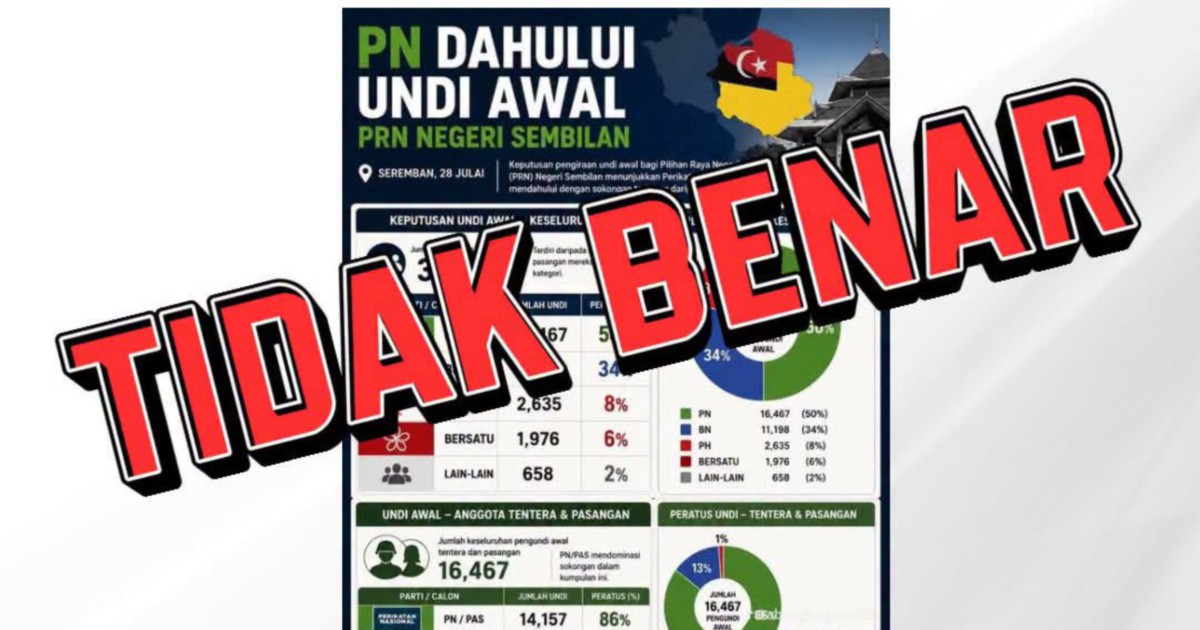
The Election Commission confirmed on Wednesday that early voting tally procedures for Negeri Sembilan's 16th state election will commence at 5 o'clock on Saturday evening, establishing a clear timeline for the critical first phase of the overall counting process. This announcement, made public in Seremban, represents the commission's attempt to inject transparency into electoral procedures while simultaneously addressing confusion spreading through social media channels regarding preliminary outcome projections.
The scheduling decision underscores the meticulous preparations required for state-level elections in Malaysia. Early voting mechanisms allow particular voter categories—principally election officials, security personnel, and individuals with justified mobility constraints—to cast ballots before the main polling day. Separating the tabulation of these votes from general election day results creates administrative clarity and serves as an important procedural safeguard in democratic processes across the region.
The EC's explicit confirmation of the 5pm Saturday timeline assumes heightened significance given the proliferation of unverified claims circulating online purporting to show preliminary election outcomes. These viral posts, which the commission has now formally denounced as inaccurate, highlight ongoing challenges facing Malaysia's electoral framework as digital misinformation becomes increasingly sophisticated. The deliberate injection of false data into public discourse during sensitive political moments represents a contemporary threat to electoral integrity that extends beyond traditional ballot security concerns.
Negeri Sembilan's forthcoming state election carries particular weight within Malaysia's current political landscape. As one of the country's constituent states, electoral outcomes influence the broader balance of parliamentary power and coalition-building dynamics at the national level. The 16th iteration of Negeri Sembilan's state election occurs within a context of evolving political alignments across Malaysia, where state-level contests frequently function as referendum-style exercises reflecting voter sentiment regarding federal governance.
The decision to publicly refute false claims before the actual vote count commences reflects lessons learned from previous electoral cycles. Malaysian political observers have increasingly documented how premature or fabricated outcome projections can delegitimise official results, particularly when distributed through informal social networks that prioritise speed over verification. By establishing unambiguous procedural timelines, the EC attempts to create institutional credibility that can withstand post-election contestation.
Saturday's early vote count represents merely the opening chapter in what will become a comprehensive electoral narrative. The subsequent main polling day activity and final result compilation will determine the state administration for the coming term. However, the procedural integrity of early vote processing carries symbolic weight disproportionate to the absolute number of votes involved, as observers from opposing political camps scrutinise the process for any irregularities that might subsequently become focal points for disputing outcomes.
The EC's proactive communication regarding timing and the falsification of preliminary claims demonstrates heightened awareness of contemporary electoral vulnerabilities. Regional counterparts across Southeast Asia have similarly grappled with the challenge of maintaining public trust in electoral systems while operating within digital information ecosystems characterised by rapid misinformation dissemination. Malaysia's approach of combining transparent procedural disclosure with explicit debunking of false narratives reflects an evolving institutional response to 21st-century democratic challenges.
For Malaysian voters and political stakeholders monitoring the Negeri Sembilan election, the verified timeline of 5pm Saturday for early vote counting provides concrete reference points amid speculation-filled periods. This clarity becomes particularly valuable in states where electoral margins prove tight, as compressed timeframes between counting phases sometimes create vacuum conditions conducive to rumour amplification and unfounded claims about momentum shifts or unexpected outcome trajectories.
The broader implications of the EC's communications extend to public confidence in Malaysia's entire electoral apparatus. As the country continues navigating complex political transitions and coalition realignments, institutional credibility regarding procedural fairness becomes increasingly essential. Voters evaluating whether to participate meaningfully in electoral processes often base assessments partly on demonstrated commitment to transparency and authentic commitment to preventing systematic manipulation or fraud.
The falsified early vote claims that circulated beforehand underscore how electoral periods activate bad-faith actors motivated by factional political advantage or general democratic destabilisation objectives. When social media platforms amplify unverified outcome predictions, the resulting information disorder complicates genuine democratic deliberation and erodes institutional legitimacy even before official tallying commences. The EC's decision to issue explicit rebuttals recognises these dynamics and demonstrates institutional willingness to actively defend electoral integrity rather than passively relying on ex-post-facto fact-checking.
As Negeri Sembilan voters prepare for Saturday's early vote count and subsequent main polling activities, the established procedures and verified timelines provide essential anchors amidst the inevitable political speculation. The EC's dual approach—establishing clear operational schedules while simultaneously confronting misinformation—reflects pragmatic acknowledgement that modern elections require institutional defences operating simultaneously across procedural and informational domains. The test of electoral integrity will ultimately rest not merely in accurate vote tallying, but in whether institutions can maintain public trust while processing results within increasingly contested information environments that characterise contemporary Malaysian politics.

