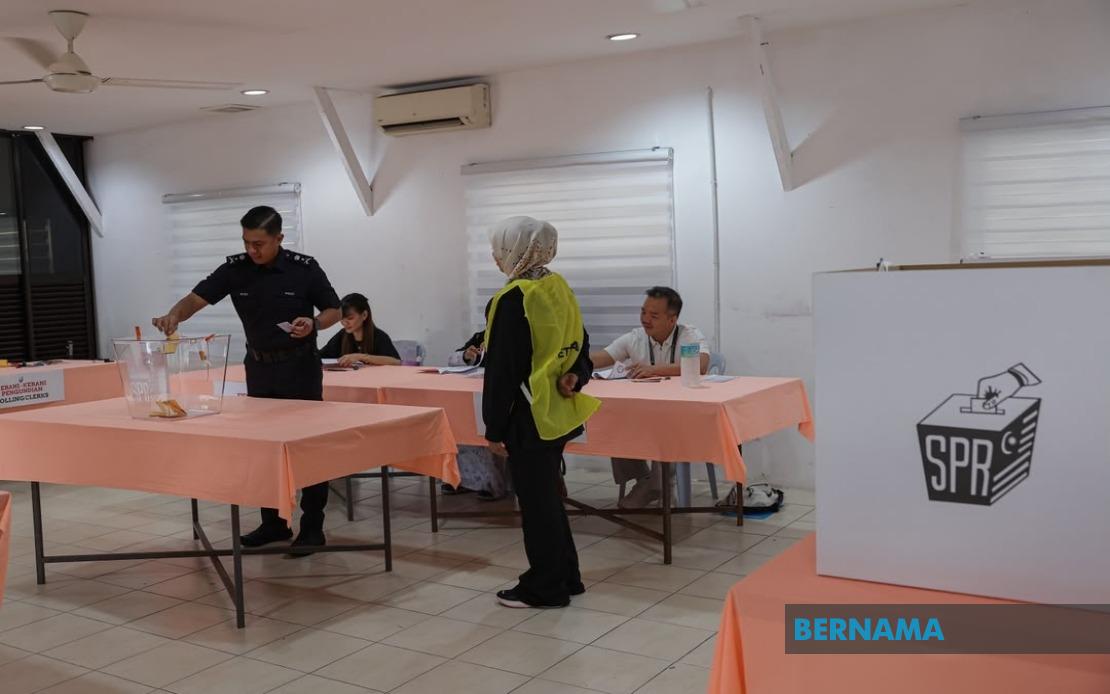
Early voting commenced across Negeri Sembilan on Monday with 38 polling stations opening their doors at 8 am to facilitate the participation of 22,339 members of the security forces and their families in the 16th state election. The staggered voting arrangement reflects Malaysia's practice of allowing uniformed personnel to cast their ballots ahead of the general election day, recognising their operational commitments and ensuring their democratic voice is secured regardless of duty schedules.
The Malaysian Armed Forces contingent comprised the larger group among early voters, with 16,884 military personnel and their spouses distributed across eight dedicated polling stations in Seremban and surrounding areas. This logistics arrangement underscores the significant representation of the armed forces in the state, reflecting Negeri Sembilan's role as home to various military installations and defence establishments. The separation of military and police voting centres—with the latter accommodating 5,455 Royal Malaysia Police members and their dependents across 30 locations—follows established electoral procedures designed to maintain operational readiness across security agencies.
The Election Commission coordinated the phased closure of voting centres between noon and 5 pm, ensuring that the early voting process would conclude comfortably before the main election scheduled for Saturday, August 1. This timeline provided sufficient overlap with regular working hours while accounting for the operational demands placed on security personnel who may be called to duty at short notice. The weather conditions on voting day favoured smooth operations, with bright skies reported across most areas of the state, eliminating potential weather-related complications for voters travelling to designated centres.
The broader context of this election reveals significant competition among political coalitions and parties vying for control of the 36-seat Negeri Sembilan State Legislative Assembly. Pakatan Harapan has fielded the maximum slate with 36 candidates, leveraging its position as the incumbent coalition at both state and federal levels. Barisan Nasional, seeking to reclaim ground it has lost in recent electoral cycles, entered the contest with 25 candidates, while Bersatu—the Malay-Muslim focused party that has emerged as a consequential player in Malaysian politics—fielded 24 contenders.
The fragmented opposition landscape reflects broader divisions in Malaysian politics. Perikatan Nasional, which represents a loose alliance primarily comprising Bersatu and the Pan-Malaysian Islamic Party, fielded 11 candidates, attempting to establish itself as an alternative to both established coalitions. Beyond the major players, four independent candidates sought election, alongside representatives from smaller parties including Berjasa, ASLI, and PSM, demonstrating the diversity of political voices competing for voter attention in Negeri Sembilan.
In total, 103 candidates registered for the contest, indicating a reasonably competitive election with multiple candidates per seat in many constituencies. This level of competition suggests that many races would develop into three-cornered or multi-way contests, potentially fragmenting votes and creating unpredictable outcomes in marginal constituencies. For Malaysian and regional observers, such fragmented electoral competition has become increasingly characteristic of post-2018 Malaysian politics, where the dominance of the two major coalitions has eroded and new political configurations continue to evolve.
The dissolution of the Negeri Sembilan State Assembly on June 5 initiated the electoral cycle leading to the August 1 voting date. This timeframe reflects constitutional processes requiring elections to be held within a specified period following dissolution, though the exact date represents a strategic choice by the caretaker government. The interval between dissolution and polling day provided candidates and parties with approximately two months for campaigning, a relatively compressed timeline compared to federal elections, potentially favouring incumbent parties with established campaign machinery and name recognition.
Saturday's general voting will engage approximately 889,490 ordinary voters across the state, representing a substantial electoral body that will determine the composition and direction of the Negeri Sembilan state government for the next electoral cycle. This voter population encompasses the state's diverse demographics, from urban centres like Seremban to rural areas, Orang Asli communities, and industrial constituencies, each presenting distinct priorities and political leanings that campaigns must address. The turnout and voting patterns will provide crucial insights into electoral trends in Peninsular Malaysia's central regions, potentially signalling broader shifts in voter behaviour ahead of the next federal election.
For Malaysia's political system, state elections in Negeri Sembilan carry significance beyond the state itself. As a medium-sized state with competitive politics and reasonable socioeconomic diversity, electoral outcomes here often serve as bellwethers for national political movements. The interplay between federal-level coalition politics and state-level dynamics has intensified since the 2020 federal election, creating complex scenarios where state governments operate under different coalitions than the federal government, as has been the case in several Malaysian states. The Negeri Sembilan result will therefore be closely watched by political analysts and party strategists seeking to understand the evolving Malaysian electoral landscape.

