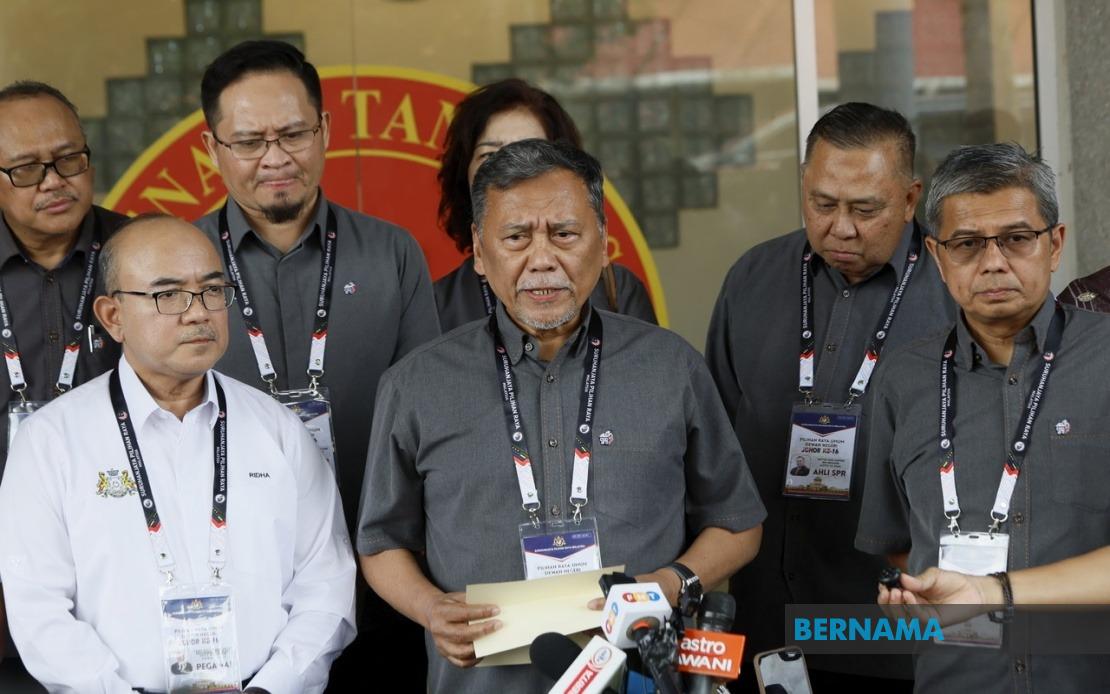
The Election Commission is pushing for a strong early voting performance in the Johor state election, setting an ambitious 96 per cent participation target for voters casting ballots ahead of Saturday's main polling day. Election Commission chairman Datuk Seri Ramlan Harun indicated the projection reflects achievement levels recorded in previous electoral exercises, providing confidence that the benchmark is attainable based on demonstrated voter engagement patterns.
Ramlan outlined the logistical framework supporting early voting operations across the state, revealing that 62 designated centres opened their doors at 8 am to accommodate advance casting. The staggered closure schedule accommodated different operational arrangements, with 29 centres wrapping up at midday, five additional sites closing at 2 pm, and the remaining 28 facilities staying open until 5 pm. This tiered approach reflects practical considerations around venue availability and staffing requirements across diverse locations.
The early voting process was specifically designed to facilitate participation among groups with demanding schedules or operational constraints. In total, the exercise engaged 20,607 eligible voters, split between security personnel and their families. The breakdown revealed 8,544 participants from the Malaysian Armed Forces contingent alongside their spouses, whilst an additional 12,063 police officers and their spouses participated in the early ballot process. This voter cohort represents a crucial demographic that requires flexible voting arrangements to balance professional responsibilities with democratic participation.
Security protocols surrounding the early ballot materials underscore the Election Commission's commitment to maintaining electoral integrity throughout the process. Completed ballot boxes will be transferred to police custody at selected stations pending the official counting phase, ensuring proper chain-of-custody procedures and protection against tampering. This arrangement balances accessibility with security, allowing early voters to fulfil their democratic obligation whilst maintaining confidence in the ballots' integrity.
The counting phase has been meticulously scheduled to provide timely election results whilst maintaining procedural rigour. Although early ballots will not be tallied until 5 pm on Saturday—aligned with the close of regular polling stations—the Election Commission anticipates announcing complete results within several hours. Ramlan projected that final tallies could be available as early as 10 pm, though officials cautioned that midnight represents a reasonable outer boundary for comprehensive result dissemination.
The Johor election is commanding significant administrative resources and operational focus. With 2.7 million ordinary voters eligible to participate on Saturday's main polling day, the Election Commission faces considerable logistical demands in processing this substantial electorate across multiple constituencies. The early voting process serves as a pressure valve, allowing advance participation and distributing voting load across consecutive days rather than concentrating all activity into a single intensive period.
Ramlan framed the election as a fundamental democratic exercise requiring broad public participation. His appeals to ordinary voters emphasised the civic dimensions of electoral participation, characterising the ballot as a mechanism through which citizens actively contribute to national governance and reinforce the democratic institutional framework. This messaging reflects broader efforts to encourage participation and legitimise electoral outcomes through visible voter engagement.
The 96 per cent early voting target reflects confidence in the voting system's accessibility and public confidence in the electoral process. Such high participation rates among security personnel traditionally demonstrate strong engagement with democratic processes, partly reflecting the structured nature of military and police voting arrangements but also suggesting satisfaction with electoral procedures. Whether this enthusiasm translates to the broader civilian electorate on Saturday will be an important indicator of public interest in the Johor state election.
The staggered polling schedule across three separate time windows demonstrates the Election Commission's attention to operational realities. Different venues operate under different constraints—some may be located at facilities with competing uses, others at bases with specific access windows, and some at locations with limited evening availability. Accommodating these variations through differentiated closure times represents pragmatic election administration whilst maintaining uniform access across the state.
The positioning of result announcements reflects electoral best practices and public expectation management. By providing initial indications as early as 10 pm, the Election Commission enables media reporting and public awareness of outcomes without unnecessarily prolonging uncertainty, though maintaining flexibility regarding final completion acknowledges that comprehensive counting across multiple constituencies requires adequate time for accuracy verification.

