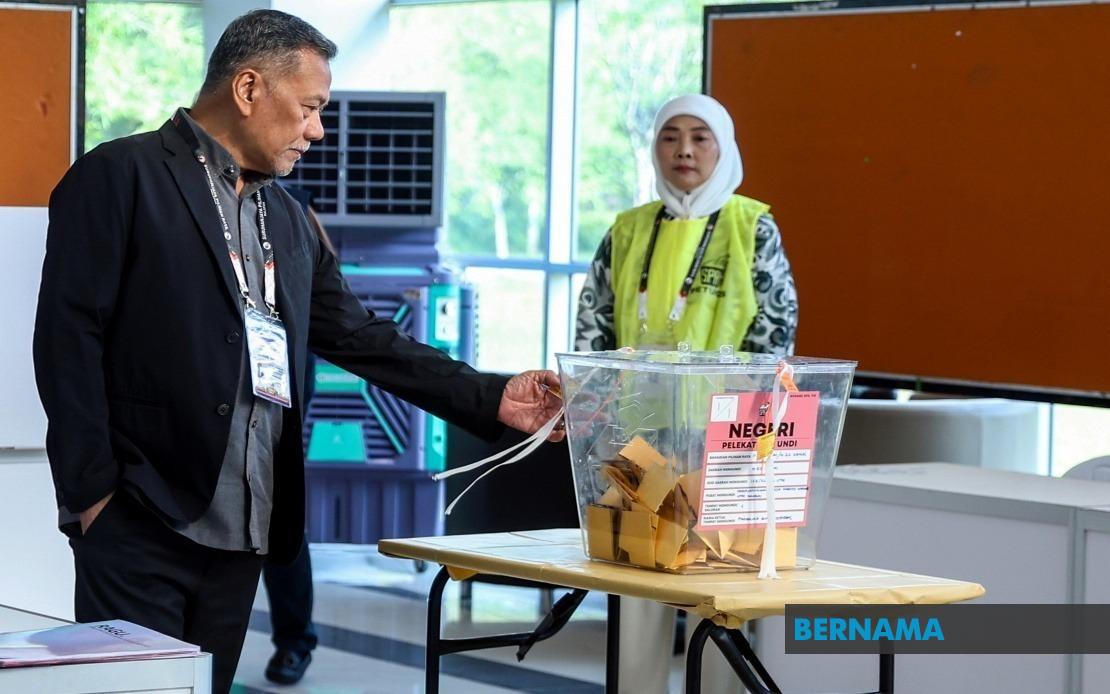
The Election Commission's top official made an early morning tour of polling stations across Johor Bahru on July 11, undertaking a systematic review of operational standards as voters cast their ballots in the 16th state election. Datuk Seri Ramlan Harun, the EC chairman, commenced his inspection at approximately 8.50 am at Dewan Raya Taman Ungku Tun Aminah, which served the Skudai constituency with seven separate polling streams.
The inspection circuit reflected the commission's standard protocol during major electoral exercises, whereby senior officials circulate among voting venues to verify compliance with established procedures and identify any operational bottlenecks. This hands-on approach by the EC leadership sends a signal to poll workers and election observers that the commission maintains active oversight throughout polling day, rather than relying solely on administrative reports submitted after voting concludes.
Following his assessment at the Skudai location, Ramlan proceeded to Raja Zarith Sofiah Library at Universiti Teknologi Malaysia (UTM) in Senai, which operated with two polling streams. The inclusion of a university facility in the inspection route underscores the logistical complexity of accommodating student voters in state elections, as educational institutions typically serve as designated polling centres due to their availability, infrastructure capacity, and neutral institutional status.
The chairman subsequently visited Sekolah Agama Taman Bukit Mewah serving the Kempas constituency, where six polling streams had been established. His final stop took him to Sekolah Menengah Kebangsaan Bandar Uda Utama in Perling, the largest of the four centres with nine voting streams. The variation in stream numbers across constituencies reflects differences in registered voter populations and the commission's allocation decisions regarding polling infrastructure.
During each facility visit, election officials briefed Ramlan on the implementation of voting procedures and provided him with direct observation of the voting environment. This included examination of facilities available to voters, such as privacy booths, ballot box security measures, and information stations, as well as assessment of working conditions for election personnel managing voter registration, ballot distribution, and vote recording. The physical inspection of infrastructure quality demonstrates the EC's commitment to maintaining standards of accessibility and dignity throughout the voting experience.
Ramlan's inspection visits served multiple institutional purposes beyond routine oversight. For Malaysian electoral observers and international monitors, such high-level field presence from the EC chairman provides transparency regarding the commission's management of the state election. It also allows the EC leadership to directly encounter implementation challenges that might not surface through formal reporting channels, enabling real-time problem identification and resolution if issues arise during the remainder of polling day.
For Johor voters, the visible engagement of the EC's leadership in monitoring voting operations reinforces public confidence in the electoral process and the impartiality of the commission. In Malaysia's political context, where electoral management remains subject to periodic public scrutiny and debate, demonstrations of active institutional oversight help address concerns about the integrity of state-level elections. The Johor state election carries particular significance given the state's political history and its status as Malaysia's second-largest state by population and economic output.
The four constituencies inspected represented a reasonable geographic and demographic cross-section of the broader Johor polling environment. Skudai, in the northern part of the city, includes urban residential and industrial areas. Senai, home to UTM, encompasses both university and residential zones. Kempas and Perling represent different residential and commercial configurations within the greater Johor Bahru metropolitan area. This selection pattern suggests the EC's intention to sample polling experiences across varying constituency types rather than concentrating inspections in a single district.
The scheduling of inspection visits during the early morning hours, commencing before 9 am, reflects the EC's awareness that the opening hours of polling stations often present distinctive operational challenges. Initial voter flows, establishment of polling procedures with fresh shifts of workers, and activation of security and administrative protocols create a window when irregularities might more easily occur. Early day inspections allow senior officials to verify that these critical opening phases proceed according to established standards.
Ramlan's announcement of a subsequent press conference indicated the commission's intent to provide public commentary on his inspection findings. Such post-polling briefings typically cover operational metrics, logistical observations, notable compliance issues if any arose, and the EC chairman's overall assessment of polling day conduct. For Malaysian media and election observers, these statements provide the first official institutional perspective on the day's electoral execution, shaping public understanding of whether the election proceeded successfully or encountered significant difficulties.
The rotation of EC leadership responsibility for polling day inspections represents standard institutional practice across democratic electoral bodies worldwide. In Malaysia's context, the visibility of the EC chairman conducting direct field oversight reinforces the commission's projection of independent authority and technical competence. This proves especially important for state elections, where voter confidence in electoral management sometimes varies compared to federal-level exercises, and where regional political dynamics may create heightened sensitivity regarding procedural fairness and impartial commission conduct.

