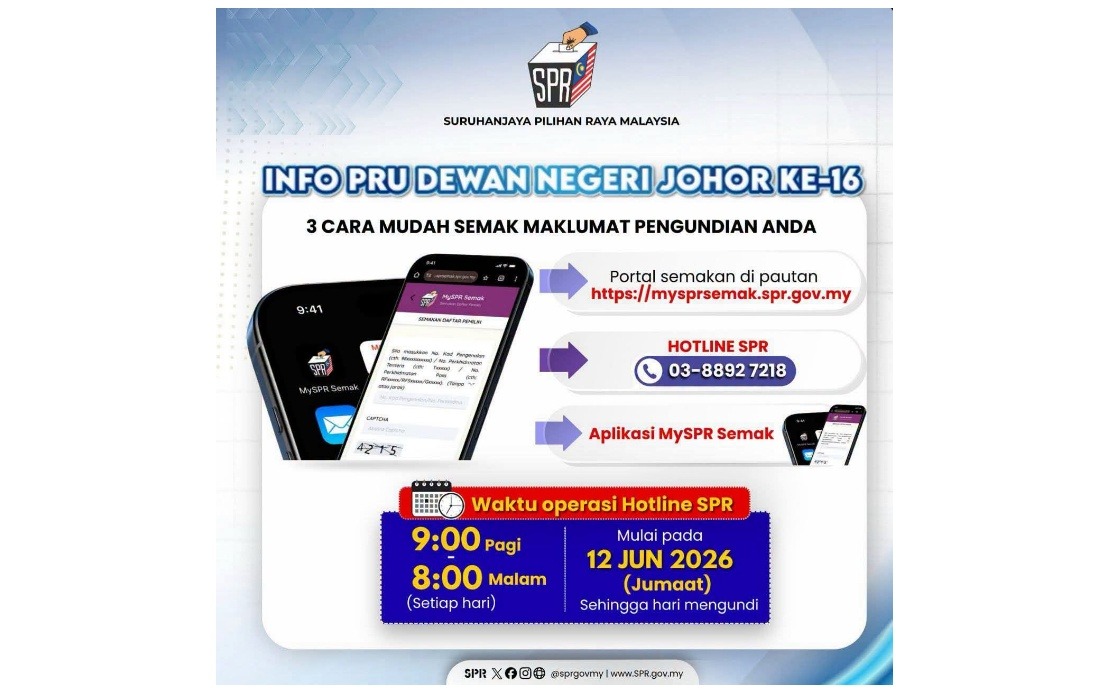
As Johor prepares for its 16th state election on July 11, the Election Commission has issued a timely reminder to registered voters to confirm their designated polling locations and voting arrangements in advance. The administrative advisory aims to streamline Saturday's electoral process and ensure smooth participation across the state, with officials encouraging citizens to utilise available digital resources to plan their voting logistics.
Voters can access their polling centre information through two convenient channels: the MySPR Semak portal or the MySPR Semak mobile application. These platforms allow registered electors to verify their assigned voting streams and locations without leaving their homes, reducing queues and confusion on election day itself. The EC's proactive communication reflects lessons learned from previous electoral cycles and demonstrates a commitment to facilitating voter participation through technology-enabled solutions.
The stakes for this election are substantial, with approximately 2.7 million eligible ordinary voters expected to cast ballots across Johor. These voters will elect 56 state assembly representatives who will shape the peninsula's southernmost state's governance for the coming term. The scale of participation underscores the significance of logistical preparation, both from the electoral authorities' perspective and individual voters' standpoint.
Early voting has already commenced, with 19,471 security personnel and their spouses having cast ballots last Tuesday. This contingent comprised 7,960 military personnel and their families alongside 11,511 police officers—including members of the General Operations Force and their spouses—who voted under provisions allowing those in essential services to participate before the general election date. This staggered approach prevents concentration of voters on a single day and provides election officials with valuable data regarding turnout patterns.
The electoral competition in Johor reflects Malaysia's broader political fragmentation, with 172 candidates vying for the 56 state seats. Pakatan Harapan and Barisan Nasional each field complete slates of 56 candidates, maintaining their traditional positioning as the primary contenders for state control. Perikatan Nasional has mounted a significant challenge with 33 candidates, representing its continued bid to expand influence beyond its strongholds in the northern states and federally administered territories.
Smaller political entities are also contesting the election, though with limited resources and candidate numbers. Parti Bersama Malaysia presents 15 candidates, whilst MUDA fields four aspirants, reflecting newer political movements' attempts to establish footholds in peninsular state politics. The Parti Orang Asli Malaysia and Parti Sosialis Malaysia also have representatives in the contest, alongside six independent candidates running outside party structures. This diversity of candidacy reflects Malaysian voters' increasing willingness to consider non-traditional political options.
For Malaysian observers monitoring state-level electoral dynamics, the Johor contest carries particular significance. The state has traditionally served as a political bellwether, with results often presaging broader national trends. Johor's position as an economically significant state with substantial urban and rural components makes its voting patterns influential in calculations about national political direction. The 2.7 million eligible voters therefore represent a constituency whose choices extend implications well beyond state boundaries.
The EC's emphasis on voters fulfilling their civic responsibility reflects a broader governance concern about participation rates and electoral legitimacy. When voters actively verify their polling locations and prepare for participation, turnout generally increases and procedural efficiency improves. This preparatory messaging thus serves multiple purposes: it facilitates administrative operations whilst simultaneously reinforcing the normative importance of democratic participation within Malaysian political culture.
For individuals unfamiliar with the MySPR platform or those with limited digital access, the dual availability of portal and mobile application options ensures inclusivity across age groups and technological comfort levels. This redundancy in accessibility mechanisms demonstrates election administration's effort to accommodate Malaysia's diverse population, from digitally native younger voters to older citizens who may prefer alternative information channels.
The election arrives amid complex political circumstances at both state and federal levels, with coalition alignments and intra-party dynamics influencing campaign messaging and voter calculations. The diversity of competing coalitions—ranging from Pakatan Harapan's multiethnic framework to Perikatan Nasional's predominantly Malay-Muslim orientation, alongside Bersama's centrist positioning—offers Johor voters genuine ideological and programmatic choices. These options, combined with accessible voting logistics, should facilitate meaningful democratic participation.
As election day approaches, the EC's reminder to voters encapsulates essential preparation that can transform polling day from a source of potential frustration into a smooth civic exercise. By checking polling locations beforehand, voters eliminate last-minute complications that could suppress turnout or create operational bottlenecks. This simple administrative step, multiplied across millions of participants, collectively determines whether an election functions as an efficient democratic process.

