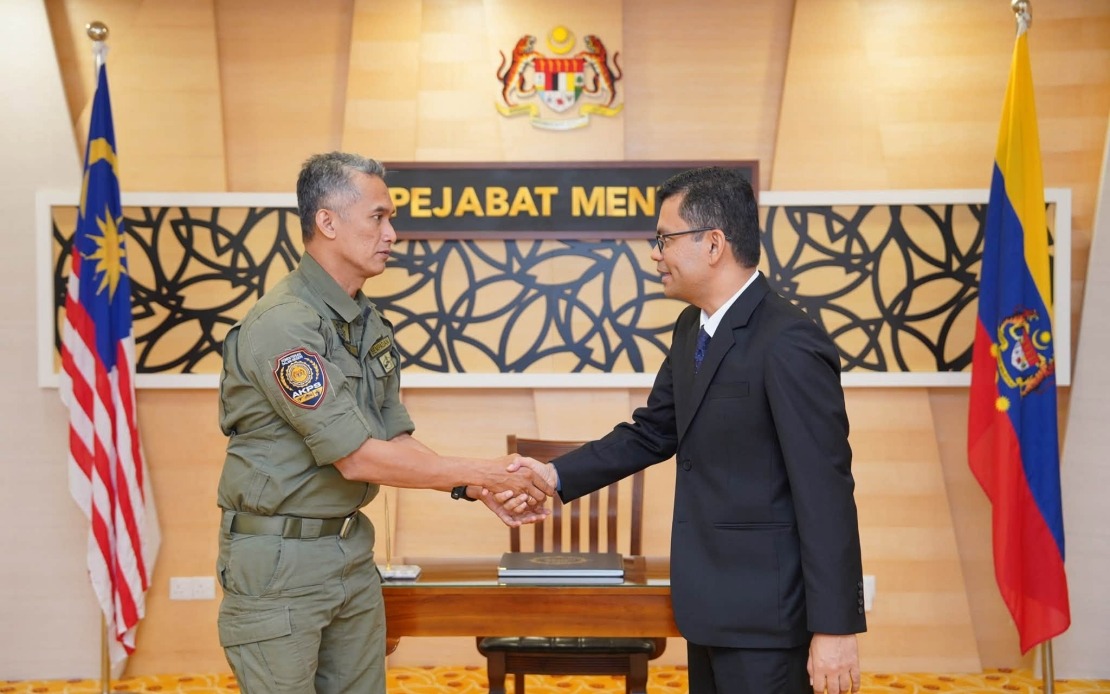
Malaysia's Economy Ministry and the Malaysian Border Control and Protection Agency (AKPS) have entered discussions on allocating development resources to modernise the country's border management systems, signalling a coordinated push to upgrade critical entry point infrastructure and operational capabilities. The talks, which took place in Putrajaya on August 5 between Economy Minister Akmal Nasrullah Mohd Nasir and AKPS Director-General Datuk Seri Mohd Shuhaily Mohd Zain, underscore the government's recognition that investing in border infrastructure is essential to facilitating legitimate trade while maintaining security standards.
The discussions centred on four interconnected pillars: upgrading physical infrastructure at border checkpoints, deploying advanced technology systems, developing strategic assets, and expanding operational capacity across the agency's workforce. These components reflect an understanding that modern border management requires simultaneous investment across multiple domains rather than piecemeal upgrades. The Economy Ministry's public acknowledgement that these improvements would support economic growth alongside security objectives signals a departure from framing border control purely as a security issue, instead positioning it as integral to Malaysia's trade competitiveness and economic resilience.
AKPS itself is a relatively young institution, having officially commenced operations on January 1, 2025, as a consolidation of border enforcement functions previously distributed across six separate agencies. This structural integration brings together the Immigration Department, Royal Malaysian Customs Department, Malaysian Quarantine and Inspection Services Department, Health Ministry border functions, Department of Wildlife and National Parks, and Road Transport Department operations. The merger was designed to eliminate coordination gaps and reduce bureaucratic overlap at entry points, but realising those efficiency gains requires substantial investment in harmonised systems and infrastructure.
The agency's strategic direction includes a deliberate emphasis on what it terms "smart border technology," encompassing integrated biometric systems that can rapidly verify traveller identities, automated cargo scanning equipment to accelerate customs clearance, and real-time data integration powered by artificial intelligence. These technological components are not novel in isolation, but their integration into a unified system across Malaysia's various border entry points represents a significant operational shift. Such systems can theoretically reduce processing times, improve detection accuracy, and enable predictive analysis to identify higher-risk transactions before they reach physical checkpoints.
For Malaysian trade and commerce, the implications are substantial. Delays at border crossings impose cumulative costs on businesses through inventory holding, fuel expenses, and workforce idle time. Faster, more efficient processing at entry points like those connecting to Singapore, Thailand, and Brunei could enhance Malaysia's competitive position as a regional logistics hub. The focus on improving efficiency at the country's entry points suggests recognition that bureaucratic friction, even well-intentioned security friction, can disadvantage Malaysian exporters competing against more streamlined regional rivals.
The commitment to human resource capacity building within AKPS reflects awareness that technology implementation alone is insufficient. Border officers require training in new systems, updated protocols for integrated operations, and professional development to work effectively across the agency's merged structure. Mohd Shuhaily's emphasis on strengthening integrity alongside operational efficiency acknowledges that public confidence in border management depends not only on whether goods are processed quickly, but whether the system operates transparently and free from corruption. Given that border agencies have historically been susceptible to misconduct, this focus represents a deliberate effort to establish the new agency's reputation.
The timing of these discussions also matters contextually. AKPS is still in its foundational phase, establishing standard operating procedures and embedding the merged workforce's institutional culture. Budget allocations made now will shape the agency's trajectory for years. The Economy Ministry's engagement suggests that resource constraints will not be used as an excuse for prolonged delays in implementation, though the actual quantum of development funds allocated remains unstated in public messaging. Malaysian businesses and regional trading partners will be watching whether the government commits budgets proportional to the ambition of modernisation plans announced.
Regionally, Malaysia's border infrastructure development carries implications beyond national security. The country serves as a crucial transit point for regional trade flows, and congestion at Malaysian checkpoints can disrupt supply chains across Southeast Asia. Thailand, Singapore, and Brunei have invested substantially in their respective border technologies; Malaysia's modernisation efforts represent an attempt to ensure that Malaysian entry points do not become bottlenecks that disadvantage the country relative to regional competitors for trade routing and logistics investment.
The discussions between the Economy Ministry and AKPS also indicate a shift in how Malaysia's government is approaching border management strategy. Rather than treating border operations as an isolated security function managed by enforcement-focused agencies with limited funding, the elevation to ministerial-level engagement with the economy portfolio signals that border efficiency is now understood as economic infrastructure. This reframing could unlock different funding mechanisms, potentially opening doors to development finance, public-private partnerships, or regional cooperation agreements that might not have been available under a purely security-focused framework.
Looking forward, the success of AKPS will depend on whether budgetary commitments materialise in concrete form and whether the agency can execute technological deployment without disrupting the flow of legitimate commerce. The consolidation of six agencies into one creates opportunity for efficiency but also organisational risk. Integration challenges, such as harmonising different agencies' legacy systems or reconciling distinct workplace cultures, could slow implementation if not managed effectively. The Economy Ministry's partnership in this process suggests awareness that economic stakeholders must be part of success measurement and feedback loops.
The discussions represent an important alignment between Malaysia's trade and economic development strategy and its border management modernisation agenda. For Malaysia to sustain growth and attract foreign investment, border infrastructure must keep pace with rising trade volumes and evolving security threats. The commitment to developing strategic assets and enhancing operational capacity indicates that Malaysia's policymakers recognise this necessity and are positioning the country to compete effectively in an era where sophisticated border management capabilities are increasingly treated as economic assets rather than merely security expenses.

