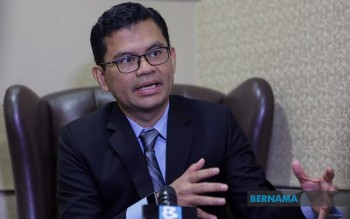
The Economy Ministry has outlined plans for RM58 billion in development spending during 2027, signalling the government's continued prioritisation of infrastructure investment as a driver of national growth. Economy Minister Akmal Nasrullah Mohd Nasir disclosed the preliminary projection at a press conference in Putrajaya, emphasising that the figure aligns with the cabinet's strategic focus on sustaining economic momentum through physical development initiatives. The allocation, pending formal submission to the Finance Ministry, represents a measured approach to managing public expenditure whilst maintaining the trajectory of long-term infrastructure programmes across the nation.
The proposed budget maintains the government's established policy framework, whereby 70 per cent of total development expenditure—approximately RM40.6 billion under the 2027 projection—flows directly into basic development initiatives. This disciplined allocation reflects a deliberate strategy to ensure foundational services and infrastructure improvements remain the backbone of public investment, rather than dispersing resources across competing priorities. By preserving this ratio consistently from year to year, policymakers signal stability to both private investors and international observers assessing Malaysia's commitment to structural economic development.
Historical context reveals a gradual escalation in development spending, anchored firmly on this core principle. The Finance Ministry allocated RM57.6 billion for basic development in 2026, representing 71 per cent of total development expenditure, compared to RM55.67 billion or 65 per cent in 2025. The 2027 projection of RM58 billion suggests a modest annual increase, reflecting careful calibration between competing fiscal demands and the imperative to sustain infrastructure programmes that underpin broader economic competitiveness. For Malaysian businesses and investors seeking visibility into the government's spending intentions, this consistency offers reassurance about long-term infrastructure development pathways.
Akmal Nasrullah clarified that the Economy Ministry's development expenditure proposal remains subject to comprehensive review and approval by the Finance Ministry, which will conduct the final assessment during the Budget 2027 formulation process. This hierarchical oversight ensures that development allocations are harmonised with broader fiscal considerations, including revenue projections, debt management, and macroeconomic policy objectives determined at the highest levels of financial governance. The minister's emphasis on departmental focus—with his team concentrating narrowly on development expenditure while the Finance Ministry weighs oil price benchmarks and fiscal balance—demonstrates the compartmentalised nature of Malaysia's budgeting apparatus.
The question of whether Budget 2027 will employ a global oil price benchmark fell outside the Economy Ministry's purview, Akmal Nasrullah explained, residing instead with Finance Minister Datuk Seri Anwar Ibrahim's portfolio. Oil price assumptions carry profound implications for Malaysia's fiscal calculations, directly influencing revenue from Petronas and other petroleum-linked sources that historically subsidise government spending. The minister's deference to the Finance Ministry on this technical matter underscores how commodity price volatility remains a persistent variable in Malaysia's medium-term fiscal planning, a reality particularly salient for a nation whose economy remains substantially linked to hydrocarbon exports despite diversification efforts.
Current economic performance provides cautiously optimistic backdrop for 2027 planning, with the economy expanding at 5.8 per cent during the second quarter of 2026, surpassing Bank Negara Malaysia's forecasted band of 4 per cent to 5 per cent. First-half growth reached 5.6 per cent, substantially outperforming expectations and suggesting underlying economic resilience. However, Akmal Nasrullah sounded a note of caution, acknowledging that maintaining such elevated growth rates through the second half of 2026 faces structural headwinds. The elevated baseline established in early 2026 creates a mathematical challenge for subsequent quarters, as percentage-point improvements become incrementally harder to achieve on increasingly large bases.
External risk factors loom over Malaysia's economic trajectory, a reality that necessarily constrains the confidence with which planners project sustained high growth. Global uncertainties persist despite regional recovery momentum, whilst climate phenomena such as El Niño can materially disrupt economic activity through agricultural impacts, energy demand fluctuations, and supply chain disruptions. The minister's explicit acknowledgment of ongoing global crises reflects a measured approach to economic forecasting, avoiding the overconfidence that sometimes accompanies strong quarterly performance. This cautious optimism shapes the development expenditure proposal, which seeks continuity without presupposing unrealistic growth scenarios.
The development expenditure blueprint serves multiple policy objectives beyond simple infrastructure creation. By maintaining substantial annual investment in basic development—roads, ports, power generation, water systems, and comparable foundational assets—the government sustains employment in construction and related sectors, supports domestic demand, and creates positive externalities that benefit broad business communities. Multinational corporations considering Malaysia as a manufacturing or logistics hub calibrate investment decisions partly around government infrastructure commitments, making visible, consistent development spending a soft power tool in regional and global economic competition.
Prime Minister Datuk Seri Anwar Ibrahim will table Budget 2027 before the Dewan Rakyat on October 9, 2026, providing the formal occasion for parliamentary scrutiny and public debate regarding the government's fiscal priorities. The Economy Ministry's preliminary development expenditure proposal of RM58 billion feeds into this comprehensive budgetary exercise, one component among numerous revenue, taxation, and sectoral allocation decisions that collectively shape Malaysia's fiscal stance. For businesses, civil society organisations, and regional observers, the October announcement will signal whether the government maintains its infrastructure-centric development model or adjusts priorities in response to evolving economic circumstances.
The modest projected increase in development expenditure—from RM57.6 billion in 2026 to RM58 billion in 2027—reflects fiscal constraints and competing demands on public resources that shape contemporary governance. Debt servicing obligations, entitlement programmes, and operational expenses crowd the budget, leaving development spending in a position where growth must be carefully measured. Yet the government's insistence on maintaining the 70 per cent allocation to basic development demonstrates that infrastructure investment retains political and economic priority despite budgetary pressures. This commitment, if sustained across multiple budget cycles, promises tangible improvements to Malaysia's physical capital stock whilst supporting medium-term competitiveness in an increasingly integrated regional economy where infrastructure quality increasingly determines investment location decisions and trade competitiveness.

