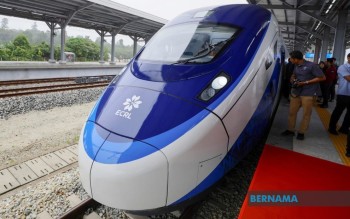
The East Coast Rail Link (ECRL) has emerged as a pivotal infrastructure initiative with substantial long-term economic implications for Malaysia, with government projections indicating the project will contribute between RM80 and RM90 billion to the nation's gross domestic product by 2047. Deputy Economy Minister Datuk Mohd Shahar Abdullah outlined these figures during a recent engagement in Kuantan, emphasising that the railway corridor represents far more than a transportation conduit. Rather, he positioned the RM50.27 billion undertaking as a transformative catalyst designed to reshape economic development patterns across Malaysia's less-developed eastern seaboard.
The anticipated economic gains rest fundamentally on the execution of 21 Economic Accelerator Projects strategically positioned along the ECRL corridor. These initiatives function as anchor developments intended to generate commercial activity, attract investment, and unlock employment opportunities in regions historically overshadowed by the economic dominance of the western corridor. The deliberate identification and development of these projects reflect a sophisticated approach to infrastructure planning that recognises transportation networks alone cannot drive sustainable prosperity without complementary economic activities.
Central to this strategy is the designation of three major logistics hubs at strategic ECRL station locations. Pasir Puteh in Kelantan will feature a substantial 213-acre facility, positioning it as a potential regional freight distribution centre. Kemaman in Terengganu will incorporate a 68-acre hub, whilst Temerloh in Pahang will operate a 50-acre logistics facility. These three locations have been deliberately selected to leverage their geographical positioning along the corridor, enabling them to serve as command centres for supply chain operations that could serve broader Southeast Asian markets. The logistics sector focus aligns with Malaysia's broader positioning as a regional trade and distribution hub, particularly as manufacturing and e-commerce activities intensify across Southeast Asia.
Deputy Minister Mohd Shahar explicitly rejected characterisations of ECRL as merely supplementary or competitive with existing international shipping routes. Instead, he framed the project as a complementary infrastructure component that strengthens Malaysia's overall logistics ecosystem. This distinction carries significance for regional positioning; the railway network enables land-based freight movement that complements maritime routes, creating redundancy and resilience within Malaysia's supply chain architecture. For businesses operating across Southeast Asia, the availability of multiple transport modalities reduces dependency on any single corridor and enhances operational flexibility.
A critical component of the ECRL's economic strategy involves narrowing the persistent development gap between Malaysia's eastern and western regions. Economic activity has historically concentrated in the western corridor around Kuala Lumpur, Selangor, and Penang, leaving eastern states of Kelantan, Terengganu, and Pahang comparatively underdeveloped. The ECRL fundamentally reshapes accessibility patterns by reducing travel times and freight costs between these regions and major consumption centres. This improved connectivity directly addresses geographic disadvantages that have constrained eastern Malaysia's economic competitiveness for decades.
The government has reinforced its commitment through specific development milestones. The first phase of the Perodua logistics hub in Paya Besar, Kuantan, is targeted for completion by 2029, demonstrating tangible progress toward establishing the infrastructure upon which Economic Accelerator Projects will operate. Perodua's involvement signals that established industrial entities recognise genuine commercial opportunity within the ECRL ecosystem. Manufacturing and logistics companies require confidence in transport infrastructure before committing capital to regional operations; the Perodua hub announcement therefore validates the project's viability and may catalyse investment decisions by competitors and complementary industries.
Alignment with broader national development frameworks enhances the ECRL's policy coherence. Deputy Minister Mohd Shahar referenced the 13th Malaysia Plan as the overarching policy context, noting that the Malaysia Development Composite Index and MyRMK system guide resource allocation toward areas demonstrating genuine development need. This institutional architecture ensures that ECRL-related investments complement rather than duplicate existing programmes, whilst directing financial resources to regions where intervention generates highest social and economic impact. For Malaysian policymakers, such integration prevents fragmented infrastructure development that characterised earlier decades.
The project's operational timeline structures near-term expectations around specific delivery dates. Scheduled for completion in December 2026 with operational commencement anticipated in January 2027, the ECRL enters a critical construction phase. The 665-kilometre corridor incorporates 11 electric multiple unit train sets configured with six cars each for passenger services, alongside 12 electric locomotives dedicated to cargo operations. This balanced allocation between passenger and freight capacity recognises that sustainable corridor development requires diverse revenue streams; passenger revenues provide stable operational funding whilst freight services capture value from supply chain activities that Economic Accelerator Projects will generate.
The ECRL's implications extend beyond Malaysia's borders into the broader Southeast Asian context. Regional supply chain networks increasingly span multiple countries, with manufacturing occurring in Vietnam or Thailand, component production in Malaysia, and final assembly in Indonesia. Efficient rail corridors that move freight quickly and cost-effectively across Malaysia reduce total logistics costs for multinational enterprises operating across the region. Malaysian East Coast ports and inland hubs connected by ECRL therefore become more competitive relative to alternative regional routes, potentially attracting additional transhipment activity and related services.
However, realising the projected RM80 to RM90 billion GDP contribution requires sustained execution beyond infrastructure completion. Economic Accelerator Projects must succeed commercially, logistics hubs must attract tenants and operators, and supply chain participants must fundamentally alter routing decisions to utilise ECRL facilities. Whilst government financial commitment appears solid, the private sector's response will ultimately determine whether infrastructure investment translates into the anticipated economic contributions. Regional economic integration across Southeast Asia, logistics cost dynamics, and global trade patterns will influence whether the corridor achieves its transformative potential or functions as a underutilised national asset.
The ECRL ultimately represents a long-term wager on Malaysia's eastern regions, with success requiring coordination across government agencies, private investors, and operational entities. The specificity of government projections and the alignment with established planning frameworks suggest serious institutional commitment rather than aspirational rhetoric. For regional observers, the ECRL demonstrates how infrastructure investment, economic corridor development, and deliberate logistics positioning intertwine within emerging Southeast Asian trade networks. Malaysia's willingness to invest substantial capital in rebalancing regional development patterns may influence similar initiatives elsewhere in the region, particularly in developing countries seeking to reduce urban concentration and create distributed economic opportunity.

