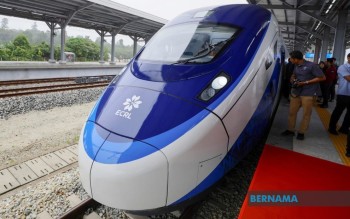
Malaysia's East Coast Rail Link represents far more than a transportation infrastructure project—it signals the beginning of a comprehensive economic restructuring for the peninsula's eastern corridor. According to Datuk Mohd Shahar Abdullah, Deputy Minister of Economy and Member of Parliament for Paya Besar, the ECRL's true value lies in its capacity to fundamentally reshape how businesses operate and compete across Pahang, Terengganu, Kelantan and Selangor. Speaking recently in Kuantan, he outlined a vision where the megaproject catalyses an interconnected economic ecosystem that extends beyond rail operations into supply chain management, warehousing, logistics, and supporting services.
The infrastructure's transformative potential rests on several interconnected mechanisms that will unfold as construction progresses toward completion in December. Rather than functioning as an isolated transport corridor, the ECRL will anchor what planners call transit-oriented development—a strategy that concentrates commercial activity around stations and transport nodes. Simultaneously, cargo-oriented development will emerge, with industrial parks and warehouse clusters establishing themselves along the rail route. This layered approach means entrepreneurs will not simply gain faster access to markets; they will operate within newly created commercial zones engineered to reduce friction in supply chains and lower operational costs.
The cost dynamics alone represent a significant competitive advantage for regional businesses. As logistics expenses decline and delivery times compress, companies can expand their market reach without proportionally increasing transport expenditures. This economic calculus fundamentally alters the business case for scale. Mohd Shahar illustrated this through a practical example: a manufacturer producing ten thousand units operates under different cost structures than one producing twenty thousand. As production scales upward, unit costs fall, enabling price competitiveness that previously seemed unattainable for East Coast-based firms. For entrepreneurs constrained by limited access to distant markets or prohibitive shipping costs, the ECRL removes a critical barrier to growth.
The project's ripple effects will extend across multiple economic sectors, particularly benefiting industries rooted in local entrepreneurship. The tourism sector stands to gain substantially as improved connectivity attracts visitors to East Coast destinations. This increased footfall directly stimulates demand for services provided by small traders, handicraft vendors, and food entrepreneurs operating in communities along the corridor. Batik producers, whose traditional products carry cultural significance and export potential, gain access to larger customer bases without relocating operations. Similarly, manufacturers of local specialities can now consider regional distribution models previously economically unfeasible.
Construction and operation of the ECRL itself generates intermediate economic activity often overlooked in headline discussions of infrastructure benefits. Employment emerges across construction, facility maintenance, and operational management. Supply chains supporting these functions—materials providers, technical service contractors, and logistics coordinators—expand to meet project demands. This secondary economic activity provides near-term income while the broader market-access benefits materialise. The Deputy Minister's framing emphasises that genuine infrastructure value emerges when these immediate employment gains transition into sustained competitive advantages for private enterprises.
Yet realising this potential requires strategic adaptation from businesses themselves. Mohd Shahar cautioned that entrepreneurs cannot passively await ECRL benefits; instead, they must position themselves to capitalise on emerging opportunities. This demands technological adoption and business model innovation rather than reliance on traditional operational approaches. Companies must integrate digital platforms for inventory management, supply chain coordination, and customer engagement. Those who embrace technology-enabled operations—leveraging data analytics for demand forecasting, automated logistics systems, and digital marketing—will capture disproportionate shares of newly accessible markets. The ECRL removes geographic constraints; intelligent business strategy converts that removal into competitive advantage.
For Malaysian policymakers, the ECRL exemplifies infrastructure-as-economic-policy, where transport investment explicitly targets regional inequality and entrepreneurial inclusion. The East Coast has historically lagged wealthier western corridors in manufacturing concentration and institutional investment. By anchoring an integrated economic zone around the rail network, the project attempts to rebalance development patterns. This approach differs from classic infrastructure deployment; rather than connecting existing economic clusters, the ECRL aims to generate new clusters where none previously enjoyed comparative advantage. Success depends partly on complementary policies that support small and medium enterprises in accessing financing, technology adoption, and market information.
The construction trajectory suggests realistic timelines for market activation. As of April, the overall megaproject had achieved 93.66 per cent completion, with Pahang-specific sections reaching 97.33 per cent progress. This advancement means that the institutional and commercial infrastructure supporting ECRL operations will emerge within months rather than years. Warehousing facilities, customs coordination arrangements, and logistics service providers will require advance preparation. Entrepreneurs should interpret these timelines as signals to begin positioning themselves—exploring location opportunities in emerging commercial zones, assessing technology requirements, and evaluating how expanded market access aligns with their production capacity and product offerings.
Regional comparisons underscore the ECRL's strategic significance. Southeast Asian competitors in Vietnam, Thailand, and Indonesia have leveraged similar rail connectivity projects to relocate manufacturing away from congested central corridors toward emerging zones with lower operating costs. Malaysia's East Coast possesses labour availability, manufacturing heritage, and port access that, when combined with improved inland rail connectivity, creates an attractive proposition for businesses seeking to diversify geographic footprints. The ECRL potentially positions the East Coast not merely as a consumer market but as a competitive production zone within regional supply chains.
The project's success ultimately hinges on whether cost and connectivity improvements translate into genuine business expansion rather than merely shifting existing commercial activity. If ECRL benefits concentrate among already-established enterprises or attract primarily external capital, local entrepreneurship gains diminish. Conversely, if small and medium enterprises successfully leverage reduced logistics costs and market access to scale operations and create employment, the project validates the infrastructure-as-inclusion model. For Malaysian entrepreneurs, the ECRL represents both opportunity and challenge—a window to access markets previously economically inaccessible, contingent upon their readiness to innovate and adapt business strategies to a transformed competitive landscape.

