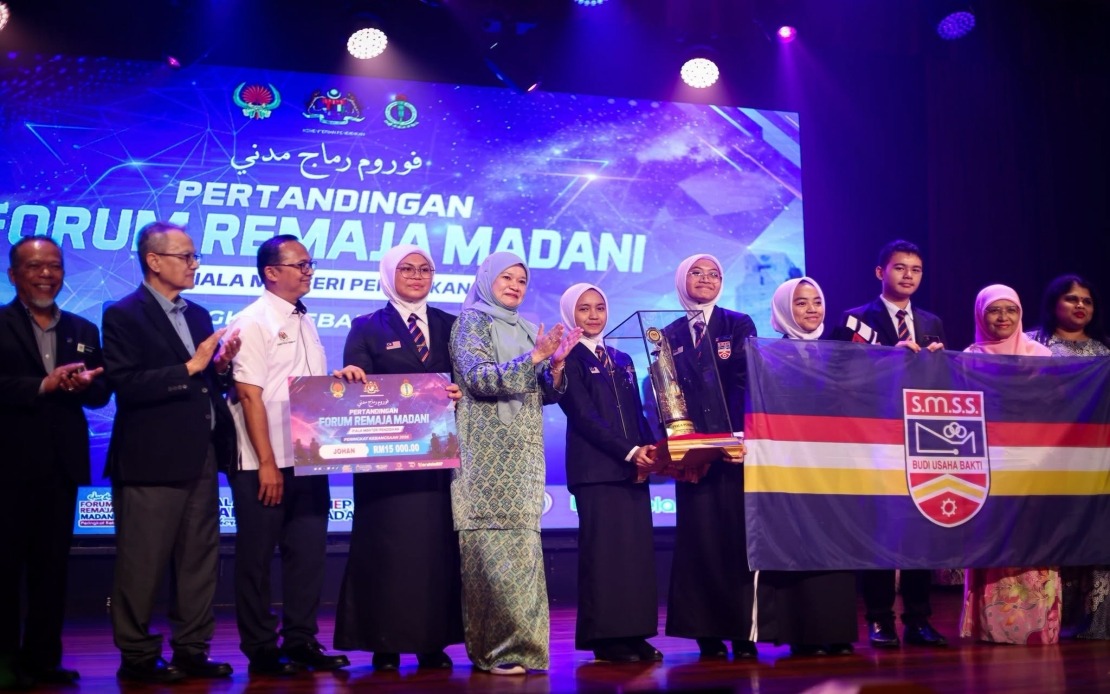
Education Minister Fadhlina Sidek has outlined a vision of character development that extends beyond traditional concepts of moral instruction, emphasising instead the cultivation of informed, articulate citizens capable of navigating disagreement with grace. Speaking at the National MADANI Youth Forum, she articulated an approach to character education that positions critical thinking and respectful dialogue as foundational pillars for building a mature society. The remarks signal a deliberate pivot toward preparing young Malaysians not merely to conform, but to engage meaningfully with ideas and with one another across lines of difference.
Fadhlina's framing of character education represents a significant statement about the government's educational priorities at a time when Malaysia faces complex social and political challenges requiring nuanced public discourse. Rather than defining success as universal agreement or unquestioning acceptance of authority, she argues that genuine national maturity emerges when citizens possess both the intellectual tools to construct sound arguments and the emotional intelligence to listen to opposing views. This perspective reflects contemporary educational thinking that views critical faculties not as threatening to stability but as essential to it.
The minister observed that participants at the youth forum demonstrated precisely this constellation of skills. Young people were articulating their positions with clarity, engaging with alternative viewpoints, and mounting reasoned defences of their arguments. This hands-on observation of youth engaging in substantive discourse appears to have reinforced her conviction that Malaysian young people are capable of and hungry for this type of intellectual engagement. The forum itself functioned as a practical demonstration of the character education model she advocates, moving beyond abstract principle to concrete application.
Central to Fadhlina's argument is the distinction between directive and enabling approaches to education. She explicitly rejected the notion that educators should determine what young people ought to say, instead positioning the role of schools and institutions as providing the foundational knowledge and ethical framework necessary for independent thought. This framing acknowledges agency and autonomy among students while maintaining that institutional guidance remains valuable and necessary. The approach requires educators to step back from prescription while stepping forward in cultivating the capacities that enable authentic choice.
The minister has woven the strengthening of the Malay language into her vision of youth development in ways that merit careful attention. She contends that linguistic capacity and intellectual expression are intimately connected, suggesting that the Malay language will flourish when young Malaysians encounter it not as an obligation but as a living instrument capable of conveying complex, contemporary thought. This perspective reframes language policy away from preservation toward vitality, positing that the next generation will maintain the language precisely by using it to express ideas that matter to them in their own moment.
Fadhlina's assertion that educators should ensure young people possess the knowledge and courtesy to participate in substantive debate touches on a frequently neglected dimension of public discourse: the skills required to disagree constructively. Malaysia's multicultural, multireligious composition means that citizens regularly encounter worldviews at odds with their own, yet formal training in the mechanics of respectful disagreement often remains absent from curricula. By elevating courtesy alongside knowledge and critical thinking, the minister identifies an essential capability for a diverse society.
Her concluding observation that maturity emerges not from uniformity of opinion but from the capacity to navigate disagreement presents a philosophical position with profound implications for Malaysian governance and social cohesion. This formulation suggests that rather than viewing social harmony as dependent on suppressing dissent or enforcing conformity, genuine stability flows from citizens who understand both how to express disagreement and how to listen to it. The notion runs counter to certain historical narratives about Malaysian nation-building, implying a more dynamic understanding of what holds diverse societies together.
The timing and context of these remarks warrant consideration. Malaysia has experienced cycles of polarisation on religious, ethnic, and political lines, often accompanied by heated rhetoric and mutual incomprehension. The Education Ministry's explicit promotion of critical thinking paired with respectfulness suggests an institutional commitment to addressing these fractures at their root—by shaping how young Malaysians learn to think and communicate before entrenched positions calcify. Early intervention in developing these capacities may prove more effective than attempting to bridge divides among adults.
Fadhlina's emphasis on giving young people spaces to speak and to use the Malay language for substantive expression also touches implicitly on questions of representation and inclusion. When youth feel genuinely heard—when their views matter and are engaged seriously—they are more likely to remain invested in democratic and institutional processes. Conversely, when young people perceive that they lack genuine voice or that serious engagement is unwelcome, they may disengage from or turn against those institutions. The minister's framing suggests recognition that character education and democratic participation are mutually reinforcing.
The distinction between teaching young people to be good—a more traditional characterisation of moral instruction—and teaching them to think and speak well represents a meaningful recalibration of educational philosophy. Goodness, in the framework Fadhlina articulates, emerges not from obedience or conformity but from the exercise of informed judgment tempered by respect. This approach implicitly trusts in the possibility of ethical reasoning among young people and in the benefits of encouraging them to grapple with moral questions themselves rather than simply receiving answers.
Implementing this vision will require significant shifts in pedagogical practice, teacher training, and school cultures across Malaysia. Educators themselves must be equipped to model the qualities of intellectual humility and respectful engagement that Fadhlina advocates. Additionally, creating genuine space for youth voice sometimes means tolerating expressions and ideas that make authority figures uncomfortable. The success of this educational direction will ultimately depend on whether institutions genuinely commit to these principles or employ them rhetorically while maintaining traditional hierarchies and constraints on youth expression.

