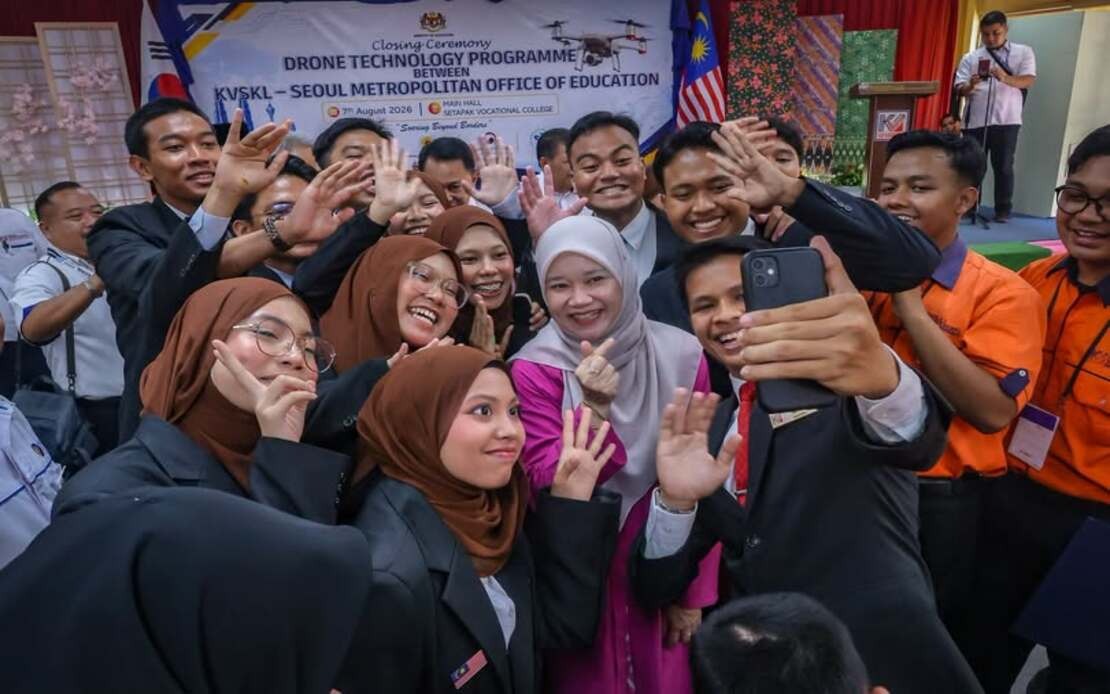
Education Minister Fadhlina Sidek has set an ambitious challenge for students at Setapak Vocational College: conceive practical applications of drone technology to fortify campus security within the next month. The initiative, unveiled during a collaborative education programme with Seoul Metropolitan Office of Education, reflects Malaysia's growing emphasis on embedding emerging technologies into vocational training and problem-solving curricula. The students will be expected to present their proposals directly to the minister, transforming classroom learning into actionable solutions addressing genuine institutional needs.
The challenge emerged during a partnership programme that also drew South Korean Ambassador to Malaysia Yeo Seung-bae, underscoring the international dimensions of the collaboration. This bilateral educational exchange signals how Southeast Asian nations are increasingly looking to share technological expertise and pedagogical approaches with advanced economies. South Korea's reputation as a technology innovation hub makes the partnership particularly strategic for Malaysian vocational institutions seeking to upgrade their capabilities in robotics and automation.
Fadhlina's remarks during the event conveyed a broader philosophy about modern education. She observed that many students succeeded in their initial drone and robotics demonstrations, while others encountered difficulties—yet persisted in their attempts. This emphasis on perseverance through failure reflects contemporary educational thinking that prizes experimentation and resilience over perfection, qualities increasingly demanded in technology-driven workplaces. The minister's framing of these setbacks as genuine learning moments rather than deficiencies suggests a deliberate recalibration of how Malaysian vocational colleges measure student progress.
The minister stressed that robotics, drone systems, and artificial intelligence are no longer futuristic abstractions confined to research laboratories or theoretical discussions. These technologies have already permeated contemporary work environments across industries ranging from manufacturing to logistics to infrastructure inspection. By positioning this challenge within the present rather than the distant future, Fadhlina underscores the urgency for Malaysia's education system to keep pace with technological adoption in the global economy. Institutions that fail to equip students with practical competency in these domains risk producing graduates misaligned with employer expectations.
Setapak Vocational College's selection for this initiative highlights the ministry's intention to use vocational institutions as laboratories for innovation integration. Unlike traditional secondary schools, vocational colleges are positioned to develop hands-on technical skills suited to immediate labour market demands. By channeling students toward real-world problem-solving—in this case, security enhancement—the college bridges the conceptual gap between learning technology and applying it purposefully. This approach contrasts sharply with purely theoretical instruction disconnected from practical utility.
The one-month timeline imposed by the minister creates meaningful pressure that simulates professional project constraints. In actual technology development and deployment, deadlines are absolute; teams must prioritize, iterate rapidly, and make difficult trade-offs between ideal solutions and viable implementations. By replicating this urgency in an educational setting, Fadhlina is exposing students to authentic conditions they will encounter in their careers. The compressed timeframe also forces students to think critically about feasibility rather than merely theorizing about possibilities.
Drone technology specifically offers considerable relevance to campus security. Unmanned aerial vehicles can survey perimeter areas, monitor blind spots inaccessible to ground-based cameras, detect unauthorized intrusions, and provide real-time incident documentation. For vocational students, designing such systems requires understanding not only how to operate drones but also how to integrate them with existing security protocols, establish communication networks, manage data feeds, and address privacy considerations. This multidisciplinary scope deepens learning beyond simple equipment manipulation.
The partnership with Seoul Metropolitan Office of Education extends beyond ceremonial collaboration. South Korea has invested heavily in educational technology and possesses extensive experience integrating advanced systems into school environments. Knowledge transfer from South Korean educators could accelerate Setapak Vocational College's capability development. Malaysian institutions often benefit from exposure to international best practices, particularly from neighbours that have successfully navigated the transition toward technology-centric education systems. This regional knowledge exchange strengthens the broader Southeast Asian capacity for innovation in technical education.
Fadhlina's challenge implicitly acknowledges that Malaysia's future competitiveness depends on a workforce comfortable with emerging technologies. As automation reshapes labour markets globally, countries that develop citizens capable of designing, implementing, and maintaining sophisticated systems will retain competitive advantages. Vocational education—historically viewed as a secondary pathway—becomes increasingly central to national development strategy. By elevating vocational students' engagement with cutting-edge technology, the ministry signals that technical excellence merits equal respect and investment as academic pathways.
The challenge also carries implications for how Malaysian institutions measure educational success. Rather than relying solely on examination results and credential accumulation, this model values demonstration of practical capability, creative problem-solving, and the ability to translate theoretical knowledge into functional applications. As employers increasingly emphasize portfolio evidence and demonstrated competencies over traditional qualifications, educational institutions must adapt their assessment approaches accordingly. The Setapak project exemplifies this shift toward performance-based evaluation.
Looking forward, the outcomes from this challenge could influence how other Malaysian vocational colleges structure their programmes. If students produce viable security drone concepts, the success becomes a case study encouraging similar initiative-based learning across the institution. More broadly, the project positions Malaysia within a regional narrative of technological modernization in education, competing with initiatives in Indonesia, Thailand, and Vietnam that are similarly investing in technical skill development among younger generations. The stakes extend beyond individual student achievement to questions of national capacity and regional standing in the knowledge economy.

