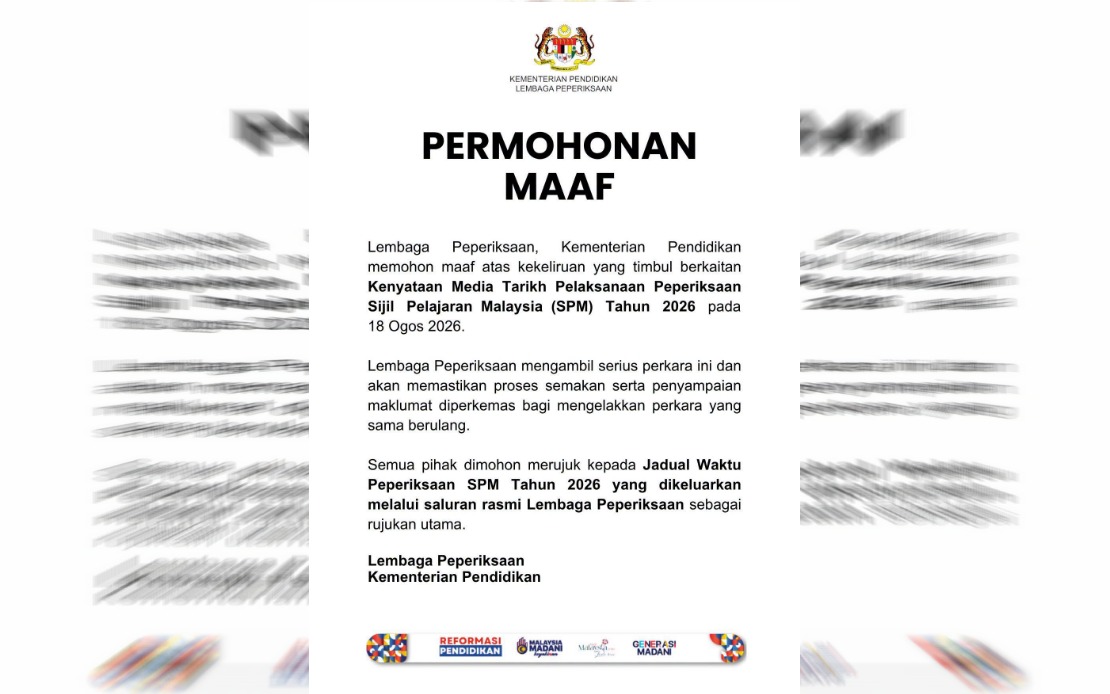
The Examination Board under Malaysia's Ministry of Education issued a formal apology on Tuesday for the confusion sparked by a press release distributed the previous day concerning the implementation schedule for the 2026 Sijil Pelajaran Malaysia examination. In a brief statement, the board acknowledged the issue and committed to strengthening its internal review mechanisms and communication protocols to prevent similar incidents from occurring in the future. The directive came as education officials sought to restore clarity amid a critical period when students, teachers, and schools are preparing for one of the nation's most significant academic milestones.
The confusion centred on conflicting or unclear information contained in yesterday's announcement regarding when the 2026 SPM would take place. Such mix-ups at the examination board level can create substantial anxiety among candidates and their families, who depend on accurate timelines to plan study schedules and logistical arrangements. Given that the SPM is a high-stakes qualification that influences university placements and career trajectories, any ambiguity about examination dates can disrupt preparation efforts across the country's secondary schools.
In addressing the situation, the Examination Board instructed all stakeholders—students, parents, educators, and school administrators—to treat the official 2026 SPM Examination Timetable distributed through the board's recognised channels as the sole authoritative source of information. This guidance underscores the importance of relying on primary sources rather than secondary reports or unofficial communications that may misinterpret or inadvertently distort the original details. The board's emphasis on streamlining its information delivery process signals recognition that maintaining trust and reducing confusion requires improved coordination between departments and more rigorous quality assurance before public announcements.
According to the latest figures, a total of 420,879 candidates have registered to participate in the 2026 SPM examination across 3,334 examination centres situated throughout Malaysia. This substantial cohort represents an entire generation of Malaysian students whose educational trajectories depend significantly on their performance in this standardised assessment. The widespread geographic distribution of examination centres—spanning urban areas, suburban regions, and rural locations—reflects the Ministry of Education's commitment to ensuring equitable access to testing facilities across the nation.
The 2026 SPM examination is scheduled to commence on November 23 and conclude on December 17, providing a three-week examination window. This timeline allows the examination board to administer papers across multiple subject streams while managing the logistics of invigilating, collecting, and processing answer scripts from over 400,000 candidates nationally. The schedule also aligns with Malaysia's academic calendar and permits sufficient time for result compilation and distribution before the year's end.
For Malaysian families and educators, the clarification serves as a reminder of the importance of maintaining direct communication with official education authorities rather than relying on third-party interpretations of policy announcements. This incident, while relatively minor in scope, highlights potential vulnerabilities in how large-scale national examinations are communicated to the public. When examination schedules are misunderstood or misrepresented, the downstream effects can include unnecessary anxiety among candidates, logistical complications for schools, and confusion among parents attempting to support their children's preparation efforts.
The Education Ministry's examination infrastructure must handle immense administrative complexity, coordinating with state education departments, school principals, and thousands of invigilators to ensure that examinations proceed smoothly. Errors or ambiguities in announcing examination dates can cascade through this system, creating operational challenges that schools must then navigate. By prioritising clearer communication channels and more rigorous internal review processes, the Examination Board aims to prevent future incidents that could undermine confidence in the examination system itself.
From a broader perspective, this episode reflects growing challenges faced by government agencies in the digital age, where unofficial reports, social media discussions, and misinterpreted announcements can spread rapidly and create confusion before official clarifications are issued. The Examination Board's response—directing all parties to consult official sources exclusively—represents a pragmatic approach to managing information in an environment where multiple channels of communication exist and not all provide accurate details.
Looking ahead, the 2026 SPM will be a significant undertaking involving hundreds of thousands of students competing for places in tertiary institutions. With registration already closed and candidates beginning their intensive preparation phase, maintaining clear and accurate communication from now until December 2026 becomes critical. The examination board's commitment to improving its processes carries implications not only for current students but also for the Ministry of Education's broader credibility and the public's confidence in national assessment systems.
Schools across Malaysia have already begun organising their examination schedules around the November 23 to December 17 window, and teachers are structuring their curriculum delivery to ensure students complete all required topics before assessments commence. Any further confusion about dates or procedures could create cascading disruptions. The apology and clarification issued this week serve as an important reset, establishing the official timetable as the definitive reference point for all stakeholders moving forward.

