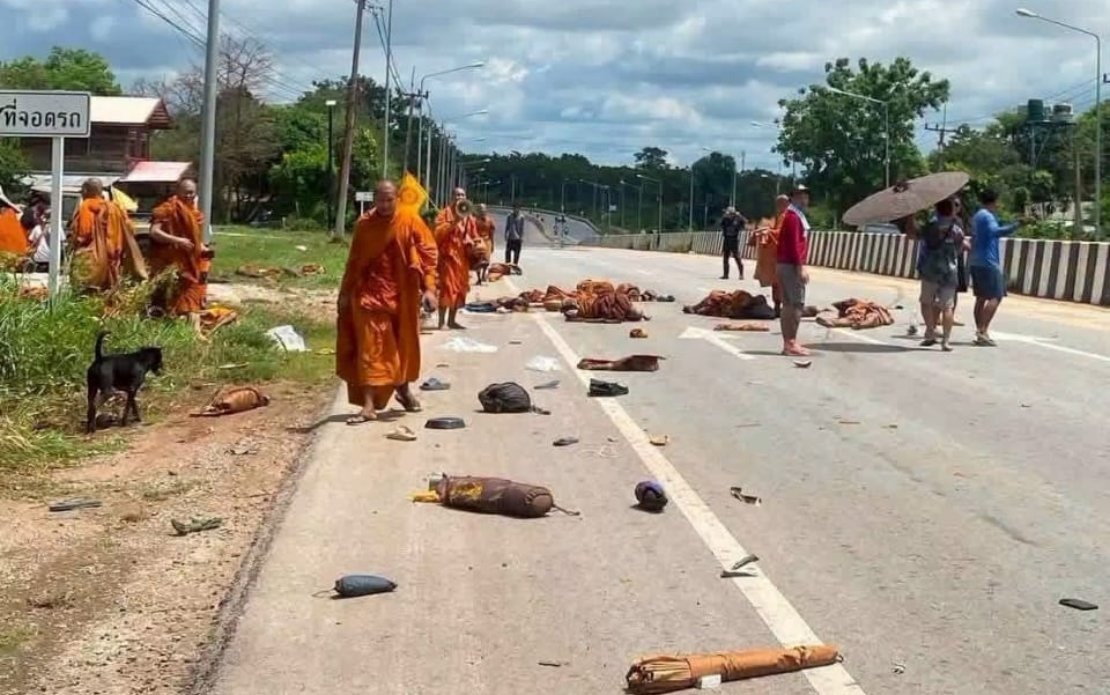
A tragic accident in Thailand's northeastern Mukdahan province has left eight Buddhist monks dead and 14 others injured after being struck by a pickup truck driven by a juvenile driver. The incident occurred on Thursday as the monks undertook a religious pilgrimage on foot toward Nam Khun district in the neighbouring Ubon Ratchathani province, highlighting the dangers pedestrians face on busy Thai highways and raising fresh questions about vehicle safety regulations and parental oversight.
According to provincial authorities, the monks began their spiritual journey at approximately 11 am, walking along Ban Na Si Nuan Road in Mueang district while adhering to proper pedestrian safety protocols by moving against the direction of traffic. The group maintained a position roughly two metres from the road's edge as they progressed towards their destination. The deliberate choice to walk against traffic flow demonstrates the monks' awareness of standard safety practices, yet this precaution proved insufficient to prevent the catastrophe that unfolded.
The initial phase of the collision saw the first five monks manage to evade the vehicle as it suddenly veered out of control and onto the roadside. However, those monks following behind lacked sufficient time or distance to escape the truck's path. The vehicle struck the remainder of the procession with force, resulting in immediate casualties. Five monks died at the accident scene itself, while three additional monks succumbed to injuries sustained during the incident after being transported to hospital facilities.
Mukdahan Provincial Public Health Chief Dr Narong Chankaew provided details on the extent of injuries treated following the accident. Four victims sustained critical wounds requiring intensive medical intervention, whilst a further ten experienced moderate injuries. In total, 23 patients were admitted to Mukdahan Hospital, comprising 22 ordained monks and a single layperson who had been participating in or accompanying the pilgrimage.
Mukdahan Governor Warayan Boonnarat revealed that preliminary investigation findings indicated the pickup truck had unexpectedly lost control before mounting the roadside where the monks were walking. Eyewitness accounts gathered by investigators corroborated this sequence of events, though the precise mechanical or human factors contributing to the loss of control remained under examination. The sudden nature of the vehicle's departure from its intended path suggests either mechanical failure, driver error, or a combination of both circumstances.
The driver, identified as a minor under 15 years old, was immediately taken into police custody at the scene. This age raises significant concerns about how the vehicle came to be operated by someone far below Thailand's legal driving age. Mukdahan Provincial Police Commander Police Major General Phairoj Thaiputra stated that investigators were methodically gathering evidence and conducting interviews with the driver's parents to establish the underlying causes of the collision. The focus extends beyond mere accident reconstruction to encompassing the circumstances that permitted a child to operate a motor vehicle on a public road.
The police investigation is considering potentially charging the parents with negligence for permitting their underage child to drive the vehicle. This prosecutorial avenue reflects growing awareness among Thai authorities regarding parental responsibility in preventing accidents involving minors. Should such charges proceed, they would establish an important legal precedent regarding the liability of guardians who enable underage individuals to access and operate potentially dangerous machinery. The case thus transcends a simple traffic accident to become a broader examination of familial accountability and child safety governance.
Legal proceedings against the juvenile driver will be conducted according to Thailand's juvenile justice framework, which typically applies different standards than those governing adult offenders. The application of age-appropriate legal procedures reflects Thailand's adherence to international conventions protecting children's rights whilst still maintaining accountability mechanisms. However, the severity of the incident—involving eight deaths—will likely attract significant scrutiny regarding whether existing juvenile justice protocols adequately address such serious outcomes.
Following the tragedy, Mukdahan Hospital issued an urgent appeal for blood donations to sustain the ongoing medical treatment of injured survivors. This humanitarian request underscores the substantial medical demands created by mass casualty incidents and the vital role community contributions play in supporting healthcare systems during crises. The appeal also highlights how such accidents extend their impact beyond immediate victims to encompassing broader community support networks and medical resource allocation challenges.
The incident carries particular significance for Southeast Asian readers given the commonality of similar road safety vulnerabilities across the region. Thailand's experience with underage drivers and inadequate vehicle control reflects patterns observable in other developing economies where enforcement of traffic regulations and parental supervision remain inconsistent. The accident serves as a stark reminder of the consequences when multiple safety failures converge—permitting underage operation, apparent mechanical or driver control issues, and high-speed traffic—creating conditions for tragedy among groups engaged in peaceful religious observance.
Buddhist communities throughout Thailand and neighbouring countries will likely view this incident with profound sorrow, as monks represent spiritual leadership and are traditionally afforded considerable social respect. The deaths of eight religious practitioners during a sanctioned pilgrimage raises fundamental questions about state responsibility for protecting vulnerable groups, particularly in rural areas where highway infrastructure may be inadequate and enforcement presence limited. The tragedy may stimulate broader policy discussions regarding speed restrictions in areas frequented by pedestrian religious processions and stricter enforcement of vehicle operation regulations.

