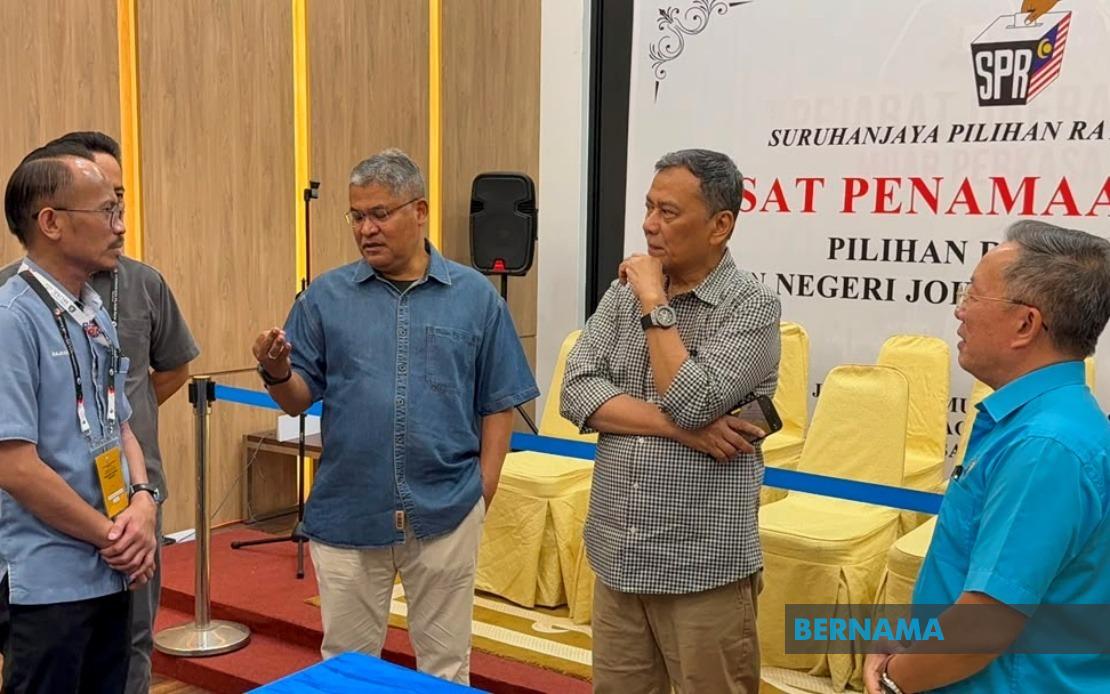
The Election Commission has declared itself fully prepared for tomorrow's nomination process in the Johor state election, with officials conducting comprehensive last-minute checks across all designated candidate nomination centres. The preparatory work reflects the scale and complexity of managing a major state poll in Malaysia's second-largest state by population, with extensive coordination required between multiple government agencies to ensure the exercise proceeds without incident.
A survey of several nomination centres throughout Johor Bahru revealed that final preparations were largely technical in nature, with infrastructure and procedural layouts already in place. The emphasis at this stage has shifted from construction and setup to verification, testing of systems, and coordination with supporting agencies. This measured approach allows officials to identify and resolve any last-minute issues while maintaining the timeline for the election process that formally commenced with the dissolution of the Johor State Legislative Assembly on June 1.
Nazatul Shima Mohamad, the returning officer overseeing the Perling state constituency nomination centre located at Dewan Jubli Intan Hall, expressed confidence that all necessary preparations had reached completion. She emphasized that the layout of the venue had been finalized and that simulation exercises involving all participating agencies had been successfully conducted. This comprehensive testing of procedures is standard practice in managing large-scale electoral operations, ensuring that participating agencies understand their roles and that logistical arrangements function as intended when the actual process commences.
For candidates preparing to submit their nominations, officials have issued clear guidance on documentation and timing requirements. Intending candidates are advised to arrive early on nomination day to allow sufficient time for their applications to be processed and verified. The requirement to bring deposit money alongside all supporting documents underscores the administrative and financial components that form part of Malaysia's nomination procedures. Early arrival is particularly important given the volume of candidates expected across all constituencies and the fixed time window available for the nomination process.
The Kota Iskandar nomination centre at the main hall of Iskandar Puteri City Council in Medini represents a significant case study in how authorities are preparing for the anticipated scale of public participation on nomination day. Returning officer Shahrulizam Abdul Rashid outlined extensive measures designed to accommodate party supporters while maintaining public order and security. The coordination between the Election Commission and police represents a critical dimension of electoral administration in Malaysia, where nomination days often draw substantial crowds of party workers and supporters seeking to show solidarity with their candidates.
The security and crowd management protocols implemented at Kota Iskandar provide insight into how authorities balance the right to political expression with the need for orderly administration. Road closures around the nomination centre, a 50-metre restriction zone limiting supporter access to the actual venue, designated tent areas for supporters outside the hall, and physical barriers separating supporters of rival parties all form part of a coordinated approach to preventing confrontations. These measures represent standard practice in Malaysian electoral administration and reflect lessons learned from previous nomination exercises where large gatherings of supporters have occasionally generated tensions.
Public advisories issued by election officials emphasize the importance of decorum and restraint during the nomination process. While supporters have the right to gather and demonstrate support for their candidates, officials have explicitly cautioned against provocative behaviour or actions that could escalate tensions between rival political camps. This messaging reflects awareness that nomination day can be an emotionally charged occasion, particularly in competitive constituencies where multiple candidates from different parties are seeking to represent the same area.
The scale of the electoral operation becomes apparent when considering the administrative infrastructure required. A total of 56 candidate nomination centres have been established across Johor to process applications from candidates across all state constituencies. The coordination required to ensure that each centre operates according to identical procedures and standards, while accommodating the unique circumstances of individual constituencies, represents a significant logistical undertaking. The fixed window for nominations—scheduled from 9 to 10 am across all centres—further concentrates administrative pressure on a single morning, necessitating thorough advance preparation.
The electoral roll for this election encompasses 2,727,926 registered voters across Johor, representing the ultimate constituency that candidates will seek to persuade during the campaign period. This figure includes 2,703,175 ordinary voters, 12,041 military personnel and their spouses, and 12,710 police personnel and their spouses. The inclusion of military and police votes reflects Malaysia's constitutional provisions regarding voting rights for uniformed personnel, a distinctive feature of the country's electoral framework. The substantial size of the electorate underscores why thorough election administration is essential and why comprehensive preparation translates into smooth operational execution.
The timeline for the Johor state election extends across several weeks following the assembly's dissolution on June 1. Tomorrow's nomination day marks the formal commencement of the campaign period, after which candidates will have approximately two weeks to conduct their campaign activities. Early voting is scheduled for July 7, providing military personnel and other eligible groups with the opportunity to cast ballots before polling day. The final polling exercise is set for July 11, at which point the state's voters will determine the composition of the next Johor State Legislative Assembly.
This election carries particular significance for Johor as Malaysia's second-largest state by population and a significant political constituency. The timing of the election and the scale of electoral participation underscore why the Election Commission's meticulous preparation has been necessary. The successful execution of the nomination process tomorrow will set the tone for the remainder of the electoral exercise, making today's final checks and coordination efforts critical to maintaining public confidence in the integrity of the democratic process. The readiness expressed by returning officers across the state suggests that the institutional capacity to manage the nomination process has been thoroughly tested and verified.

