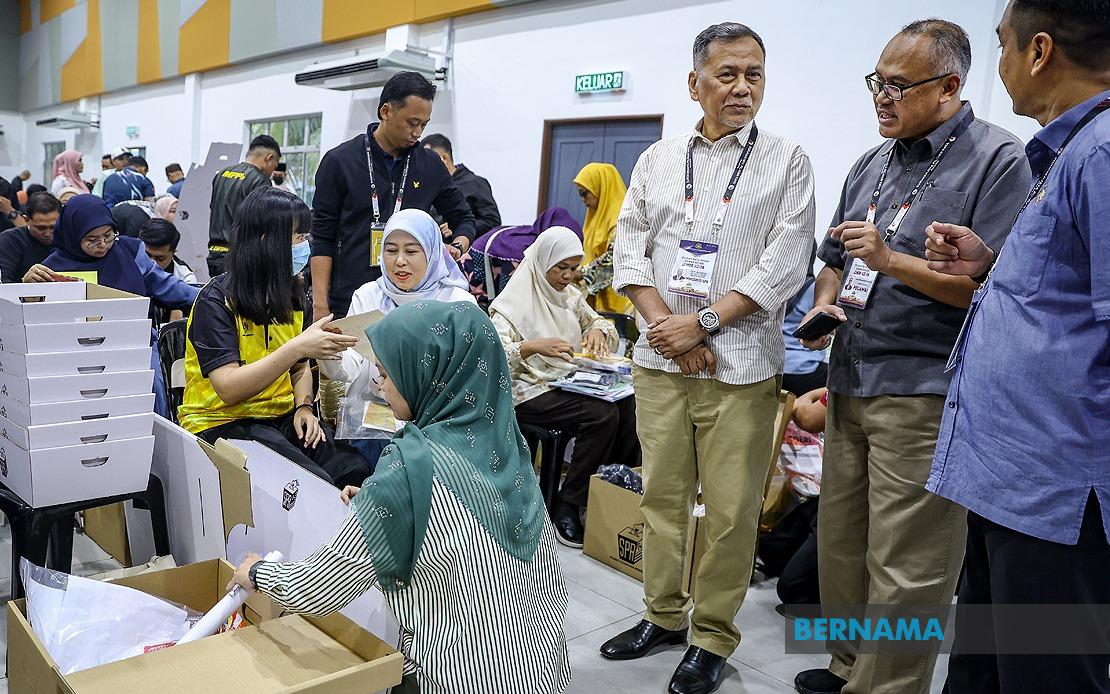
The Election Commission's machinery across Johor entered its final operational phase on July 10, with personnel stationed at polling centres and vote tallying facilities undertaking last-minute checks to guarantee a seamless election day when voters head to the polls on July 11 for the 16th Johor State Election. EC Chairman Datuk Seri Ramlan Harun confirmed that rigorous examinations of ballot boxes and voting equipment designated for all 56 state constituencies had been concluded, ensuring that essential materials and systems were in full working order and ready for deployment across the state.
The verification protocol represents a cornerstone element in the electoral framework, enabling the commission to guarantee that polling day operations will unfold without significant disruption whilst facilitating the exercise of civic duty for approximately 2.7 million enrolled voters throughout Johor. According to Datuk Seri Ramlan, the overwhelming majority of Returning Officers supervising operations at each of the 56 designated centres had successfully finalised their assigned responsibilities by the time of his inspection tour. He undertook direct observation of ballot verification activities at the Sultan Ibrahim Jubilee Hall in Pontian and the Permas Multipurpose Hall in Kukup, allowing him to assess conditions firsthand.
Voter compliance and flow management emerged as critical considerations in the EC's messaging to electors. The chairman appealed to registered voters to utilise their designated voting time slots to prevent bottlenecks and overcrowding at polling stations. He additionally requested that all voters bring valid identification documents and demonstrate full cooperation with election officials supervising the voting process. These reminders underscore the commission's aim to balance accessibility with operational efficiency across the sprawling Johor landscape.
On-the-ground assessments revealed intensive preparation efforts across multiple constituencies. At Sekolah Kebangsaan Bukit Mutiara, EC teams were engaged in detailed setup activities including material labelling, furniture arrangement, and installation of navigational signage. The polling supervisor for Puteri Wangsa state seat, Mohd Rasib Ngadiman, disclosed that 12 classrooms would be converted into distinct polling streams, supported by 74 EC personnel and 12 police officers ensuring security. The commission had also arranged wheelchair facilities to accommodate elderly voters and individuals with disabilities, demonstrating attention to inclusive voting access.
Preparations in the Kluang division centred on the Sekolah Kebangsaan Kampong Melayu facility, where 30 staff members orchestrated the establishment of five separate polling streams designed to serve roughly 3,000 voters in the Mahkota constituency. Similar meticulous setup processes occurred at Sekolah Menengah Kebangsaan Dato' Seth in Yong Peng within the Batu Pahat region, where organisers prioritised comfort and accessibility amenities for elderly citizens, first-time voters, and persons with mobility limitations.
One of the more complex logistical undertakings emerged in Mersing, where the Tenggaroh constituency encompasses four island communities—Pulau Aur, Pulau Pemanggil, Pulau Sibu, and Pulau Tinggi—requiring ballot box transportation via the Mersing Jetty. Tenggaroh Returning Officer Jamil Hasni Abdullah indicated that this island operation mobilised approximately 50 personnel operating under stringent security protocols coordinated with the Marine Police Force and Mersing district police headquarters, reflecting the heightened safeguarding measures necessary for transporting electoral materials across maritime routes.
The competitive landscape for this election encompasses 172 candidates contesting across the 56 state seats, representing a diverse array of political entities. Pakatan Harapan and Barisan Nasional fielded complete slates across all constituencies, while Perikatan Nasional presented 33 candidates. Parti Bersama Malaysia, the newer entrant to electoral competition, fielded 15 candidates, whereas MUDA mounted a more limited campaign with four candidates. The Malaysian Orang Asli Party and the Socialist Party of Malaysia each presented singular candidates, and six independent candidates completed the field. This multi-party configuration reflects Malaysia's evolving political dynamics and voter appetite for alternative options beyond the traditional BN-PH dichotomy.
For Malaysian observers and political analysts, the Johor election carries particular significance within the broader Southeast Asian context. As the nation's southernmost state and an economically substantial region, Johor's electoral outcome will provide important indicators regarding voter sentiment towards the current federal coalition government and prevailing sentiment on state-level governance. The participation rate of 2.7 million voters will be scrutinised as a barometer of public engagement with democratic processes, particularly given Malaysia's recent experience with varied turnout patterns across different electoral contests. The comprehensive EC preparations undertaken across such diverse geographies—from urban polling centres to remote island communities—demonstrate the institutional capacity required to conduct elections across a complex and geographically dispersed electorate, a capability that remains essential for democratic legitimacy.

