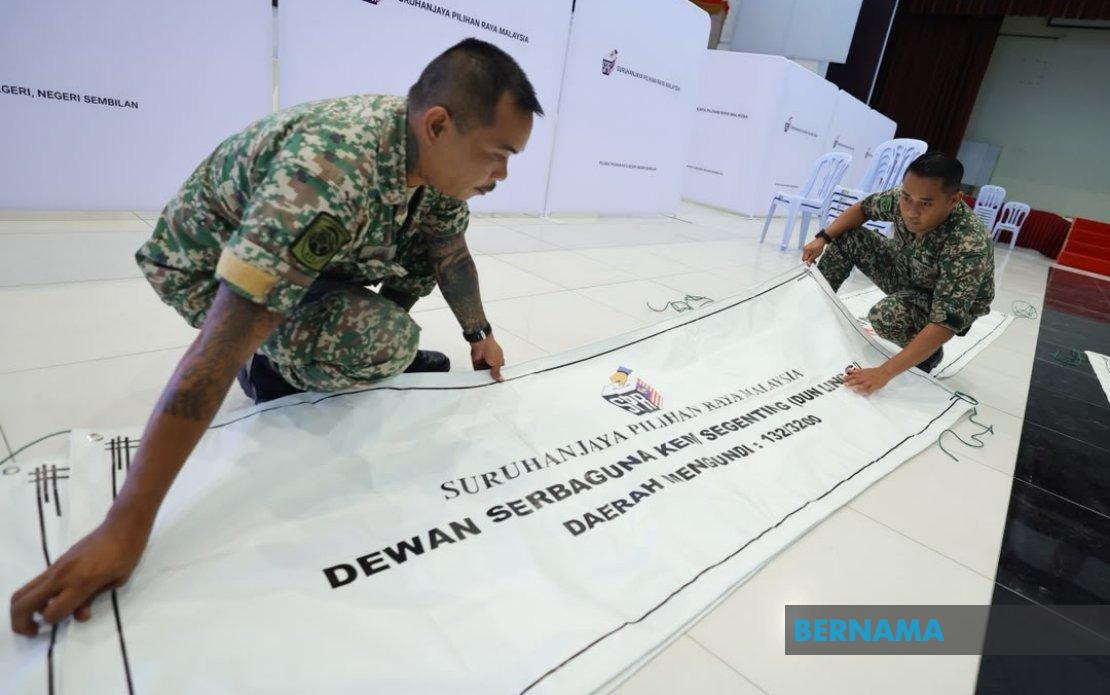
The Election Commission has concluded its logistical preparations for early voting in the 16th Negeri Sembilan State Election, with proceedings set to commence across 38 designated polling centres tomorrow. Election Commission chairman Datuk Seri Ramlan Harun confirmed that all necessary equipment and infrastructure have been positioned and tested, positioning the poll body to execute the initial voting phase without complications. The early voting mechanism, a standard feature of Malaysian elections for security personnel and their families, represents a critical first phase before the general election takes place on August 1.
The scope of early voting extends to a substantial cohort of eligible voters, with 16,884 military personnel and their spouses participating alongside 5,455 police officers and their spouses. This combined total of 22,339 individuals represents a significant portion of those expected to participate in the overall election. The tiered voting arrangement allows security sector employees, whose duties may conflict with standard polling day schedules, to exercise their franchise without disrupting operational capabilities or public order maintenance.
Fieldwork conducted by election observers at multiple polling venues, including the Seremban District Police Headquarters, the Negeri Sembilan Contingent Police Headquarters, and Kem Segenting in Port Dickson, demonstrated that final preparations were advancing smoothly. Election staff were observed conducting last-minute verification checks and system tests at these facilities, with security personnel providing logistical support. The collaboration between electoral administrators and uniformed personnel reflects the institutional coordination required to manage voting operations within military and police establishments.
Voting will commence at 8 am across all early polling locations, though the closure times will vary according to local conditions and voter turnout projections. This flexibility in closing hours accounts for differences in personnel deployment and facility capacity across the state. Such staggered arrangements are common practice in Malaysian elections involving distributed polling sites, allowing administrators to accommodate the specific circumstances of each location while maintaining standardised procedures.
The election itself has crystallised around 103 candidates competing for 36 state seats following the formal dissolution of the Negeri Sembilan State Assembly on June 5. The field of candidates represents various political parties and independent contenders, each advocating distinct visions for the state's development trajectory. The 16th state election occurs within Malaysia's broader electoral calendar and regional political context, where state-level contests frequently serve as barometers for public sentiment regarding governance and policy direction.
From a regional perspective, the Negeri Sembilan election reflects patterns evident across Malaysian state assemblies, where electoral competition remains robust and multiple political formations vie for voter support. The turnout among security personnel, facilitated through early voting arrangements, often demonstrates high participation rates. This reflects both the civic consciousness of military and police cohorts and the institutional culture that encourages electoral participation among public sector employees.
The preparation protocols employed by the Election Commission illustrate the organisational maturity of Malaysia's electoral administration. Advance voting for uniformed personnel has become a standardised feature, enabling these groups to fulfil their democratic obligations without compromising security operations or public order responsibilities. The logistics of managing 22,339 early voters across multiple discrete facilities requires coordination between electoral bodies, security agencies, and administrative personnel.
The Negeri Sembilan contest arrives as the state faces questions regarding economic development, infrastructure investment, and social services delivery. State election outcomes frequently influence resource allocation, policy priorities, and governance approaches, making electoral outcomes consequential for residents. The result will determine which coalition or party secures the mandate to direct these domains over the coming term.
The Election Commission's completion of preparatory work signals institutional readiness to execute the voting phase without administrative impediments. Early voting represents the formal commencement of the electoral process, with the main polling day scheduled for August 1 determining the ultimate composition of the state assembly. For Malaysian observers monitoring electoral processes and democratic participation patterns, the early voting phase offers preliminary insights into voter engagement and turnout dynamics.

