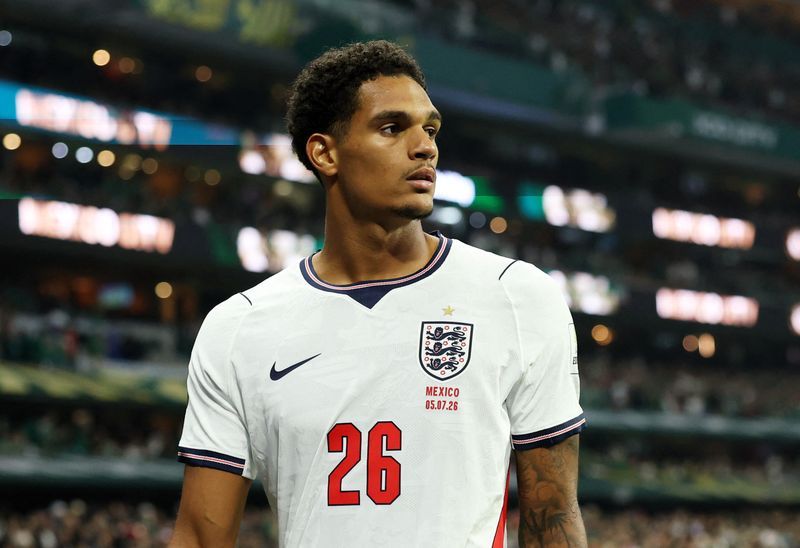
The controversy surrounding FIFA's handling of player suspensions has spilled into the political arena, with British MPs publicly demanding that world football's governing body apply its disciplinary rules consistently across all competitors. The clash centres on whether defender Jarell Quansah deserves the same suspension deferral granted to American striker Folarin Balogun, a decision that has become the tournament's most contentious moment after United States President Donald Trump publicly acknowledged lobbying FIFA head Gianni Infantino on the matter.
Quansah received a red card during England's 3-2 victory at Mexico's Azteca Stadium on Sunday, triggering an automatic one-match ban that would sideline him from the quarter-finals against Norway. The situation mirrors Balogun's case almost entirely: both players were sent off in group matches and faced mandatory suspension, yet FIFA's judicial bodies have already intervened to defer Balogun's penalty until after the tournament concludes. This discrepancy has prompted Labour MPs Noah Law and Melanie Onn to formally request that Infantino extend the same reprieve to Quansah, citing the American player's precedent as grounds for consistency.
The intervention by British parliamentarians marks a significant escalation in the row and represents the first time politicians have attempted to leverage the Balogun ruling to support another player's case. Law's public statement acknowledged the legitimacy of the initial red card decision while arguing that deferring the suspension would align with FIFA's treatment of Balogun. Onn went further, contending that failing to apply identical standards would expose FIFA to accusations of selective justice and undermine the credibility of its disciplinary framework. Both MPs warned that inconsistent application of rules threatens to erode public confidence in the sport's governance structures at a moment when the World Cup should be showcasing football at its finest.
Caroline Dinenage, who chairs the House of Commons Culture, Media and Sport Committee, raised the stakes further by demanding that FIFA provide urgent public explanation for its decision on Balogun. Her intervention shifts focus from individual player treatment to systemic accountability, questioning whether political pressure has infiltrated FIFA's supposedly independent judicial process. Dinenage's statement explicitly referenced Trump's admitted contact with Infantino, framing the entire episode as a challenge to the principle that sports rules must apply equally regardless of geopolitical or economic influence.
FIFA's official position maintains that its judicial bodies acted with complete independence in the Balogun matter, and the organisation has declined to comment on whether similar considerations would apply to Quansah. The English Football Association is reportedly weighing its options regarding a potential appeal, though no formal action has been announced. This silence from FIFA intensifies speculation that the governing body may be reconsidering how transparently it handles such decisions, particularly given the unprecedented level of political scrutiny now focused on its disciplinary processes.
The broader significance of this controversy extends beyond the immediate question of whether one player's suspension should be deferred. For Malaysian and Southeast Asian observers, the episode demonstrates how even the world's most powerful sporting institution remains vulnerable to pressure from major political figures, raising uncomfortable questions about FIFA's vaunted independence. The situation also illustrates how World Cup tournaments can become flashpoints for diplomatic tensions, with smaller nations and their representatives potentially disadvantaged if they lack equivalent political leverage to influence outcomes.
Trump's public admission that he contacted Infantino fundamentally altered the nature of this dispute. While FIFA has stated that Infantino assured the American president that judicial bodies would decide matters independently, the mere fact of presidential intervention has poisoned perceptions of impartiality. European football authorities and politicians have seized upon this revelation as evidence that FIFA's decision-making processes may not be as insulated from political influence as claimed. The precedent now established—that presidential pressure can at least be attempted and openly acknowledged—creates problematic expectations for future tournaments.
The mechanism at play involves FIFA Article 27, which apparently provides the judicial bodies with discretionary authority to defer suspensions in certain circumstances. However, the criteria for invoking this provision remain opaque, and the selective application to Balogun while Quansah's case languishes raises fundamental questions about equity and transparency. If FIFA clarifies that Article 27 allows deferral for players whose suspension would eliminate them from crucial knockout matches, then perhaps consistency demands that Quansah receive identical treatment. If the article requires some other justification, FIFA must articulate that reasoning publicly.
For Malaysian readers, this controversy carries implications for how international sporting bodies engage with smaller nations' athletes and officials. The implicit message that political connections matter in FIFA's decision-making process mirrors broader concerns about unequal treatment in global governance structures. It suggests that players from nations with less political clout may be more vulnerable to inconsistent disciplinary application, particularly if similar disputes arise in future tournaments.
England's preparation for the quarter-final against Norway in Miami will unfold against this backdrop of political tension and uncertainty. The team enters the match with momentum from their dramatic victory in Mexico, yet the suspicion that their defensive options might be arbitrarily constrained by inconsistent FIFA rulings creates additional pressure. Quansah's status remains officially unresolved, leaving both the player and team in a state of uncertainty that extends beyond normal pre-match preparations.
The resolution of this matter will establish important precedents for international sports governance. If FIFA ultimately grants Quansah the same deferral without providing clear, consistent criteria, it validates the British MPs' pressure campaign and effectively confirms that political engagement can influence outcomes. Conversely, if FIFA denies the request while standing firm on Balogun's exception, it must articulate principled reasoning that distinguishes the two cases. Either outcome will carry significant implications for how other nations approach interactions with FIFA and whether the institution truly operates according to transparent, consistently applied principles or whether political leverage remains a decisive factor in major decisions.

