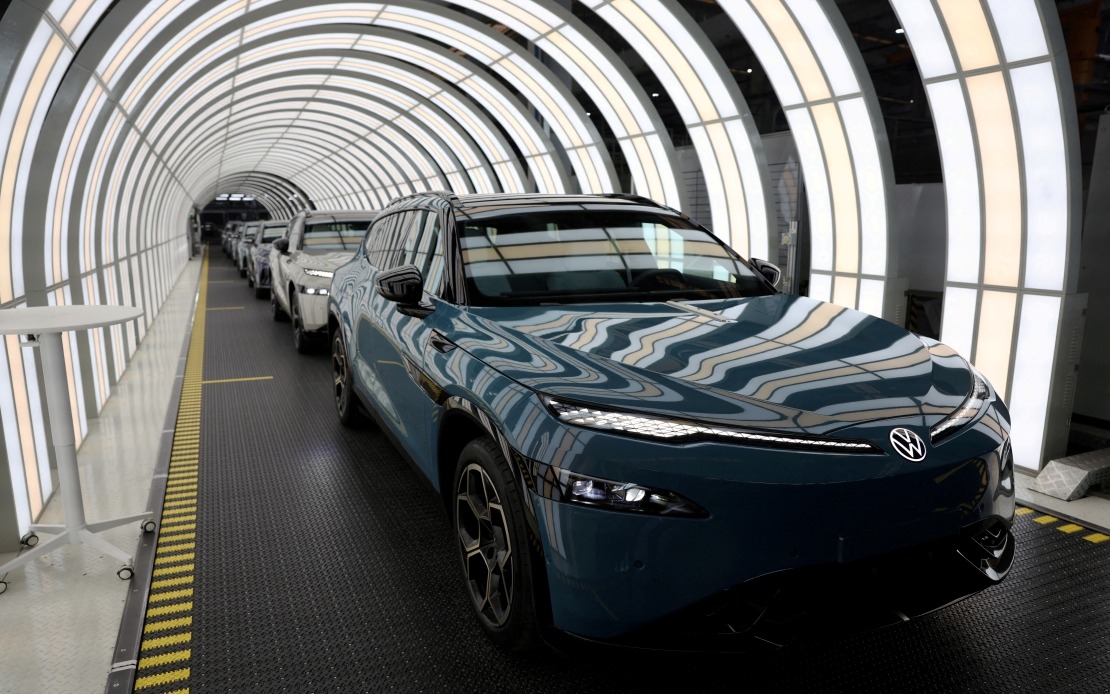
The European Union's punitive tariff strategy on Chinese-made electric vehicles appears to be achieving one of its stated objectives: encouraging Western manufacturers to relocate production capacity back to Europe. A comprehensive study by the European transport advocacy group T&E reveals a marked reversal in sourcing patterns among major automotive brands, signalling a potential reshaping of global EV supply chains that carries implications well beyond Europe's borders.
According to the T&E analysis, which drew on production and sales data compiled by GlobalData, the proportion of Chinese-manufactured battery electric vehicles sold in Europe under Western brands collapsed to just 23 per cent of total EV sales during the first quarter of this year, down sharply from 38 per cent recorded in 2024. This shift encompasses leading players including BMW, Dacia, Volvo, Smart and Tesla, demonstrating that the tariff mechanism has reached across the premium and mass-market segments alike. For Tesla specifically, the trend proved even more pronounced, with its reliance on Chinese-made inventory for European customers declining from 23 per cent to 19 per cent over the same comparative period.
The tariff architecture itself has proven sophisticated and differentiated in its application. Beijing-based SAIC encountered particularly punitive duties—nearly double those imposed on competitors such as BYD and Geely—after European regulators determined the company had benefited disproportionately from state subsidies embedded throughout its supply chain. This stratified approach reflects the EU's attempt to calibrate trade measures based on assessments of government support, rather than applying blanket restrictions that might invite World Trade Organization challenges.
Yet the tariff regime has produced an uneven outcome. While Western manufacturers have retreated from Chinese supply sources, Chinese automakers themselves have largely circumvented trade barriers by continuing to export vehicles from domestic factories. BYD and Geely sustained rising sales volumes in Europe despite the tariffs, leveraging surplus production capacity at home. This dynamic underscores a critical reality in contemporary trade policy: tariffs alone do not eliminate competitive advantages rooted in manufacturing scale, labour costs and supply chain integration.
The most telling response from Chinese automakers has been their accelerated pivot toward establishing local production on the European continent. Since the EU launched its subsidy investigation in 2023—the precursor to the tariff regime—Chinese manufacturers have announced intentions to build 10 separate production facilities across Europe. This represents a substantial capital commitment and signals confidence in capturing medium-term market share even within a protectionist environment. By manufacturing locally, Chinese firms can sidestep tariffs while creating employment and demonstrating long-term commitment to European markets.
A secondary shift in product strategy has also emerged. Chinese automakers have progressively tilted their European export portfolio toward plug-in hybrid vehicles, which occupy a different regulatory and tariff category than pure battery electric cars. Their penetration of the EU plug-in hybrid market surged to 13 per cent in the first quarter of 2025, compared with just 3 per cent in 2024. This manoeuvre reflects commercial pragmatism: if tariffs restrict one product pathway, redirect capacity toward an alternative that remains accessible.
For Malaysian policymakers and businesses, this European precedent carries instructive value. Southeast Asia faces comparable questions about balancing protectionist measures to nurture domestic EV manufacturing against the risk of supply disruption and higher consumer prices. The EU experience demonstrates that tariffs can reshape sourcing patterns among multinational firms, but they do not prevent determined foreign competitors from adapting through localisation, product diversification or alternative export routes. Any tariff regime functions as one tool among many within a broader industrial strategy, not as a standalone mechanism for market transformation.
The implications extend to regional automotive supply chains. If Chinese manufacturers succeed in establishing European production bases, they will possess the capability to serve multiple markets from geographically distributed facilities. This could ultimately create competitive pressure on regional producers in Asia, as Chinese firms gain production experience and cost refinement within developed economies, then potentially apply those gains to manufacture for Southeast Asian markets. Malaysia's automotive sector, already grappling with the rise of Chinese EV makers, faces a future where competitors operate not merely from cost-advantaged Asian bases but increasingly from European footprints as well.
The Western automakers' renewed commitment to European production carries its own long-term complications. European manufacturing labour costs substantially exceed those in China, placing upward pressure on vehicle prices. While tariffs may succeed in redirecting production geography, they do not eliminate underlying cost differentials. Whether European consumers ultimately benefit from this reshoring—through job creation and industrial resilience—or suffer from restricted choice and elevated prices remains a question that will unfold over coming years. Early indications suggest that the tariff regime has accelerated investment decisions, but concrete plant openings and production ramp-ups remain ahead.
The T&E study thus captures a moment of transition within global automotive markets. Traditional supply chain patterns forged over decades are yielding to state-directed reallocation. How durable these changes prove—and whether they represent a permanent reorientation or a temporary adjustment as firms optimise to new constraints—will shape the competitive landscape for years ahead. For stakeholders across Southeast Asia contemplating their own EV strategies, the lesson is clear: trade barriers work, but not in isolation, and adaptable competitors will always seek alternatives.

