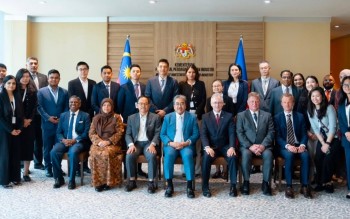
A high-powered European business delegation concluded a three-day engagement with Malaysian government officials, signalling renewed momentum in economic ties between the European Union and Malaysia. The visit by representatives from the EU-ASEAN Business Council brought together more than 25 European companies and 70 delegates for direct conversations with ministers and senior policymakers across multiple portfolios, from finance and investment to environment and customs. The timing reflects growing confidence in Malaysia as a destination for European capital, particularly as both regions navigate the complexities of global supply chain realignment and the transition toward greener economies.
Chris Humphrey, executive director of the EU-ASEAN Business Council, characterised the engagement as exceptionally positive, with delegates receiving detailed briefings on Malaysia's policy direction across several critical areas. The delegation's itinerary provided opportunities to clarify government regulations and demonstrate European backing for Malaysia's ongoing institutional and economic reforms. At the Economy Ministry, conversations centred on the government's reform packages alongside Malaysia's commitment to sustainable development, the circular economy model, and digital transformation—themes that resonate strongly with European investors increasingly focused on environmental, social and governance criteria. These discussions underscored how Malaysia's modernisation agenda aligns with European corporate priorities, making the country a potentially more attractive proposition for long-term investment partnerships.
The financial sector figured prominently in the delegation's deliberations. Meetings at the Finance Ministry explored mechanisms for project financing, taxation frameworks, government procurement processes, and broader assessments of Malaysia's investment climate. Such discussions prove essential for European firms evaluating market entry or expansion; clarity on fiscal incentives, procurement eligibility, and financing availability can significantly influence investment decisions. The delegation's observations about the overwhelmingly constructive tone of these interactions suggest Malaysian officials successfully conveyed confidence in the country's macroeconomic stability and openness to foreign partnership, elements critical for reversing any perception among international investors that Malaysia has become less welcoming or predictable.
Malaysia's central bank governor and senior trade and investment officials, including Investment, Trade and Industry Minister Datuk Seri Johari Abdul Ghani and Economy Minister Akmal Nasrullah Mohd Nasir, engaged directly with the European contingent, signalling high-level political commitment to strengthening relations. This ministerial engagement carries symbolic weight, demonstrating that Malaysia's leadership takes European business interests seriously at a moment when both regions are reassessing economic partnerships in response to geopolitical pressures and shifting global trade dynamics. For Malaysian officials, hosting such delegations reinforces the country's position as a responsible, business-friendly economy within Southeast Asia and the broader Indo-Pacific region.
The environmental and energy portfolio merits particular attention given the European Union's aggressive decarbonisation targets and the corresponding pressure on member states and their corporations to demonstrate climate credentials throughout their supply chains. Discussions with the Natural Resources and Environmental Sustainability Minister and the Energy Transition and Water Transformation secretariat addressed Malaysia's direction on sustainable development and the circular economy. European companies increasingly face investor and regulatory demands to source from suppliers advancing genuine environmental improvements; Malaysian government clarity on these fronts allows European firms to assess whether Malaysian partners can meet their sustainability obligations, potentially unlocking significant investment flows in green manufacturing, renewable energy, and resource-efficient industries.
Customs modernisation and the combating of illicit trade emerged as a priority for both sides. The delegation plans to engage with the Royal Malaysian Customs Department to discuss procedures, clearance acceleration, and digital integration—practical measures that lower transaction costs and reduce delays affecting bilateral commerce. More significantly, European companies and Malaysian authorities identified tobacco smuggling as a shared concern warranting collaborative enforcement efforts. This issue bridges commercial and public health interests; efficient customs operations and effective anti-smuggling cooperation benefit legitimate traders whilst protecting government revenues and public health. For European companies operating in Malaysia or using the country as a regional hub, streamlined customs processes directly enhance profitability and competitiveness.
Healthcare cooperation represents an emerging frontier for European-Malaysian business engagement. European firms see opportunities to support Malaysia's healthcare infrastructure and access to medicines, whilst also promoting preventive self-care models aligned with global health trends. As Malaysia's population ages and chronic disease prevalence increases, demand for medical technology, pharmaceuticals, and healthcare services will expand; European companies possess significant expertise and product portfolios in these areas. Discussions about innovative financing mechanisms reflect recognition that traditional procurement models may constrain access to advanced treatments; creative financial structures could enable broader adoption of cutting-edge healthcare solutions whilst preserving fiscal sustainability.
Underlying these specific discussions is Malaysia's inherent appeal as a regional investment hub. The country's geographic centrality within Southeast Asia, modern infrastructure, sophisticated digital connectivity, educated workforce, and abundant natural resources create a compelling value proposition for European investors seeking Asian exposure. Malaysia's political stability, relatively mature financial markets, and established rule of law distinguish it from some regional competitors, even as geopolitical uncertainties and domestic economic challenges warrant ongoing attention. European companies recognise these structural advantages and remain committed to deepening their Malaysian presence when policy clarity and regulatory predictability are assured.
The trajectory of Malaysia-EU free trade agreement negotiations exemplifies the forward momentum both sides seek to cultivate. Having completed four negotiating rounds, with a fifth scheduled for late September in Brussels and a potential sixth before year-end, policymakers believe sufficient progress exists to conclude the agreement by 2027. A comprehensive FTA would eliminate tariff barriers, harmonise standards, and provide legal certainty for bilateral investment—outcomes highly valued by European companies operating across the region. The ambitious timeline reflects political will on both sides, though negotiators will encounter familiar challenges around agricultural trade, intellectual property, labour standards, and regulatory divergence.
The scale of existing economic integration underscore both the partnership's maturity and the potential for expansion. The EU ranks among Malaysia's five largest trading partners; bilateral merchandise trade in 2025 reached approximately €48.9 billion, with Malaysia exporting €30.3 billion in goods and importing €18.6 billion from European sources. Beyond trade flows, European investment stock in Malaysia totalled €33.1 billion in 2024, reflecting sustained confidence in the country as a stable, profitable destination. These figures demonstrate substantial mutual economic interest; a formalised trade agreement would likely amplify these flows by reducing transaction costs and regulatory uncertainty.
Looking forward, the delegation's visit encapsulates a broader recalibration of European engagement with Southeast Asia. As global supply chains diversify away from concentration in China and other regions amid geopolitical tensions, Malaysia's proven manufacturing capacity, logistical advantages, and labour availability position it well to attract European investment seeking alternatives or complementary sourcing. Simultaneously, Malaysia's commitment to green transition and digital modernisation aligns increasingly with European corporate governance expectations and investor mandates. The constructive tone of this week's discussions and the detailed policy engagement across multiple sectors suggests Malaysian policymakers understand these dynamics and are positioning the country to capture opportunities arising from this realignment.

