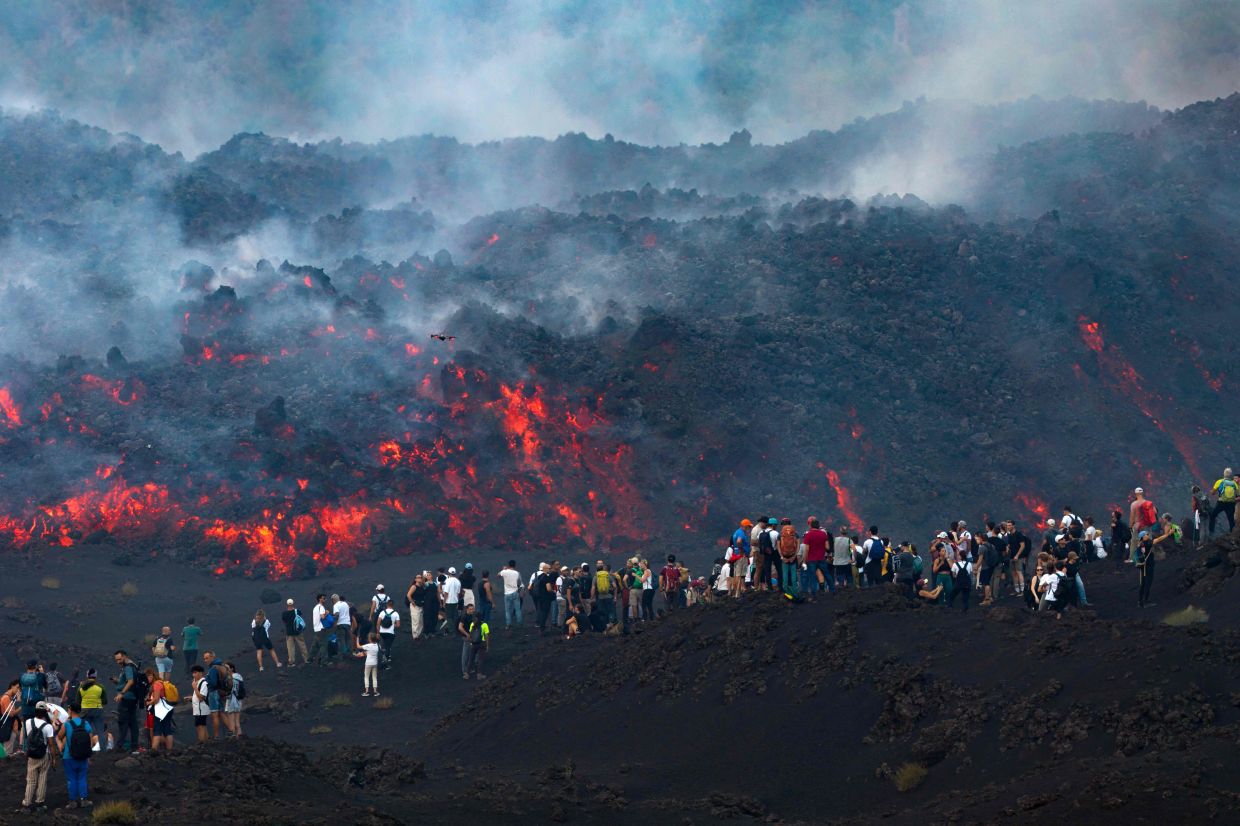
The dramatic eruption of Mount Etna has transformed Sicily's most formidable geological feature into an unexpected tourism magnet, with the volcano's glowing lava flows and ash emissions creating scenes that have captivated audiences worldwide and driven thousands of people to flock toward the danger zone. Europe's highest active volcano has been in near-continuous activity for several days, ejecting molten rock and particulate matter down its slopes in what local guides have dubbed a "touristic eruption" – an event that combines genuine geological spectacle with enough perceived accessibility to draw crowds far larger than usual summer visitor numbers.
The economic and logistical repercussions extend well beyond the slopes themselves. Catania International Airport, the principal aviation hub servicing eastern Sicily and one of Italy's most visited regions, has been forced into repeated operational halts as volcanic ash has rendered runways unsafe for commercial traffic. Since the weekend, hundreds of flights have been cancelled, and the disruption threatens to cascade across Mediterranean tourism networks during peak season. The airport handled approximately 12 million passengers in 2024, making these closures a significant economic disruption for an island economy heavily dependent on tourism revenue and international connectivity.
Guide Etna, one of the main commercial operators offering evening hikes to observe the eruption, has experienced an extraordinary surge in demand that reveals just how powerful the draw of natural spectacle can be. Company founder Daniele Perricelli, a 41-year-old experienced mountaineer, reported receiving roughly 300 booking requests daily – approximately triple the typical volume during an average summer evening – as tourists from across Europe and beyond seek to witness the volcano's raw power firsthand. The phenomenon speaks to a broader trend in global tourism where dramatic natural events, particularly those offering an element of controlled danger and visual drama, attract visitors willing to travel considerable distances and accept non-trivial risks.
Yet this surge presents serious management challenges that local professionals struggle to contain. Perricelli has raised concerns about overcrowding on mountain trails, noting that upwards of 2,000 people attempt the ascent each evening, creating congestion that transforms pathways designed for dozens into highways for thousands. The composition of this crowd troubles him particularly – many climbers arrive wholly unprepared, some even in flip-flops, revealing a disconnect between public perception of the danger involved and actual mountain conditions. Without proper footwear, acclimatisation, or knowledge of volcanic terrain, these visitors expose themselves to injuries ranging from minor lacerations to potentially fatal falls or toxic gas exposure.
The regulatory framework governing access to Etna attempts to mitigate risks through tiered restrictions. Current regulations permit independent climbing to approximately 2,400 metres altitude, but all higher elevation access requires accompaniment by certified guides who possess the specialist knowledge necessary to navigate unstable terrain and interpret warning signs. Despite these rules, many visitors either lack awareness of such requirements or deliberately circumvent them, driven by the desire to secure photographs or achieve bragging rights. The result is a landscape increasingly populated by under-trained individuals in hazardous conditions.
Some high-profile visitors have drawn public criticism for what social media commentators have characterised as reckless behaviour. Italian television personality Diletta Leotta faced online backlash following posts showing her in apparent proximity to active lava flows – photographs that guides suggest were taken in locations safely distant from genuinely molten material but nonetheless projected an impression of extreme proximity that encourages copycat behaviour among less cautious visitors. This celebrity element amplifies the volcano's allure precisely among demographics least equipped to manage genuine danger.
Guides like Ernesto Maria Magri have observed that local residents themselves have joined the migration up the mountain, sometimes gathering in disorganised clusters around visible lava flows. This local participation complicates safety management because residents, familiar with Etna's history of frequent eruptions, may underestimate the particular hazards of current conditions or the unpredictable nature of volcanic behaviour. The false sense of security that familiarity breeds creates its own risk category – one where people who should know better expose themselves to preventable harm.
From a technical perspective, Etna's relatively accessible lower slopes do offer genuine opportunities for safe observation. In zones where lava has already cooled to solid basalt, visitors can approach within several metres of the flow channels, creating legitimate opportunities for dramatic photography and educational experience without exposure to active thermal hazards. This technical possibility, however, becomes dangerous when publicised without emphasising the stringent conditions under which such access remains genuinely safe – namely, with experienced guidance and proper equipment.
Italy's civil protection authorities have designated Etna with a yellow alert status, the second level on a four-category warning scale ranging from green to red. Yellow alert classification indicates frequent eruptions with potential for explosive episodes, suggesting authorities expect continued activity and possible intensification. This designation exists partly to inform emergency services and residents, but its public visibility also contributes to the perception that the volcano represents a managed, almost spectatorial hazard – when in reality, volcanic systems remain fundamentally unpredictable and lethal.
For Malaysian and Southeast Asian observers, Etna's current situation offers instructive parallels to the region's own volcanic infrastructure challenges. Countries including Indonesia, the Philippines, and Malaysia possess numerous active volcanic systems where similar tourism pressures intersect with seismic unpredictability. The regulatory and safety management approaches being tested on Etna – balancing economic opportunity from geological tourism against genuine public safety imperatives – will resonate across an Asia-Pacific region where volcanic tourism increasingly drives local economies while creating management headaches for authorities.
The immediate challenge facing Catania airport authorities and Sicilian tourism boards involves balancing the economic windfall of extraordinary visitor interest against infrastructure strain and safety liability. Airlines and ground handlers face cascading operational complications, while accommodation and transport providers experience simultaneous overload that both benefits and stresses their capacities. Local guides must simultaneously capitalise on unprecedented demand while managing the responsibility of shepherding increasingly large numbers of minimally-prepared people through genuinely hazardous terrain.
Perricelli's calls for enhanced official vigilance reflect a fundamental governance question: whether authorities should restrict access more aggressively or instead invest in education and mandatory guide requirements. More stringent limitations would reduce economic benefits and limit public access to a remarkable natural phenomenon. Conversely, permissive policies create liability exposure and environmental degradation as trails suffer from excessive footfall. Etna's eruption, for all its spectacular beauty, has illuminated tensions between democratic access to natural wonders and the technical realities of managing human behaviour in genuinely hazardous environments.

